


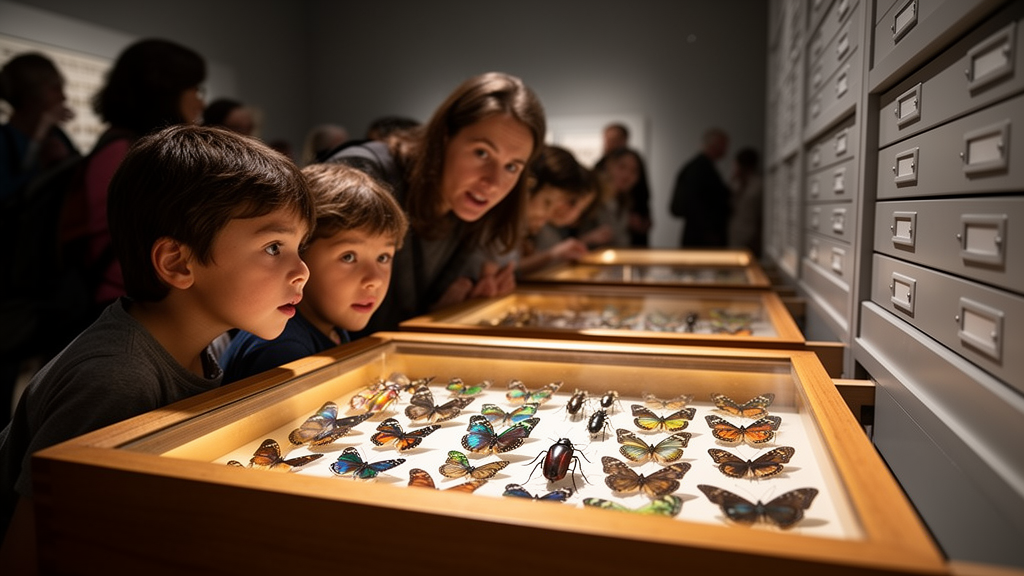
Insect research collections have long relied on a humble but powerful tool for public engagement: the outreach drawer. These glass-topped displays, packed with pinned specimens and short explanatory labels, travel to community festivals, school visits and museum tours, offering audiences a rare close-up encounter with the most diverse group of multicellular organisms on Earth. Yet despite decades of service, there has been surprisingly little systematic understanding of how these drawers are designed, used, or evaluated for quality. A new study published in Natural History Collections and Museomics now changes that, introducing a numerical framework that allows curators to score their outreach displays objectively and prioritize improvements where they matter most.
The research team, based at the University of Kansas, began by surveying the community of people who actually use insect drawers for public outreach. The anonymous online survey ran from September 10 to October 10, 2024, and was distributed through social media platforms and the Entomological Collections Network Listserv. Of 73 responses received, 44 were complete and applicable, representing collection managers, curators and faculty members primarily from universities and public museums in the United States and Canada, with additional responses from the United Kingdom, South Africa, Germany and the Galapagos. The institutions ranged from small collections with fewer than one million specimens to giants holding more than five million.
The survey results paint a vivid picture of a widely used but under-assessed resource. Outreach drawers per collection varied dramatically, from as few as three to as many as 67 permanent displays, with an average of about 18 drawers per institution. These drawers are used frequently, with 80 percent of respondents reporting use at events at least twice per academic semester. Themes spanned general insect diversity, research-focused topics, current issues such as climate change and pollinator conservation, location-based displays, historical and cultural subjects like the silk trade, and taxonomic groups such as bees and flies. Most strikingly, 93 percent of respondents considered their outreach collections at least moderately to extremely impactful for research, teaching or learning.
But the assessment side told a different story. About half of the surveyed institutions had never formally evaluated the quality of their outreach drawers. Those that did relied on regular inspections for damage, condition, age or appearance, or on anecdotal feedback from visitor reactions. Images of the drawers were generally not available online, with only three institutions reporting publicly accessible photographs. Respondents cited a lack of a dedicated website, low priority, perceived lack of necessity, limited funding or time, and simply never having considered it as reasons. The primary challenges associated with maintaining these collections were insufficient funding, limited space, lack of time and inadequate staffing, with outreach collections often receiving limited attention from universities and donors.
To address this gap, the researchers drew inspiration from a nearly 40-year-old quantitative system introduced by the Smithsonian’s Entomology Collections Committee to assess the curation status of its collections. That system, sometimes fondly referred to as McGinleying after its author R.J. McGinley, evaluates specimen care, conservation, accessibility, physical organization and data capture, enabling early detection of issues and guiding improvements across drawers. The team wondered whether a similar framework could be developed and applied to outreach drawers specifically, moving beyond the subjective experiences or interests of curators and collection managers to ensure that displays maximize public engagement.
The resulting assessment tool scores each drawer across five categories, ranked from 0 to 4: information, relevance, aesthetics, potential for engagement and inspiration. Information evaluates whether the scientific content is accurate, detailed and up to date. Relevance examines whether the theme aligns with current topics of interest and resonates with diverse audiences. Aesthetics assesses visual appeal using principles from photographic studies, including the rule of thirds, saliency, contrast and complementary colors. Engagement measures whether the display attracts attention through striking specimens, intriguing facts and reflective questions. Inspiration evaluates whether the drawer offers clear access points for further independent learning, such as websites, links or QR codes. Dividing the total score by the maximum possible score of 20 yields the Outreach Potential Index, or OPI, a value between 0 and 1 where higher numbers indicate greater potential to convey information and engage or inspire the public.
One of the authors applied this system to 17 drawers from the Snow Entomological Collection’s outreach set at the University of Kansas, a collection of about 20 drawers known as the Oh My drawers, used in outreach activities for over 20 years with minimal updates. The average OPI was 0.47, with scores ranging from a low of 0.25 in drawers featuring common Kansas insects to a high of 0.85 in those displaying the monarch migration and the life cycle of the silkworm. The distribution showed a right skew, with roughly 40 percent of drawers scoring below 0.40, indicating that many displays require improvements to enhance their outreach impact. The categories with the lowest average scores were potential for engagement, averaging 1.82, and inspiration, averaging just 0.77.
The analysis revealed that displays built around a compelling narrative scored highest. The monarch migration and silkworm life cycle drawers, both earning OPI values of 0.85, reinforce the idea that assembling displays around a central theme enhances their effectiveness at conveying information and engaging audiences. Even the highest-scoring drawer remained outdated in terms of information regarding the effects of climate change and deforestation on monarch butterflies, suggesting that when properly designed and planned, outreach drawers can have a lasting impact with minimal updates to maintain relevance. The framework also allows systematic analysis across multiple dimensions, helping identify and prioritize drawers needing attention, especially given limited funds, time and personnel.
An interesting question arising from the analysis is how OPI values correlate with actual usage and audience interest. One of the most frequently used drawers at outreach events, featuring common Kansas insects, received a low OPI score of 0.25, suggesting that OPI values may not fully correlate with usage, although that reported use reflects the presenter’s choice rather than public interest. Addressing these questions requires tracking drawer usage and employing observational or experimental methods to assess public engagement, including measuring time spent at displays, administering pre- and post-visit surveys, recording questions asked by the audience, and observing levels of interaction between the public and the display. Measuring knowledge gain and long-term attitude changes in the public should also be considered as part of these evaluation methods.
Beyond curatorial efforts, improving the accessibility and inclusivity of these outreach drawers is critical. When incorporating text or graphics, factors such as letter size, contrasting colors for readability and multilingual labels should be considered. Despite Kansas’ large Native American population, none of the University of Kansas drawers currently includes names in indigenous languages. Furthermore, outdated or potentially offensive common insect names still appear in some older collections, necessitating careful review and updates. One example is a drawer focused on the commercial value of certain insect species, a theme that could inadvertently promote exploitation; updating this display to address the illegal insect trade, associated threats and conservation efforts would better align with contemporary ethical considerations and educational goals.
Given the importance and longevity of outreach drawers, the researchers recommend developing a clear storyline for each display and maintaining a written record to ensure key messages remain consistent across outreach events. This is essential for maximizing engagement potential across different presenters while preserving the original intent of the designers. Additionally, high-quality photographs of each drawer should be made publicly available on the museum’s website, serving both as an extended outreach drawer and as a tool for promoting museum events and reaching broader audiences. Considering the funding challenges highlighted by survey respondents, the team also encourages integrating these outreach collections into the Broader Impacts aspects of National Science Foundation grant initiatives, which could provide critical support for their curation and expansion.
The hope is that this work generates further discussion and ideas on assessments and best practices for outreach drawers, which are highly valued yet often overlooked in research collections. The multidimensional framework evaluates outreach drawers while enabling the prioritization of actions to enhance their quality and impact. The five criteria used, along with the numerical system outlined here, can be modified or adapted to fit the needs of different institutions. As insect populations face alarming declines due to pesticide use, climate change and landscape disturbance, the urgency of documenting insect biology and preserving specimens for future research and education has never been greater. Outreach drawers, when properly assessed and improved, could play a vital role in fostering public scientific literacy and appreciation for these essential ecological functions.
Subject of Research: A framework for the assessment of outreach drawers in insect collections
Article Title: A framework for the assessment of outreach drawers in insect collections
Article References: Gonzalez, V. H., Wiggins, K. L., Bonnell, K., & Girón, J. C. (2025). A framework for the assessment of outreach drawers in insect collections. Natural History Collections and Museomics, 2, 1-12. https://doi.org/10.3897/nhcm.2.153644
Image Credits: AI Generated
Keywords: framework, assessment, outreach, drawers, insect, collections, scientific research
Cite Scienmag News
Gavin Prescott. (October 19, 2026). New scoring tool reveals how well insect collection drawers inspire the public. Scienmag. https://scienmag.com/new-scoring-tool-reveals-how-well-insect-collection-drawers-inspire-the-public/
Gavin Prescott. "New scoring tool reveals how well insect collection drawers inspire the public." Scienmag, 19 October 2026, https://scienmag.com/new-scoring-tool-reveals-how-well-insect-collection-drawers-inspire-the-public/. Accessed 19 October 2026.
Gavin Prescott. "New scoring tool reveals how well insect collection drawers inspire the public." Scienmag. October 19, 2026. https://scienmag.com/new-scoring-tool-reveals-how-well-insect-collection-drawers-inspire-the-public/


