

Sunday, August 16, 2026
Science
No Result
View All Result
  • Login
  • HOME
  • SCIENCE NEWS
  • CONTACT US
  • HOME
  • SCIENCE NEWS
  • CONTACT US
No Result
View All Result
Scienmag
No Result
View All Result
Home Science News Marine

The variability of ocean weather

August 6, 2024
in Marine
Reading Time: 2 mins read
0
The variability of ocean weather
66
SHARES
600
VIEWS
Share on FacebookShare on Twitter
ADVERTISEMENT

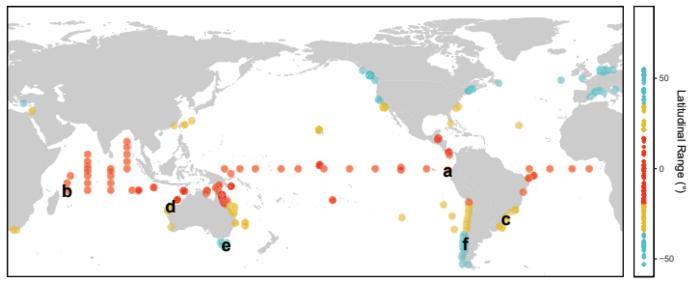
Tropical waters are not as thermally stable as once thought. Ocean waters vary widely in temperature over space and time, but the spatial and temporal resolution of remotely sensed sea surface temperature data is insufficient to capture the fine-scale variability that is relevant for marine organisms. Darren Li Shing Hiung and colleagues investigated whether ocean temperatures measured at high temporal scales are more stable in the tropics (often termed the “climate variability hypothesis”) by assembling a global array of in situ ocean temperature data with hourly or better temporal resolutions. The authors found that the long-held pattern of tropical ocean temperature stability was only valid at annual scales. At finer temporal scales, tropical waters were as variable as temperate regions—and subtropical waters were the most variable of all. This unexpected tropical and subtropical variability suggests correspondingly high variation in temperature-dependent biological rates, such as metabolism and photosynthesis, which may help to elucidate previously unexplained macroecological patterns. For instance, the results may help explain why tropical fish are more thermally tolerant than temperate fish when both are living in an overlapping subtropical range.  The authors call for consideration of ocean weather in research on species’ vulnerability to future ocean climate change.

Ocean weather map

Credit: Li Shing Hiung et al

Tropical waters are not as thermally stable as once thought. Ocean waters vary widely in temperature over space and time, but the spatial and temporal resolution of remotely sensed sea surface temperature data is insufficient to capture the fine-scale variability that is relevant for marine organisms. Darren Li Shing Hiung and colleagues investigated whether ocean temperatures measured at high temporal scales are more stable in the tropics (often termed the “climate variability hypothesis”) by assembling a global array of in situ ocean temperature data with hourly or better temporal resolutions. The authors found that the long-held pattern of tropical ocean temperature stability was only valid at annual scales. At finer temporal scales, tropical waters were as variable as temperate regions—and subtropical waters were the most variable of all. This unexpected tropical and subtropical variability suggests correspondingly high variation in temperature-dependent biological rates, such as metabolism and photosynthesis, which may help to elucidate previously unexplained macroecological patterns. For instance, the results may help explain why tropical fish are more thermally tolerant than temperate fish when both are living in an overlapping subtropical range.  The authors call for consideration of ocean weather in research on species’ vulnerability to future ocean climate change.


Journal

PNAS Nexus

Article Title

Ocean weather, biological rates, and unexplained global ecological patterns

Article Publication Date

6-Aug-2024

Share26Tweet17
Previous Post

‘New’ herbicides in blackberry production could soon be an option for growers

Next Post

Seismic detectors measure soil moisture using traffic noise

Related Posts

Study reveals benefits of co-firing wastewater sludge at thermal power plants
Marine

Study reveals benefits of co-firing wastewater sludge at thermal power plants

August 15, 2026
Ocean-derived sugars rise high into atmosphere, influencing Arctic climate
Marine

Ocean-derived sugars rise high into atmosphere, influencing Arctic climate

August 14, 2026
Sargassum Waste Transformed into High-Performance Carbon-Capture Material
Marine

Sargassum Waste Transformed into High-Performance Carbon-Capture Material

August 13, 2026
One Country, Two Oceans, and Twenty Times More Sharks
Marine

One Country, Two Oceans, and Twenty Times More Sharks

August 13, 2026
Ocean iron fertilization removes CO2—but what does nature pay?
Marine

Ocean iron fertilization removes CO2—but what does nature pay?

August 13, 2026
Climate Change Speed Influences Atlantic Meridional Overturning Circulation Stability
Marine

Climate Change Speed Influences Atlantic Meridional Overturning Circulation Stability

August 13, 2026
Next Post
Seismic detectors measure soil moisture using traffic noise

Seismic detectors measure soil moisture using traffic noise

  • Mothers who receive childcare support from maternal grandparents show more

    Mothers who receive childcare support from maternal grandparents show more parental warmth, finds NTU Singapore study

    27656 shares
    Share 11059 Tweet 6912
  • University of Seville Breaks 120-Year-Old Mystery, Revises a Key Einstein Concept

    1061 shares
    Share 424 Tweet 265
  • Bee body mass, pathogens and local climate influence heat tolerance

    682 shares
    Share 273 Tweet 171
  • Researchers record first-ever images and data of a shark experiencing a boat strike

    546 shares
    Share 218 Tweet 137
  • Groundbreaking Clinical Trial Reveals Lubiprostone Enhances Kidney Function

    531 shares
    Share 212 Tweet 133
Science

Embark on a thrilling journey of discovery with Scienmag.com—your ultimate source for cutting-edge breakthroughs. Immerse yourself in a world where curiosity knows no limits and tomorrow’s possibilities become today’s reality!

RECENT NEWS

  • Tropical Forest Biomass Responds to Diverse Climate Controls
  • Survey-Based Model Reveals How Preparedness Constraints Shape Cholera Transmission in Sudan
  • Waste-Based Retrofits Improve Thermal Performance in North Sinai Social Housing
  • KAIST develops semiconductor neuron that harnesses noise to selectively process signals

Categories

  • Agriculture
  • Anthropology
  • Archaeology
  • Athmospheric
  • Biology
  • Biotechnology
  • Blog
  • Bussines
  • Cancer
  • Chemistry
  • Climate
  • Earth Science
  • Editorial Policy
  • Marine
  • Mathematics
  • Medicine
  • Pediatry
  • Policy
  • Psychology & Psychiatry
  • Science Education
  • Social Science
  • Space
  • Technology and Engineering

Subscribe to Blog via Email

Success! An email was just sent to confirm your subscription. Please find the email now and click 'Confirm Follow' to start subscribing.

Join 5,149 other subscribers

© 2025 Scienmag - Science Magazine

Welcome Back!

Login to your account below

Forgotten Password?

Retrieve your password

Please enter your username or email address to reset your password.

Log In
No Result
View All Result
  • HOME
  • SCIENCE NEWS
  • CONTACT US

© 2025 Scienmag - Science Magazine
