


Savannas are a mixture of patches of trees and shrubs combined with an herbaceous understory. This biome significantly contributes to the global carbon stock and climate change mitigation. In Uruguay, subtropical wooded savannas account for around 100,000 hectares, with a relevant portion restricted to soils with high sodium content. Unfortunately, these savannas have suffered repeated events of illegal clear felling for harvesting wood products and being replaced by crop and livestock grazing systems. Despite this, few studies provide information regarding the distribution of carbon stored in the different components and the soil.

Credit: Baietto, A., et al.
Savannas are a mixture of patches of trees and shrubs combined with an herbaceous understory. This biome significantly contributes to the global carbon stock and climate change mitigation. In Uruguay, subtropical wooded savannas account for around 100,000 hectares, with a relevant portion restricted to soils with high sodium content. Unfortunately, these savannas have suffered repeated events of illegal clear felling for harvesting wood products and being replaced by crop and livestock grazing systems. Despite this, few studies provide information regarding the distribution of carbon stored in the different components and the soil.
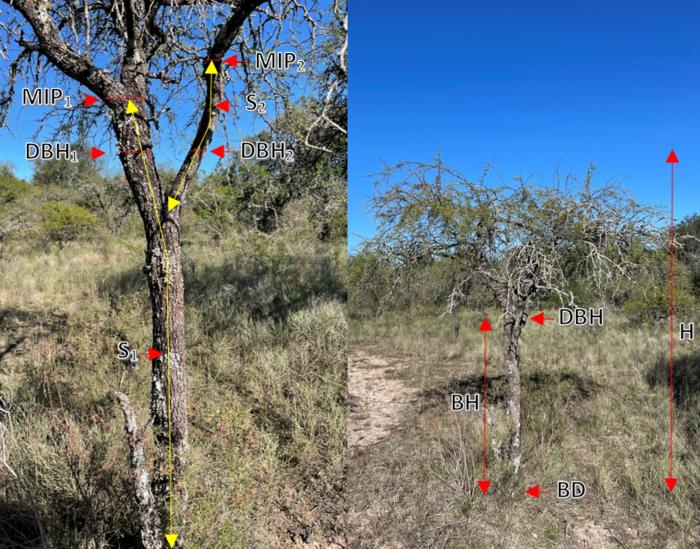
In this context, a recent study published in the journal Forest Ecosystems offers insights into mathematical relationships (allometric equations) for estimating the above-ground biomass of trees and shrubs and the carbon stock distribution among the different ecosystem components (soil, trees, shrubs, and herbaceous plants). The study’s authors, from Uruguay and Spain, found allometric equations for the most frequent tree species and shrub genera, allowing them to estimate the above-ground biomass of these components with high accuracy. To achieve this, a set of measurements was carried out on the trees (see the image) and shrubs.
“The measurements on the trees did not require their complete destruction, which is significant given the environmental and legal restrictions against cutting them down,” explains Andrés Baietto, lead and corresponding author of the study. “For the shrubs and herbaceous plants, destructive sampling methods were applied.”
To obtain the carbon stock, the team performed laboratory analyses to transform the above-ground biomass estimation into carbon stock records. Finally, soil sampling in depth was carried out to estimate the organic carbon contained in it.
The authors confirmed that subtropical wooded savannas associated with sodic soils contain substantial amounts of carbon, with the soil holding the highest proportion. Their results highlight the importance of the studied cover as a carbon sink.
“The role of the soil as the most crucial component is particularly relevant because the carbon retained in it is highly susceptible to being released if subtropical wooded savannas are replaced by crop and livestock grazing systems,” adds Baietto. “This substitution usually leads to a significant increase in carbon dioxide emissions, one of the main greenhouse gases responsible for global warming. Therefore, conserving subtropical wooded savannas associated with sodic soils could be a relevant practice for reducing carbon dioxide emissions in a climate change context.”
###
Contact the author: Forest Department, Faculty of Agronomy, University of the Republic, Montevideo, PO 12900, Uruguay abaietto@fagro.edu.uy
The publisher KeAi was established by Elsevier and China Science Publishing & Media Ltd to unfold quality research globally. In 2013, our focus shifted to open access publishing. We now proudly publish more than 100 world-class, open access, English language journals, spanning all scientific disciplines. Many of these are titles we publish in partnership with prestigious societies and academic institutions, such as the National Natural Science Foundation of China (NSFC).
Journal
Forest Ecosystems
Method of Research
Observational study
Subject of Research
Not applicable
Article Title
Carbon stock estimation in halophytic wooded savannas of Uruguay: An ecosystem approach
COI Statement
The authors declare that they have no known competing financial interests or personal relationships that could have appeared to influence the work reported in this paper.
Cite Scienmag News
Sloane Callahan. (July 31, 2024). The role of subtropical savannas in carbon sequestration and climate change mitigation. Scienmag. https://scienmag.com/the-role-of-subtropical-savannas-in-carbon-sequestration-and-climate-change-mitigation/
Sloane Callahan. "The role of subtropical savannas in carbon sequestration and climate change mitigation." Scienmag, 31 July 2024, https://scienmag.com/the-role-of-subtropical-savannas-in-carbon-sequestration-and-climate-change-mitigation/. Accessed 4 September 2026.
Sloane Callahan. "The role of subtropical savannas in carbon sequestration and climate change mitigation." Scienmag. July 31, 2024. https://scienmag.com/the-role-of-subtropical-savannas-in-carbon-sequestration-and-climate-change-mitigation/

