


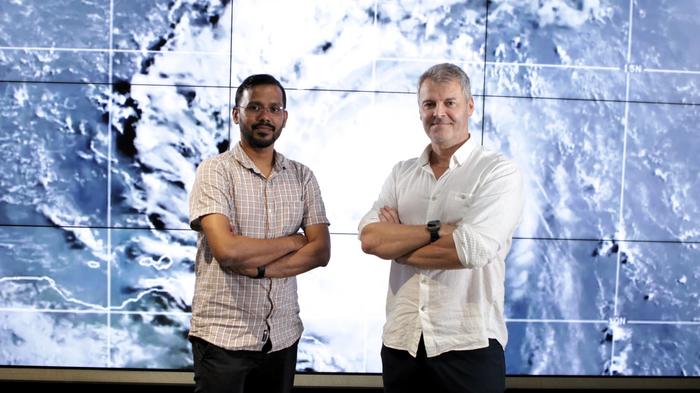
A study co-led by researchers at Rowan University in the US, Nanyang Technological University, Singapore (NTU Singapore) and the University of Pennsylvania, US, reveals that tropical cyclones in Southeast Asia are now forming closer to coastlines, intensifying more rapidly, and lingering longer over land.

Credit: NTU Singapore
A study co-led by researchers at Rowan University in the US, Nanyang Technological University, Singapore (NTU Singapore) and the University of Pennsylvania, US, reveals that tropical cyclones in Southeast Asia are now forming closer to coastlines, intensifying more rapidly, and lingering longer over land.
These changes, driven by climate change, heighten risks for tens of millions in coastal areas, with cities like Hai Phong, Yangon, and Bangkok facing unprecedented threats from longer lasting and more intense storms.
A tropical cyclone is a powerful, rotating storm that forms over warm ocean waters and brings strong winds and heavy rain. Tropical cyclones typically form in the tropical zone near the equator, characterised by warm ocean waters and consistent temperatures, providing the necessary heat and moisture for these cyclones to develop and intensify.
Based on the analysis of more than 64,000 modelled historic and future storms from the 19th century through the end of the 21st century, the study, published in the peer-reviewed Nature partner journal Climate and Atmospheric Science, highlights significant changes in tropical cyclone behaviours in Southeast Asia, such as increased formation near coastlines and slower movement over land, which could pose new risks to the region.
The study found that climate change alters tropical cyclones’ paths in Southeast Asia. This research is the first to use data from various climate models to examine cyclones over the 19th, 20th, and 21st centuries.
The group of researchers explains that around the world, tropical cyclones are affected by warming ocean waters, and the warmer they get, the more energy storms can draw from them.
Lead author Assistant Professor Andra Garner, at Rowan University’s School of Earth & Environment, said: “Southeast Asia has very densely populated coastlines, currently home to more than 70 per cent of the global population that’s exposed to future sea level rise. When you’re looking at that densely populated coastline, and it’s a region affected by tropical cyclones, there’s a real risk, especially when those storms become more damaging, and populations continue to grow.”
Co-author of the study Professor Benjamin Horton, Director of NTU’s Earth Observatory of Singapore, said: “Tropical cyclones have caused torrential rains and severe flooding across Southeast Asia, prompting mass evacuations, destroying infrastructure, and affecting the lives and livelihoods of thousands of people. Our study shows that as the cyclones travel across warmer oceans from climate change, they pull in more water vapour and heat. That means stronger wind, heavier rainfall, and more flooding when the typhoons hit land.” Prof Horton is also a Professor in Earth Science at NTU’s Asian School of the Environment.
The study is part of NTU’s S$50 million interdisciplinary climate research programme, the Climate Transformation Programme (CTP). Hosted by its Earth Observatory of Singapore and funded by Singapore’s Ministry of Education, the CTP aims to investigate climate change, develop, inspire, and accelerate knowledge-based solutions, and educate future leaders to establish the stable climate and environment necessary for a resilient and sustainable Southeast Asia.
Counting on advanced climate models to uncover new cyclone risks
Unlike traditional studies of historical weather patterns and storms, the researchers tailored computer simulations to manipulate various factors, such as projected increases in human-caused emissions and their impact on a warming planet.
The simulations show changes in where cyclones form, strengthen, slow down, and eventually dissipate, providing important insights into the impact of a warming climate on these storms.
Study co-author Dr Dhrubajyoti Samanta, Senior Research Fellow at NTU’s Earth Observatory of Singapore, said: “By examining storms over an extended period, our study delivers insights that can help governments prepare for future storms and guide community development planning. Leveraging nine global climate models, this study significantly reduces the uncertainty in predicting tropical cyclone changes, which has been a challenge in past studies using just a single model.”
Study co-author Mackenzie Weaver, from the Department of Earth and Environmental Science at the University of Pennsylvania, said: “Conducting a long-term analysis allows for better understanding of both past and future changes to tropical cyclone tracks, which can inform coastal resilience strategies in both the near-term and more distant future.
Asst Prof Garner added: “There were two takeaways: First, we should be acting to reduce emissions, so we can curb the impacts of future storms. Second, we should be acting now to protect those coastlines for the future, which will likely see some worsened tropical cyclone impacts regardless of future emissions.”
The team of researchers will conduct more detailed studies to better understand extreme weather conditions in the region and further determine how they could impact vulnerable populations.
Journal
npj Climate and Atmospheric Science
Article Title
Changes to tropical cyclone trajectories in Southeast Asia under a warming climate
Article Publication Date
1-Jul-2024
Cite Scienmag News
Sloane Callahan. (July 31, 2024). Climate change means that tropical cyclones in Southeast Asia are developing faster, lasting longer and endangering more coastal communities, finds joint international study. Scienmag. https://scienmag.com/climate-change-means-that-tropical-cyclones-in-southeast-asia-are-developing-faster-lasting-longer-and-endangering-more-coastal-communities-finds-joint-international-study/
Sloane Callahan. "Climate change means that tropical cyclones in Southeast Asia are developing faster, lasting longer and endangering more coastal communities, finds joint international study." Scienmag, 31 July 2024, https://scienmag.com/climate-change-means-that-tropical-cyclones-in-southeast-asia-are-developing-faster-lasting-longer-and-endangering-more-coastal-communities-finds-joint-international-study/. Accessed 5 September 2026.
Sloane Callahan. "Climate change means that tropical cyclones in Southeast Asia are developing faster, lasting longer and endangering more coastal communities, finds joint international study." Scienmag. July 31, 2024. https://scienmag.com/climate-change-means-that-tropical-cyclones-in-southeast-asia-are-developing-faster-lasting-longer-and-endangering-more-coastal-communities-finds-joint-international-study/

