


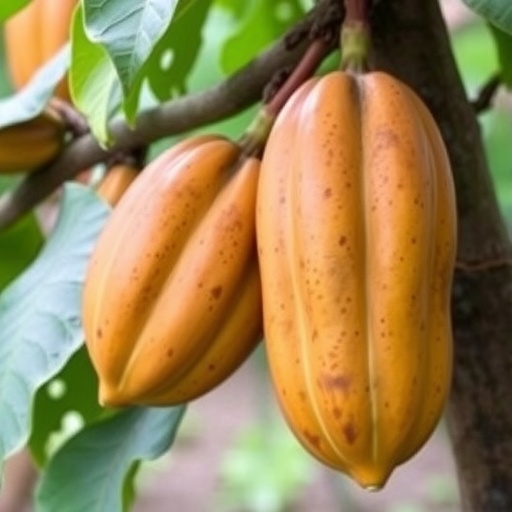
In the lush, biodiverse expanses of the Peruvian Amazon rainforest, cocoa cultivation thrives within intricate agroforestry systems, where cocoa trees coexist harmoniously alongside a variety of native tree species. This system not only promotes ecological balance but also sustains local economies dependent on cocoa production. Yet, amidst this verdant setting, leaf-cutter ants have earned a notorious reputation among farmers due to their voracious leaf consumption, which can dramatically affect cocoa yields. However, new research from Julius Maximilian University of Würzburg challenges the simplistic notion of these ants as mere agricultural villains, revealing a complex ecological role that underscores the delicate balance between cultivation and conservation.
Leaf-cutter ants, scientifically renowned for their sophisticated social structures and impressive ability to harvest vegetation, have the capacity to inflict severe defoliation on cocoa trees situated in close proximity to their nests. This intense herbivory can severely impact photosynthetic capacity and, by extension, fruit production. Yet, the impact of these ants is highly localized; beyond a radius of approximately 15 meters from their nests, the level of leaf consumption diminishes precipitously. This spatial gradient suggests that, although individual trees may suffer extensive damage, the overall cocoa plantation often experiences less detriment than previously assumed.
Blanca Iváñez Ballesteros, a postdoctoral researcher specializing in animal ecology and tropical biology, spearheaded an extensive observational study exploring the nuanced interplay between leaf-cutter ants and cocoa agroforestry. Her investigations delve deep into the ants’ nesting patterns, dietary preferences, and their broader ecological ramifications. Her work illuminates that these insects do not operate solely as crop pests but as key ecosystem engineers whose foraging and nesting behaviors actively modify soil properties and nutrient cycling dynamics within the agroforest.
A pivotal discovery from the study highlights the influence of canopy density on leaf-cutter ant populations. Dense overhead foliage creates favorable microhabitats that support a higher density of ant nests, possibly due to enhanced resource availability and protection from environmental stressors. This correlation emphasizes the importance of maintaining heterogeneous canopy structures to regulate ant populations effectively and mitigate potential crop damage.
Interestingly, the ants exhibit selective feeding behaviors, displaying distinct preferences for certain plant species over others. Experiments revealed that species such as papaya and oranges, along with the native timbers like Capirona, are favored over cocoa leaves. This preference likely arises from complex leaf chemistry variations, including the presence of secondary metabolites like caffeine in cocoa leaves, which may act as natural deterrents against herbivory. Leveraging this knowledge, agroforestry practitioners might strategically plant preferred species as ‘trap crops’ or alternative food sources, effectively diverting ant activity away from cocoa trees.
The surrounding landscape also plays a crucial role in moderating the ecological dynamics between ants and cocoa crops. Farms embedded within landscapes boasting a high proportion of intact forest cover—approximately 80% or more—tend to experience significantly reduced herbivory. This phenomenon is attributable to the presence of natural predators and competitors within the forest matrix, which exert biological control over ant populations. The conservation of adjacent forests thus emerges not only as a biodiversity imperative but also as a practical strategy to sustain agricultural productivity.
Soil alterations induced by leaf-cutter ants represent another fascinating facet of their ecological impact. Through excavating expansive tunnel networks and depositing organic waste, these ants influence soil texture, composition, and nutrient distribution. Contrary to conventional expectations, the study found decreased nutrient concentrations in surface soils adjacent to nest entrances, suggesting nutrient translocation to deeper soil strata. These microscale heterogeneities in soil chemistry potentially affect plant root dynamics and overall soil fertility patterns, warranting further investigation into their implications for agroforestry management.
The findings from this comprehensive study advocate a paradigm shift in cocoa agroforestry pest management strategies, moving away from conventional pesticide reliance towards ecosystem-based approaches. By embracing tree diversity within plantations and safeguarding contiguous forest fragments, farmers can harness natural ecological processes that regulate pest populations and enhance system resilience. This integrated strategy promises not only economic benefits through sustained yields but also bolsters biodiversity, soil health, and ecosystem stability.
Moreover, this research underscores the critical importance of understanding the ecological functions of so-called ‘pest’ species within agroecosystems. Leaf-cutter ants exemplify organisms whose roles transcend simplistic categorizations, offering both challenges and ecological services. Recognizing and balancing these dual aspects is essential for developing truly sustainable agricultural landscapes that align with conservation goals.
The study’s implications extend beyond the Peruvian Amazon, serving as a model for tropical agroforestry systems worldwide. It calls for enhanced collaboration between ecologists, agronomists, and local farming communities to design multifunctional landscapes that optimize productivity while conserving biodiversity. Such interdisciplinary efforts are pivotal in addressing the pressing challenges of sustainable food production amidst escalating environmental change.
In conclusion, leaf-cutter ants inhabit a complex niche within cocoa agroforestry, simultaneously acting as agents of damage and ecosystem engineering. Their activities shape not only the leaf biomass availability but also the very soil environment that supports plant growth. Harnessing their ecological interactions through informed landscape management holds promise for revolutionizing pest control paradigms and advancing sustainable agriculture in tropical rainforest regions.
News Publication Date: 23-Apr-2026
Web References: http://dx.doi.org/10.1111/1365-2664.70359
References: Journal of Applied Ecology
Cite Scienmag News
Margaret Porter. (April 23, 2026). The Role of Papayas in Enhancing Cocoa Cultivation. Scienmag. https://scienmag.com/the-role-of-papayas-in-enhancing-cocoa-cultivation/
Margaret Porter. "The Role of Papayas in Enhancing Cocoa Cultivation." Scienmag, 23 April 2026, https://scienmag.com/the-role-of-papayas-in-enhancing-cocoa-cultivation/. Accessed 4 September 2026.
Margaret Porter. "The Role of Papayas in Enhancing Cocoa Cultivation." Scienmag. April 23, 2026. https://scienmag.com/the-role-of-papayas-in-enhancing-cocoa-cultivation/


