


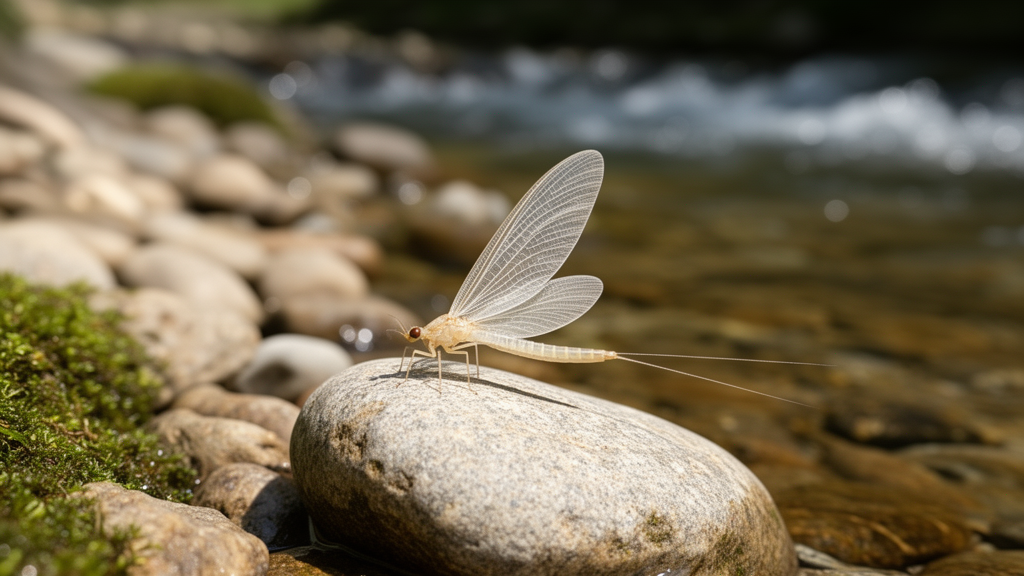
Deep in the floodplains of eastern Georgia, where the murky waters of the Alazani River wind slowly through clay and shifting sand, an insect thought to have vanished from the region has quietly reappeared. Scientists sampling the riverbed at Mijniskure, inside Vashlovani National Park, have confirmed the presence of the sand-dwelling mayfly Ametropus fragilis Albarda, 1878, a species whose only previous record from the South Caucasus dates back roughly 80 years. The discovery, published in the journal Caucasiana, not only settles a long-standing taxonomic doubt but also raises an unexpected genetic puzzle that stretches across the entire Holarctic realm.
The genus Ametropus belongs to the mayfly family Ametropodidae, a small and peculiar lineage within the order Ephemeroptera. Its representatives are among the most specialized mayflies in the world, adapted for life buried in the sandy bottoms of large rivers. The nymphs are psammophilous, meaning they dwell within sand, and behave as semi-burrowers, hiding in muddy or sandy substrata where their slender, densely hairy bodies blend seamlessly with the sediment. This lifestyle makes them notoriously difficult to collect, and their populations are typically rare and scattered even within their broad distribution range. As a result, records of Ametropus are few and far between, and each new occurrence carries significant biogeographic weight.
The history of Ametropus in the Caucasus is a story of uncertainty. The Reverend Alfred Edwin Eaton reported in 1885 that specimens of the genus were found mixed within samples collected from Russia, the Caucasus, and Armenia, though the exact localities remained unclear. Decades later, in 1940 and again in the 1940s, Sadovsky collected Ametropus sp. from the Kura River in Georgia, and the specimens were considered potentially new taxa due to taxonomic ambiguity. However, no voucher material or precise locality data survived, and the 2018 comprehensive checklist of Georgian mayflies, compiled by Gabelashvili and colleagues, flagged these old records as doubtful. Since then, no other record of Ametropus had been documented from the whole South Caucasus or nearby regions further south, leaving the very presence of the genus in the region an open question.
That question has now been answered. On April 17, 2022, researchers collected benthic samples from three plots spaced 30 meters apart in the shallow, murky waters of the Alazani River at an altitude of 95 meters above sea level. The Alazani, a 240-kilometer-long river originating from the southern slopes of the Greater Caucasus Mountains at roughly 2800 meters, is the largest left tributary of the Kura River, and its lower reach forms the border between Georgia and Azerbaijan. At the sampling sites, the river flows slowly, typical of a lowland watercourse, with a bottom composed mainly of clay and muddy silt, interspersed with sand. The water is poorly transparent, algae are negligible, and the benthic communities are homogeneous but dense, a habitat that perfectly matches the known preferences of Ametropus larvae.
Samples were collected using a kick-net with a 500-micrometer mesh size according to the AQEM sampling method, within a depth range of 15 to 80 centimeters. Among the mayfly specimens sorted from the material, five individuals were initially identified as Ametropus sp. The nymph morphology of this genus is unique among mayflies and cannot be confused with any other, which made the initial recognition straightforward. Based on morphological characteristics described by Sadovsky, Bauernfeind and Soldan, and Eiseler, the specimens were further identified as Ametropus fragilis. The general coloration is yellowish-brown, with slender and hairy bodies. The antennae bear 16 segments, and the legs are slender with long claws, the forelegs much shorter than the middle and hind pairs. Fore coxae carry a base-attached spinous patch, and seven pairs of single, lateral plate-like gills, each fringed with long setae on their margins, line the body. Maxillary and labial palps are three-segmented and covered with dense hair. In all respects, the newly collected individuals are morphologically highly similar to the Ametropus specimens described and illustrated by Sadovsky 80 years ago, confirming a striking continuity across the decades.
To resolve the species identity with certainty, the team turned to DNA barcoding of the cytochrome oxidase subunit I gene, the standard molecular tool for species identification in animals. Genomic DNA was extracted from tissue samples using a commercial kit, and partial COI sequences were amplified by polymerase chain reaction using the primer pairs LCO1490-JJ and HCO2198-JJ. Thermal cycling involved an initial denaturation step followed by two cycle sets with progressively lowered annealing temperatures, a touch-down protocol designed to maximize amplification specificity. Amplicons were visualized on agarose gels, and sequencing of unpurified PCR products in both directions was conducted at the Beijing Genomics Institute in Hong Kong. Three barcode sequences of 626 nucleotide base pairs, free from indels or stop codons, were obtained from three specimens and uploaded to the Barcode of Life Data System, where they were assigned processing IDs EPGEO001-23, EPGEO002-23, and EPGEO003-23.
The molecular results were nearly identical among the Georgian specimens, with uncorrected p-distances ranging from 0.15 to 0.61 percent, confirming they belong to a single population. The BOLD System identified the sequences under a new Barcode Index Number, BOLD:AFB6526. What came next, however, was entirely unexpected. The closest genetic match to the Caucasian specimens was not the European Ametropus fragilis but the Nearctic species Ametropus neavei from Canada, with a mean p-distance of just 3.54 percent. A larger genetic distance of 4.3 percent was found between the Georgian specimens and the single available sequence of A. fragilis from Slovakia. In other words, the mayflies of the Alazani River are genetically closer to their North American counterparts than to their European relatives, a pattern that defies simple geographic logic.
Ametropus fragilis is considered the sole species of the family Ametropodidae in Europe, with a distribution spanning Germany, Italy, Croatia, Poland, Austria, Slovakia, Hungary, Bulgaria, Romania, Estonia, Latvia, and Lithuania, with additional records from Russia, China, Belarus, and France. According to Jacob, North American A. albrighti should be treated as a synonym of A. fragilis, making the species Holarctic in scope. Yet the species is usually rare throughout its range, with very small population densities spread over a very large distribution area. Taking this into consideration, large genetic variation of around 5 percent divergence in the COI barcode region between populations would be expected. The observed pattern, however, makes interpretation difficult. The most intuitive explanation is recent translocation and gene flow, perhaps mediated by human activity or natural dispersal events. On the other hand, given the population characteristics and lifestyle peculiarities of Ametropus, the pattern may also indicate the existence of multiple divergent lineages of Eurasian and North American Ametropus, pointing to the need for a thorough taxonomic revision of the genus across the Holarctic region.
The implications of the new record extend well beyond Georgia. Since the Alazani River lies right on the border between Georgia and Azerbaijan, the species can now be said to occur in Azerbaijan as well. Taking the old literature into consideration, the Ametropus specimens observed in Iran and Armenia most probably also belong to the same species. The researchers have provided an updated distribution map, building on earlier work, showing the current known range of A. fragilis across Europe and neighboring areas, with countries where the species has become extinct marked separately from those where data is unavailable. The map reveals a fragmented European presence and highlights how much remains unknown about this elusive insect.
The rediscovery of Ametropus fragilis in Georgia is a testament to the value of renewed field surveys in understudied regions. The Georgian mayfly fauna, now known to include 77 species following recent additions, continues to yield surprises, and the Caucasus Barcode of Life project, under which the specimens are stored at Ilia State University in Tbilisi, is systematically cataloging the region’s biodiversity through molecular tools. For a genus that has hovered in taxonomic limbo for nearly a century in the South Caucasus, the confirmation of its presence, backed by both morphology and molecular evidence, represents a significant step forward. Yet the genetic closeness of Caucasian and North American populations serves as a reminder that even well-known Holarctic species may conceal hidden diversity, and that the full story of Ametropus is far from complete.
Subject of Research: Rediscovery and DNA barcoding of the mayfly Ametropus fragilis in Georgia after 80 years
Article Title: The record of Ametropus fragilis Albarda, 1878 ( Ephemeroptera , Ametropodidae ) from Georgia
Article References: Memishishi, A., Bikashvili, A., Japoshvili, B., & Mumladze, L. (2023). The record of Ametropus fragilis Albarda, 1878 (Ephemeroptera, Ametropodidae) from Georgia. Caucasiana, 2, 77-82. https://doi.org/10.3897/caucasiana.2.e102622
Image Credits: AI Generated
DOI: 10.3897/caucasiana.2.e102622
Keywords: Ametropus fragilis, Ephemeroptera, mayfly, Georgia, Alazani River, DNA barcoding, COI gene, South Caucasus, Holarctic distribution, Vashlovani National Park, biodiversity, taxonomy
Cite Scienmag News
Gavin Prescott. (October 18, 2026). The record of Ametropus fragilis Albarda, 1878 (Ephemeroptera, Ametropodidae) from Georgia. Scienmag. https://scienmag.com/the-record-of-ametropus-fragilis-albarda-1878-ephemeroptera-ametropodidae-from-georgia/
Gavin Prescott. "The record of Ametropus fragilis Albarda, 1878 (Ephemeroptera, Ametropodidae) from Georgia." Scienmag, 18 October 2026, https://scienmag.com/the-record-of-ametropus-fragilis-albarda-1878-ephemeroptera-ametropodidae-from-georgia/. Accessed 18 October 2026.
Gavin Prescott. "The record of Ametropus fragilis Albarda, 1878 (Ephemeroptera, Ametropodidae) from Georgia." Scienmag. October 18, 2026. https://scienmag.com/the-record-of-ametropus-fragilis-albarda-1878-ephemeroptera-ametropodidae-from-georgia/


