


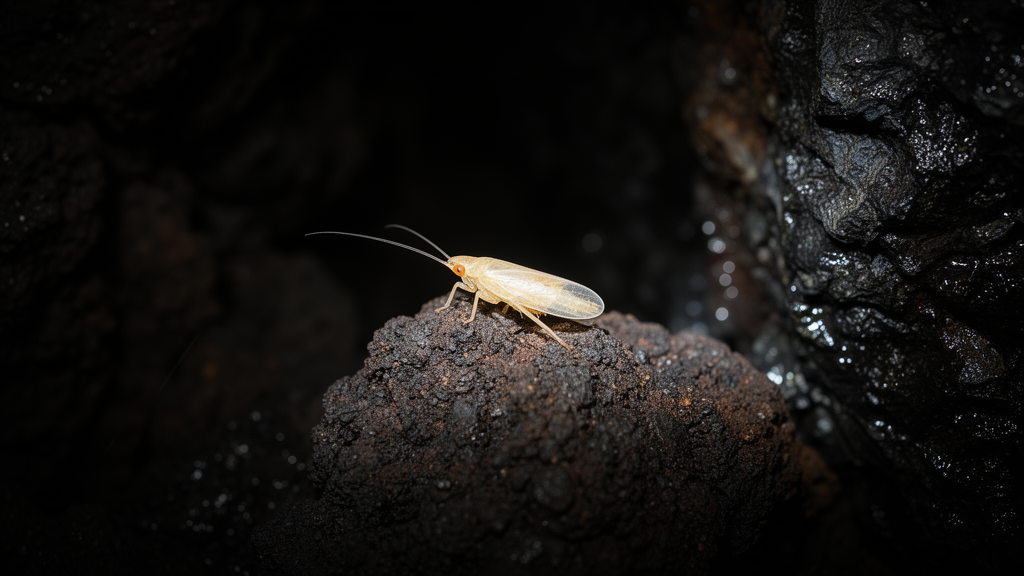
Deep beneath the volcanic landscapes of the Canary Islands, an evolutionary experiment has been running for millions of years. In the archipelago’s lava tubes and the hidden network of cracks that riddle its basaltic terrain, planthoppers have repeatedly abandoned the surface world for a life in permanent darkness. Now, researchers have described four new species of these subterranean insects, bringing the Canary Islands’ tally of cave-adapted planthoppers to seventeen — the highest number of any region on Earth and roughly a quarter of all such species known worldwide.
The new species belong to two families of planthoppers, the Cixiidae and the Meenoplidae, sap-sucking insects in the order Hemiptera. Three are cixiids: Cixius palmirandus from La Palma, Cixius theseus from El Hierro and Tachycixius gomerobscurus from La Gomera. The fourth, Meenoplus skotinophilus, is a meenoplid from El Hierro. The discovery of Tachycixius gomerobscurus is particularly significant, as it marks the first record of a subterranean-adapted planthopper on La Gomera, an island that lacks lava tube caves altogether because volcanism there ceased around 2.5 million years ago.
The Canary Islands are of purely volcanic origin, with the different islands emerging from the sea during the past 20.2 million years. The seven main islands differ considerably in age, size and altitude, ranging from El Hierro, barely 1.12 million years old, to Fuerteventura’s ancient terrain. This geological youthfulness matters enormously for subterranean life. Lava tubes form in low-viscosity basaltic flows known as pahoehoe, or ropy lava, and range from a few centimeters in diameter to tunnels several meters high and tens of kilometers long. Roots from surface vegetation entering these hollow underground spaces provide a food resource for animals that inhabit the caves throughout their entire life cycle.
More than 230 troglobionts — obligate subterranean arthropods — have been documented in the archipelago, yet the underground environment remains far less well investigated than surface biotopes. Planthoppers are among the insects most frequently encountered in the islands’ lava tubes. While some individuals show no external differences from surface-dwelling relatives and are likely occasional cave visitors, others display characteristic troglomorphies: reduction or loss of compound eyes, reduced and non-functional wings, and light bodily pigmentation. These traits mark them as troglobionts, spending their entire life cycle in subterranean habitats.
Cixius palmirandus, the new species from La Palma, is a case study in extreme cave adaptation. The single known specimen, a male just 3.9 millimeters long, was collected in Cueva Honda de Miranda, a labyrinthic lava tube with over 20 galleries and one kilometer of total development on the island’s eastern slope. The species is completely blind — compound eyes and ocelli are absent — with strongly reduced tegmina and vestigial wings, and a stramineous yellowish coloration. It is certainly unable to fly and is regarded as an obligate cavernicole, restricted to the subterranean environment throughout its life. The gallery where it was found lies relatively close to the cave entrance, where high relative humidity and abundant roots prevail.
Cixius theseus, from El Hierro, is similarly blind and flightless, with a male body length of 2.7 millimeters and a female of 3.3 millimeters. It was discovered not in a cave but in the mesovoid shallow substratum, or MSS — a network of voids and cracks at the interface between soil and rock layer. On El Hierro, this habitat takes a distinctly volcanic form: fields of recent lava and volcanic deposits where a layer of lava clinker is covered by fine ash, maintaining high humidity and rather constant temperature throughout the year. The species was found at 1230 meters altitude in laurel forest dominated by Morella faya and Erica canariensis, within the huge landslide of El Golfo on the island’s northwest. Its name refers to Theseus, the Greek hero and friend of Ariadne — a nod to the blind insect’s thread-like navigation of the subterranean labyrinth.
Tachycixius gomerobscurus presents a milder degree of troglomorphy. Unlike its blind relatives, it retains small but pigmented compound eyes and distinct lateral ocelli, though its hind wings are strongly reduced and vestigial. The species was collected over many years using pitfall traps installed in the colluvial MSS of Reventón Oscuro, a steep slope inside dense, humid laurel forest at 1035 meters altitude in Garajonay National Park. Nearly 40 individuals, both adults and nymphs, have been captured there, making this the most productive site for troglobitic planthoppers in the entire archipelago. The traps, PVC pipes with multiple holes and silicone covers, were baited with liver or blue cheese, though the planthoppers probably fell in by chance rather than being attracted, as they feed by sucking fluids from roots.
Meenoplus skotinophilus, the new meenoplid from El Hierro, occupies an intermediate position between surface-dwelling meenoplids and strongly troglomorphic species. Its compound eyes are small but present and red, its tegmina and wings are well developed, and its name — combining the Greek words for darkness and friend — reflects its cave-dwelling habits. The species was discovered in Cueva de Guinea, a barely 25-meter-long lava tube with a small roof entrance in the lowland area of Frontera. The cave’s high humidity and many roots attached to walls and hanging from the ceiling create a good environment for invertebrate communities. The researchers also obtained mitochondrial COI barcode sequences for three individuals, which proved identical to each other and showed no matches above 85 percent similarity in genetic reference databases, confirming the genetic novelty of the lineage.
With seventeen documented species of strictly hypogean planthoppers, the Canary Islands now hold the highest number of subterranean planthoppers of any region worldwide. Strikingly, twelve of the seventeen species occur on the two youngest islands, La Palma and El Hierro, where volcanic activity prevails and extended areas of suitable cave habitat exist. On La Palma, the most recent eruption in 2021 along the Cumbre Vieja ridge created the new volcano Tajogaite and certainly many new lava tubes. The researchers hypothesize that in the Cixiidae at least five to six, and maximally twelve, successful underground colonization events have taken place, while in the Meenoplidae at least two lineages must have colonized the islands despite no epigean meenoplid species having ever been reported from the archipelago.
The zoogeographic patterns observed carry a sobering evolutionary message. Most troglobitic planthoppers on the Canary Islands have no extant close epigean relatives and are therefore relicts — persistent remnants of formerly widespread faunas. The researchers conclude that the cavernicolous Meenoplidae of Gran Canaria, La Palma and El Hierro, together with several cavernicolous Cixiidae, are indicative of an ancient surface fauna that is now extinct. This pattern recurs across many other arthropod groups in the islands, which are represented only by subterranean-adapted species. All cave planthopper species of the Canary Islands are single-island endemics, known from few locations and few specimens each, and all must be regarded as vulnerable, if not endangered, under IUCN criteria.
Conservation concerns are immediate and tangible. Cueva Honda de Miranda, home of Cixius palmirandus, lies in an area heavily transformed into a rural environment with scattered homes and agricultural fields. The sewage sanitation system is non-existent, and wastewater is discharged directly into underground wells, gradually contaminating the subsurface. The detection of American cockroach nymphs in the cave signals local contamination and the potential displacement of native subterranean fauna by invasive species. At Cueva de Guinea, home of Meenoplus skotinophilus, significant tourist activity and facilities equipped with bathrooms lacking sewage connections pose similar threats. Meanwhile, at Cueva de la Curva on El Hierro, breakage of the end of the lava tube by loader machines working on the surface has caused the stable, saturated atmosphere essential for obligate troglobionts to collapse, rendering three species formerly exclusive to that cave very scarce.
Climate change compounds these pressures. Increasing periods of extreme drought have occurred over the past several years, and the stable, saturated atmosphere essential for obligate terrestrial troglobionts is no longer maintained in larger cave passages. Cave planthoppers may cope with short-term adverse conditions by retreating into smaller crevices of the MSS, which are less prone to desiccation, but long-term climate change will have lasting indirect and direct influence on the subterranean environment. Increasing temperatures and lower precipitation will alter surface plant communities, and plant species providing adequate roots for food supply may vanish. Sporadic observations indicate that cave planthoppers may be temperature sensitive, suggesting that rising average annual temperatures could result in their extirpation.
Despite these threats, the outlook for discovery remains bright. The researchers note indications — observations and images without voucher specimens — that more new species await discovery, and it is conceivable that the number of obligate subterranean planthopper species will eventually double. Particularly promising are caves in the north of La Palma, the El Golfo region on El Hierro, and the extended MSS on Tenerife, Gran Canaria and La Gomera. Conversely, the eastern islands of Fuerteventura and Lanzarote are much drier, their caves lack roots inside, and planthoppers have never been found there. Troglobitic planthoppers offer unique opportunities to study adaptation to specialized habitats, including physiology, behaviour and the evolutionary dynamics of subterranean speciation — and they could serve as models for understanding climate change impact on subterranean environments worldwide.
Subject of Research: Discovery of four new cavernicolous planthopper species in the Canary Islands
Article Title: Endless forms most wonderful: Four new cavernicolous planthopper species ( Hemiptera , Fulgoromorpha , Cixiidae and Meenoplidae ) from the Canary Islands
Article References: Hoch, H., López, H., Naranjo, M., Aguín-Pombo, D., & Oromí, P. (2025). Endless forms most wonderful: Four new cavernicolous planthopper species (Hemiptera, Fulgoromorpha, Cixiidae and Meenoplidae) from the Canary Islands. Subterranean Biology, 51, 61-101. https://doi.org/10.3897/subtbiol.51.144111
Image Credits: AI Generated
DOI: 10.3897/subtbiol.51.144111
Keywords: Canary Islands, planthoppers, cave fauna, troglobionts, Cixiidae, Meenoplidae, lava tubes, endemic species, subterranean biology, conservation, Hemiptera, biodiversity
Cite Scienmag News
Gavin Prescott. (October 18, 2026). Four new blind cave planthopper species discovered in the Canary Islands. Scienmag. https://scienmag.com/four-new-blind-cave-planthopper-species-discovered-in-the-canary-islands/
Gavin Prescott. "Four new blind cave planthopper species discovered in the Canary Islands." Scienmag, 18 October 2026, https://scienmag.com/four-new-blind-cave-planthopper-species-discovered-in-the-canary-islands/. Accessed 18 October 2026.
Gavin Prescott. "Four new blind cave planthopper species discovered in the Canary Islands." Scienmag. October 18, 2026. https://scienmag.com/four-new-blind-cave-planthopper-species-discovered-in-the-canary-islands/


