


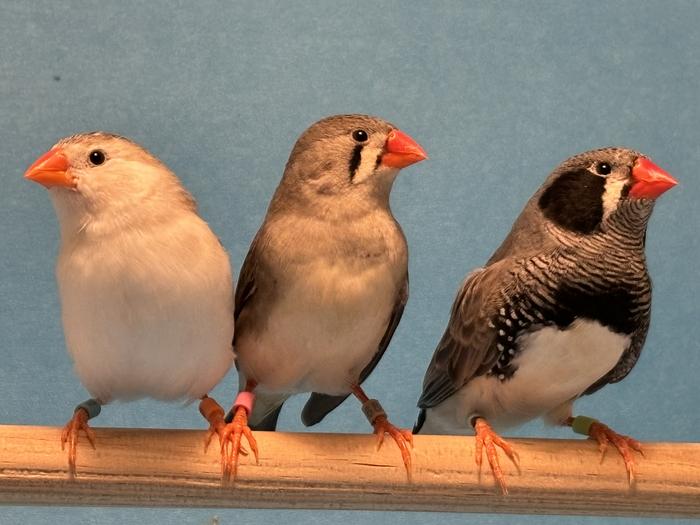
A new study on songbirds sheds light on the power of social interaction to facilitate learning, insights that potentially apply to human development.

Credit: Sarah Woolley
A new study on songbirds sheds light on the power of social interaction to facilitate learning, insights that potentially apply to human development.
McGill University researchers discovered that zebra finches deprived of early social experiences could still form strong bonds with a partner later in life. Once placed into cohabitation with a male, females that had never heard a mating song before could quickly develop a preference for his melody.
The findings, published in Proceedings of the Royal Society B: Biological Sciences, challenge the belief that early experiences alone are critical for learning song preference.
“Young humans become attuned to the language they hear most, making it difficult to learn a new language as an adult because some sounds are hard to distinguish. Similarly, female zebra finches need to hear their species’ songs when they’re young to perceive them correctly. However, our study shows that social interactions later in life can help make up for this missed experience,” said senior author Sarah Woolley, an Associate Professor in the Department of Biology.
A bird’s-eye view of zebra finch courtship
Zebra finches are small Australian songbirds that often partner for life. Males sing melodies to attract a mate, while females learn which tunes they prefer by listening to adults.
In their experiments, the McGill team captured this courtship ritual on video. They split the zebra finches into groups: birds raised by their mom without exposure to song, and birds raised by both parents. Each group was then either paired with a male or housed with a female and only overheard males singing nearby.
To test song preference, female finches were given the opportunity to pull on strings that triggered different songs from a speaker; it was understood that the more a female pulled a certain string, the stronger her fondness for that melody.
Notably, females only developed an affinity for their partner’s song when they lived together. In contrast, females who only overheard males did not form these bonds. This suggests quality time is crucial for forming strong bonds, the researchers said.
Direct social interaction is key
“Think of it as the difference between people chatting over the phone versus spending quality time together. Direct social interaction allows zebra finches to form deeper connections with their mates,” said lead author Erin Wall, a PhD graduate in the Integrated Program in Neuroscience. “Females that never see or interact with a male directly become familiar with his voice, but they don’t develop a preference for him. They only know his song in the context of him courting someone else,” said Wall.
Zebra finches are often studied because they are highly social creatures with complex communication behaviours, making them ideal for research on social interaction and learning. The team’s future research will use brain scans to delve into the neural changes associated with pair bonding.
In an increasingly online world, the researchers say these findings could open new avenues of research into the role of face-to-face interaction in learning and social bonds.
About McGill University
Founded in Montreal, Quebec, in 1821, McGill University is Canada’s top ranked medical doctoral university. McGill is consistently ranked as one of the top universities, both nationally and internationally. It is a world-renowned institution of higher learning with research activities spanning three campuses, 12 faculties, 14 professional schools, 300 programs of study and over 39,000 students, including more than 10,400 graduate students. McGill attracts students from over 150 countries around the world, its 12,000 international students making up 30% of the student body. Over half of McGill students claim a first language other than English, including approximately 20% of our students who say French is their mother tongue.
Method of Research
Experimental study
Subject of Research
Animals
Article Title
Social experiences shape song preference learning independently of developmental exposure to song
Article Publication Date
5-Jun-2024
Cite Scienmag News
Courtney Benton. (August 21, 2024). The power of face time: Insights from zebra finch courtship. Scienmag. https://scienmag.com/the-power-of-face-time-insights-from-zebra-finch-courtship/
Courtney Benton. "The power of face time: Insights from zebra finch courtship." Scienmag, 21 August 2024, https://scienmag.com/the-power-of-face-time-insights-from-zebra-finch-courtship/. Accessed 3 September 2026.
Courtney Benton. "The power of face time: Insights from zebra finch courtship." Scienmag. August 21, 2024. https://scienmag.com/the-power-of-face-time-insights-from-zebra-finch-courtship/

