


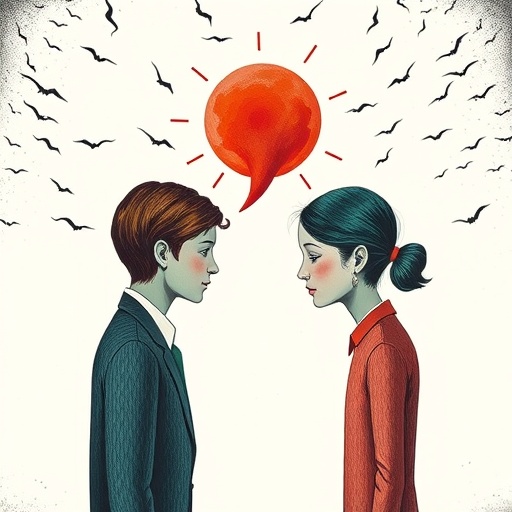
In an intriguing exploration of the moral landscape surrounding honesty and prosocial deception, a recent study conducted by psychologists from SWPS University and the University of Wrocław unpacks the complex dynamics underlying how individuals judge and prefer different types of feedback. The investigation reveals that while honesty remains a cherished attribute in social interactions, there is a nuanced appreciation for feedback that softens reality in order to protect the emotional wellbeing of others—a form of “prosocial lying.” This research challenges the traditional black-and-white perspective on truth-telling, highlighting a socially strategic flexibility in moral evaluation.
The research, spearheaded by social psychologist Katarzyna Cantarero at SWPS University and psychologist Michał Białek at the University of Wrocław, targeted nearly 900 participants across the United States. Employing experimental methodology through the Prolific online platform, the study presented scenarios involving individuals offering critiques to two cooks whose culinary efforts failed. The responses of these feedback providers were manipulated to vary in truthfulness and sensitivity—ranging from blunt honesty to tailored, sometimes deceptive, kindness.
Critically, the participants evaluated the morality, predictability, and trustworthiness of these feedback providers. It emerged that those who engaged in prosocial dishonesty—delivering overly positive or softened critiques to shield recipients from distress—were perceived as more moral than their strictly honest counterparts. This finding underscores a prevailing social value placed on empathy and interpersonal sensitivity, especially when communication might otherwise cause harm.
Moreover, the data illuminated how flexible feedback strategies, often blending honest critique with considerate softening, were not penalized morally. Feedback providers who adjusted their truth-telling depending on the recipient’s emotional resilience were considered strategically sensitive rather than inconsistent or untrustworthy. This suggests that society tolerates, and perhaps even endorses, a nuanced calibration of honesty based on social context and individual vulnerability.
Interestingly, the study exposes a divergence in preferences for receiving feedback versus providing it to others. While prosocial liars garnered higher moral esteem, individuals overwhelmingly preferred to receive unvarnished truth when evaluating themselves. Approximately 70% favored honest feedback providers for their personal growth, revealing a self-concept grounded in valuing directness for self-improvement despite the discomfort it may cause.
When it came to choosing feedback sources for others, particularly those known to have difficulty handling criticism, participants leaned toward socially sensitive feedback providers who could modulate their honesty with kindness. This protective stance underscores a societal recognition of emotional variability and a desire to preserve motivation and wellbeing in vulnerable populations, confirming that context-dependent honesty is a socially adaptive mechanism.
The findings also imply an absence of a universal “best practice” for interpersonal feedback. Instead, they point to a complex interplay where individuals weigh the moral qualities of honesty against compassion, tailoring their communication approach accordingly. This strategic adaptability likely serves to maintain relational harmony and optimize emotional outcomes, supporting theories of communication as a dynamic, socially embedded process rather than fixed normative behavior.
This study bridges gaps in moral psychology and communications research by empirically demonstrating that the binary classification of honesty versus lying is too simplistic to capture the social realities of moral judgment. It highlights how the fine line between truth and deception blurs in everyday interactions when intentions align with preserving social bonds and emotional health.
Furthermore, the investigation extends the conceptualization of morality beyond rigid adherence to factual truth, incorporating notions of empathy, social responsibility, and contextual reasoning. Such integrative perspectives bear significant implications for domains like education, management, counseling, and social policy, where feedback functions as a critical tool for growth, motivation, and social cohesion.
As feedback mechanisms continue to evolve in digital and real-world environments, understanding the moral calculus behind truth-telling strategies becomes ever more pertinent. This research offers valuable insights for designing communication frameworks that respect individual sensitivities while fostering transparency, enabling more effective and humane interactions across diverse social settings.
Ultimately, the publication titled “Selective (dis)honesty: Choosing overly positive feedback only when the truth hurts” in the British Journal of Social Psychology foregrounds a sophisticated psychological reality: honesty is not merely about adherence to facts but intimately tied to the social contexts and emotional landscapes we navigate. By recognizing this complexity, we can better appreciate the moral dimensions embedded in everyday communication.
This study invites a reevaluation of how society balances the desire for truthful feedback with the equally compelling need to shield others from unnecessary emotional harm. It expands our understanding of moral judgment to include strategic kindness and adaptive communication, revealing that selective honesty is a nuanced social skill that maintains both ethical integrity and relational empathy.
With these revelations, the dialogue about honesty in social and professional environments gains a deeper, more compassionate dimension—acknowledging that sometimes, the truth alone is not the ultimate moral good, but rather the care with which it is conveyed.
Cite Scienmag News
Courtney Benton. (February 1, 2026). The Pain of Truth: Why Prosocial Lies Boost Perceptions of Morality. Scienmag. https://scienmag.com/the-pain-of-truth-why-prosocial-lies-boost-perceptions-of-morality/
Courtney Benton. "The Pain of Truth: Why Prosocial Lies Boost Perceptions of Morality." Scienmag, 1 February 2026, https://scienmag.com/the-pain-of-truth-why-prosocial-lies-boost-perceptions-of-morality/. Accessed 3 September 2026.
Courtney Benton. "The Pain of Truth: Why Prosocial Lies Boost Perceptions of Morality." Scienmag. February 1, 2026. https://scienmag.com/the-pain-of-truth-why-prosocial-lies-boost-perceptions-of-morality/


