


The Saharo-Arabian Desert, noted for its harsh arid environment, has historically posed a significant challenge for species dependent on water to thrive. Over the past eight million years, however, research unearthed evidence that this area underwent recurrent humid periods, thus transforming the biogeographical landscape of both Africa and Eurasia in profound ways. As rainfall patterns fluctuated, driven by broader climatic shifts, opportunities for mammalian migrations—including those of our early ancestors—were created during these wetter epochs. This dynamic interplay between climate and life has recently been unraveled in a significant study published in the journal Nature, led by an international research team from the Max Planck Institute for Chemistry in Mainz.
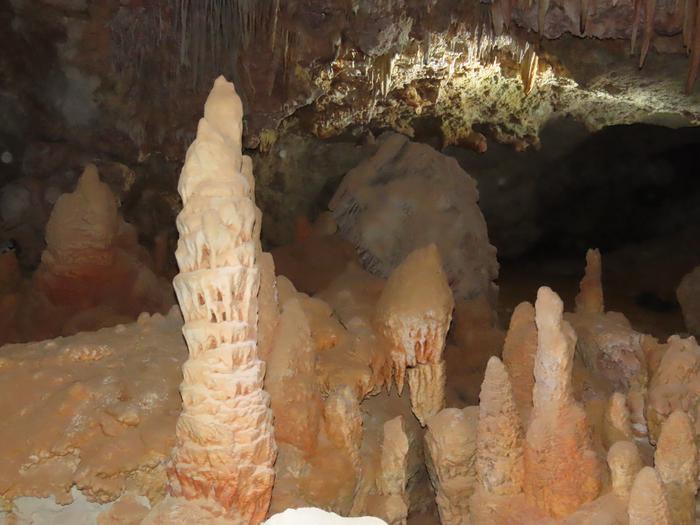
The study’s genesis lies in an ambitious analysis of speleothems—mineral formations that form in limestone caves—collected from seven caves across Saudi Arabia. Researchers utilized radiometric dating techniques to establish timelines for these formations, confirming periods of enhanced rainfall that likely turned parts of the desert into verdant landscapes. By capturing the isotopic signatures of past water sources trapped within these speleothems, scientists have unveiled a remarkable narrative of ecological transformation dating back millions of years.
Diving deeply into the findings provides an astonishing picture of the changes that have taken place in the Arabian Peninsula. Evidence suggests that during particular epochs, Arabian conditions were markedly wetter, offering refuge and resources for a variety of water-dependent mammals. The isotopes of oxygen and hydrogen located within speleothems reveal that rainfall during these humid phases likely originated from monsoonal systems sweeping in from the south. This climatic influx provided the necessary moisture to sustain a variety of ecosystems, paving the way for significant populations of fauna.
Interpreting the data implies that these humid intervals were not merely fleeting anomalies in an otherwise arid landscape. Instead, they spanned thousands of years, during which the Arabian terrain transitioned dramatically. It is hypothesized that these changes facilitated occasional migrations of mammals, including species that later evolved into humankind. Mammalian exchanges between Africa and Eurasia may have flourished during these moist periods, enabling genetic diversification and adaptation critical to survival.
In-depth investigation by researchers, including Dr. Hubert Vonhof of the Max Planck Institute, highlights that the reoccurrence of wet conditions in the Arabian Peninsula carries implications beyond climatology alone. As the desert’s intense aridification has progressed over the past several millennia, these infrequent humid phases proved to be essential for sustaining migratory pathways, including those of early hominins. The implications are significant, offering new insights that the Arabian Peninsula plays a central role in the migration narratives of mammalian and hominin populations, which had perhaps previously been dismissed.
The detailed data of ancient climate conditions interpreted through the lenses of molecular record-keeping is crucial. For many years, experts could only speculate about paleoclimatic conditions based on fossil findings. However, this new research employed advanced techniques in hydroclimate studies such as isotope analysis, leading to fresh revelations about environments that existed long ago. For instance, observing how the northward cooling of the hemisphere in recent epochs corresponded with a southward displacement of monsoonal rainfall greatly enriches our understanding of climate mechanisms.
As findings from this study disseminate through the scientific community, we find a more nuanced understanding of the interplay between climate and migratory patterns of life. The research underscores the importance of the Sahara and Arabian regions in broader ecological contexts, emphasizing that even amidst formidable barriers, pathways of exchange existed. This could reshape not just our understanding of regional history, but also informs current discussions about biodiversity, conservation, and the impacts of climate change.
The methodologies employed in this study display a fusion of geological and climatological disciplines, employing radiometric dating and isotopic analysis to construct an extensive picture of the Arabian climate history. Researchers have effectively demonstrated that even in the face of challenging terrain, life found ways to adapt and persist. As we delve deeper into this region’s historical records, the implications for understanding our own evolutionary lineage become clearer, highlighting the historical significance of the Arabian landscape.
Future investigations may build upon these findings to unravel further chapters in the ongoing story of life’s persistence in the face of climate variability. As advocates for conservation and environmental inquiry advance their research, knowledge derived from studies such as this will likely inform policy and protect ecosystems which have been instrumental in the history of life on Earth.
Moreover, this work lays critical groundwork for future explorations into interconnectivity within ancient ecosystems. The timing of climatic events mapped out over the extensive timeline contributes to our understanding of how interconnected historical environments shaped the evolutionary paths of various species. Such explorations into Arabian climate history remind us that the ecological tapestry of our planet is intrinsically woven through changing climates, forging connections far beyond their initial barriers.
Long regarded predominantly as a challenging barrier to migration, the historical and ecological significance of Arabia can no longer be overlooked, with recent studies unveiling its role as a corridor of vital synaptic connections between great landmasses. These discoveries serve as a compelling reminder of the profound effects climate can exert on migratory patterns, species survival, and ecological interdependence over geological timescales.
In sum, the ongoing narrative being unveiled through rigorous research into the Arabian climate proves to be a remarkable testament to the resilience of life and offers tantalizing prospects for future studies which seek to further clarify our understanding of life’s history during ancient shifts in climate, geography, and ecology.
Keywords
Climate change, Humid periods, Arabian Peninsula, Speleothems, Migration patterns, Biodiversity, Isotope analysis.
Cite Scienmag News
Bethany Barker. (April 9, 2025). The Lush History of the Saharo-Arabian Desert: Exploring Its Green Past. Scienmag. https://scienmag.com/the-lush-history-of-the-saharo-arabian-desert-exploring-its-green-past/
Bethany Barker. "The Lush History of the Saharo-Arabian Desert: Exploring Its Green Past." Scienmag, 9 April 2025, https://scienmag.com/the-lush-history-of-the-saharo-arabian-desert-exploring-its-green-past/. Accessed 4 September 2026.
Bethany Barker. "The Lush History of the Saharo-Arabian Desert: Exploring Its Green Past." Scienmag. April 9, 2025. https://scienmag.com/the-lush-history-of-the-saharo-arabian-desert-exploring-its-green-past/


