


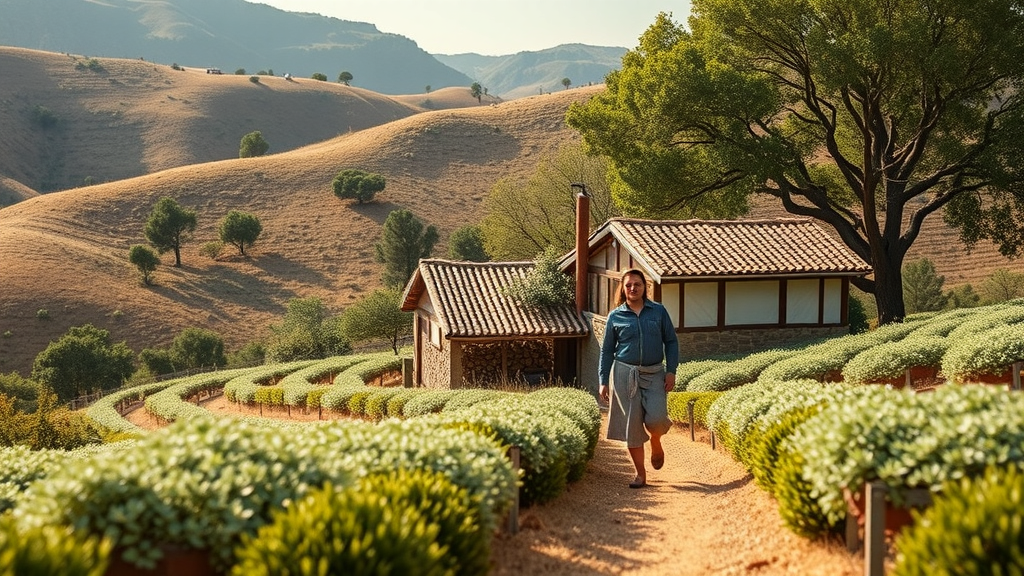
In a small mountain village in Andalusia, a family bar called Bar La Fuente opens every weekend to serve hikers, day-trippers, and lovers of rural Spain. Visitors come for the food, the square, and the sense of authenticity. What they do not see is the web of labour that makes the experience possible: the planning that begins days before a party of fourteen arrives, the shopping and cleaning that stretch into the night, the emotional vigilance that keeps family, neighbors, and customers in harmony. A new ethnographic study published in the International Journal of Anthropology and Ethnology argues that this invisible work, performed almost entirely by women, is not a footnote to rural tourism but its essential infrastructure.
Researchers Nuria Cordero-Ramos and Macarena Hernández-Ramírez of Pablo de Olavide University in Seville carried out fieldwork between October 2022 and November 2024 in a village they call Monte Verde, a pseudonym protecting the community’s identity. Women make up just over 55 percent of its population, and dense kinship networks centered on four or five families shape its social and economic life. The researchers combined participant observation, 37 recorded in-depth interviews averaging 90 minutes, informal conversations, two discussion groups, and two training workshops with local women. Data were analyzed using grounded theory alongside content analysis, with attention to preserving participants’ voices, expressions, and silences. All names of people and places were changed to guarantee confidentiality.
The central case is Bar La Fuente, run since 1988 by Juana and Pepe, both village natives whose three adult children still help on weekends. The researchers found that although the establishment is publicly known as “Pepe’s bar,” its daily operation depends overwhelmingly on the continuous, multifunctional labour of Juana, her daughters Marta and Clara, her daughter-in-law Janne, and two longtime kitchen employees. The discrepancy between public attribution and actual workload, the authors argue, reveals a gendered moral economy in which women’s contributions are naturalized as “help” or family duty rather than recognized as essential work deserving of rights, recognition, or redistribution.
The kitchen emerges as the study’s most revealing site. When Juana described her cooking to the researchers, she emphasized that everything came from the village itself—the potatoes, the ham, the oil—and that visitors told her the food “tastes like home.” Far from a purely culinary setting, the kitchen operates as a space where food preparation, emotion management, and the negotiation of scarcity converge to produce the atmosphere of closeness that tourists read as authentic rural hospitality. On a Monday morning after a busy weekend, Juana apologized for having only eggs and ham left, yet the gesture of giving what there was reaffirmed an ethic of care rooted in rural moral economies. Scarcity, the authors note, becomes an opportunity to reaffirm generosity and attentiveness, values central to the bar’s reputation.
The researchers describe this as anticipatory and emotional labour. When a table of fourteen booked, Juana began preparing on Thursday, sometimes earlier, “because she doesn’t want anyone to leave disappointment,” as her daughter Clara explained. Drawing on feminist theories of care, particularly Joan Tronto’s ethics of care and Hazel Tucker’s work on the emotional performance of hospitality, the authors show that affective availability—remembering customers’ preferences, adjusting cooking to village rhythms, projecting warmth under pressure—constitutes a core productive asset of the business. From the perspective of social reproduction theory associated with Silvia Federici and Tithi Bhattacharya, this largely unpaid and naturalized labour sustains not just one family bar but the entire tourism model on which the village depends.
Beyond the kitchen, the study documents what the authors call women’s invisible management. Juana described a rhythm with no rest: after serving, preparation for the next day begins immediately, encompassing shopping, cleaning, and organization. Clara, despite holding two other jobs and preparing for competitive exams, manages suppliers, inventories, and coordination, rising at six in the morning and not returning home until after dinner. Marta cancels plans with friends whenever the family needs her, framing the sacrifice as inevitable. The authors connect these patterns to research showing that family businesses rely on women’s unpaid or underpaid labour, producing poorly professionalized management models and heightened vulnerability. Even Janne, a northern European migrant originally hired for peak season, navigates a division of labour in which men gravitate toward financial tasks while women absorb the physical and emotional burden of service.
Crucially, the study does not portray these women as passive victims. Following anthropologists Laura Ahearn and Saba Mahmood, the authors analyze their actions as situated agency—a capacity to act that emerges within, rather than outside of, gendered obligations. Juana’s coordination of household, business, and community, Clara’s logistical command of the supply chain, and even Janne’s humorous direction of her father-in-law all demonstrate judgment, creativity, and decision-making. Yet this agency operates within constraints that limit recognition and authority. The women’s pluriactivity—juggling bar work, domestic duties, emotional mediation, and external employment—intensifies workloads without translating into greater decision-making power, echoing the capability approach of Martha Nussbaum, which asks what people are genuinely able to be and do.
The women’s work also extends into the village square, where emotional availability becomes community care. Juana regularly steps outside during peak hours to check on elderly neighbors, exchange news, or offer help, sustaining a social fabric that tourists interpret as authentic village life. The authors argue that this authenticity is not spontaneous but the product of sustained affective labour, consistent with research showing that community cohesion in post-crisis rural Spain increasingly depends on invisible relational work carried disproportionately by women. Clara’s frustration during a busy weekend captures the tension: the village insists the bar cannot close, tourists expect attention, and the women feel they must be available all the time. The study interprets this as affective overexposure—community expectations and tourism demands intersecting to produce a form of labour that is rarely acknowledged as work at all.
Perhaps most consequential are the generational tensions the study documents. Younger women value the bar as a space of sociability and identity but recognize the personal costs of a model demanding total availability. Clara, who studies so she does not “end up like my mother, always tired, always here,” embodies a refusal to reproduce a limiting model, while her sister’s observation that the village and tourists both expect unlimited service reveals the daily dilemma between continuity and exhaustion. The authors interpret these choices, informed by Rita Segato’s analysis of gendered mandates, as forms of situated resistance: not abrupt rupture but gradual reconfiguration through education, mobility, and reduced involvement. Importantly, tourism strengthens the family economy while simultaneously intensifying workloads and constraining younger women’s ability to integrate the business into their own life projects.
The study’s implications reach beyond one mountain bar. The authors call for rural development and tourism policies that recognize the unequally distributed role of care work, support family businesses through training, professionalization, and work–life balance measures, and design generational renewal strategies that incorporate the aspirations of young women. They caution against approaches that portray women’s entrepreneurship as an automatic pathway to empowerment, revealing instead the structural inequalities on which many family-based tourism enterprises depend. While the analysis rests on a single case at a particular moment, the authors argue that its value lies in illuminating social mechanisms—kinship, care, hospitality, and gender—that operate across contemporary rural tourism. In Monte Verde, as the study’s subtitle suggests, the most important work is the work you cannot see.
Subject of Research: Invisible women's care and emotional labour sustaining family-run rural tourism businesses in Andalusia, Spain
Article Title: Women's work and caregiving in rural tourism in Andalusia (Spain): “You can’t see it, but it’s just as important”
Article References: Women's work and caregiving in rural tourism in Andalusia (Spain): “You can’t see it, but it’s just as important”. (n.d.). https://doi.org/10.1186/s41257-026-00163-z
Image Credits: AI Generated
DOI: 10.1186/s41257-026-00163-z
Keywords: rural tourism, women's labour, care work, emotional labour, social reproduction, ethnography, Andalusia, family business, gender inequality, generational renewal, hospitality, moral economy
Cite Scienmag News
Courtney Benton. (September 20, 2026). The Invisible Care Work That Keeps Rural Tourism Alive in Spain. Scienmag. https://scienmag.com/the-invisible-care-work-that-keeps-rural-tourism-alive-in-spain/
Courtney Benton. "The Invisible Care Work That Keeps Rural Tourism Alive in Spain." Scienmag, 20 September 2026, https://scienmag.com/the-invisible-care-work-that-keeps-rural-tourism-alive-in-spain/. Accessed 5 October 2026.
Courtney Benton. "The Invisible Care Work That Keeps Rural Tourism Alive in Spain." Scienmag. September 20, 2026. https://scienmag.com/the-invisible-care-work-that-keeps-rural-tourism-alive-in-spain/


