


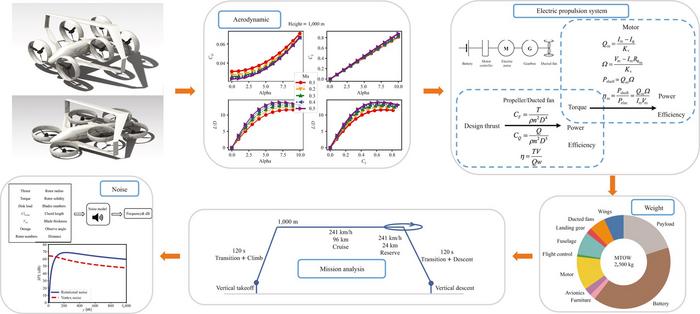

Credit: GREEN ENERGY AND INTELLIGENT TRANSPORTATION
eVTOL technology, which enables aircrafts to ascend, hover, and land vertically, has become a focus for both academic research and commercial ventures due to its numerous advantages over traditional aviation. It promises to alleviate ground traffic congestion, reduce travel times, and lower the carbon footprint of air travel by leveraging electric propulsion.
The drive behind this cutting-edge technology stems from various factors. Global urbanization is pushing the limits of conventional transport infrastructure. There is a growing need for more efficient transport solutions that can seamlessly integrate into existing cityscapes without the extensive footprint required by traditional airports and helipads.
However, the road to integrating eVTOLs into mainstream transportation networks is fraught with challenges. The primary concern is safety. Autonomous eVTOLs must demonstrate fail-safe operation under diverse conditions to gain regulatory and public approval. Current eVTOL designs incorporate sophisticated automated flight control systems that rely on a myriad of sensors and algorithms to navigate safely in urban environments. These systems handle everything from navigation to obstacle avoidance and emergency landings, ensuring high reliability and safety standards.
Regulatory hurdles also represent a significant challenge. As of now, there is no comprehensive regulatory framework specifically tailored for eVTOL operations. Traditional aviation regulations cannot be directly applied to eVTOLs due to their unique operational characteristics and technological underpinnings. Authorities like the Federal Aviation Administration (FAA) and the European Union Aviation Safety Agency (EASA) are actively working to establish guidelines that address the specific needs of eVTOL operations, including pilot training, vehicle certification, and air traffic management.
Another crucial aspect is public acceptance. For eVTOL technology to be viable, it must be embraced by the community. Concerns over noise, safety, and privacy issues need to be addressed comprehensively. Manufacturers and policymakers must engage with the public to educate and reassure them about the benefits and safety features of eVTOLs.
Despite these challenges, the potential benefits of eVTOLs are undeniable. They offer a way to bypass dense ground traffic, significantly reducing travel time between locations. This efficiency is not just about speed but also about the environmental impact. eVTOLs operate on electric power, which can be sourced from renewable energies, thereby reducing the ecological footprint of air travel.
As the technology progresses, future trends suggest that eVTOLs will become increasingly integrated with smart city infrastructure and air traffic systems. This integration will involve advanced communication networks that allow for real-time traffic management and route optimization based on various environmental and operational factors.
In conclusion, while autonomous eVTOLs are still in the developmental stages, their potential to redefine urban mobility is undeniable. With continued advancements in safety, regulatory frameworks, and public engagement, eVTOLs are set to redefine urban mobility, making air travel a commonplace option for daily commuting and cargo transport. This future, where the sky is no longer a frontier but a pathway, is on the horizon, promising a new dimension of connectivity in our increasingly urbanized world.
###
Reference
Author: Jiechao Zhang, Yaolong Liu, Yao Zheng
Affiliations:School of Aeronautics and Astronautics, Zhejiang University, Hangzhou 310027, China
Title of original paper: The Future Takes Flight: Autonomous eVTOLs Transforming Air Mobility
Article link:
Journal: Green Energy and Intelligent Transportation
Journal
Green Energy and Intelligent Transportation
Cite Scienmag News
Denise Maddox. (June 24, 2024). The future takes flight: Autonomous eVTOLs transforming air mobility. Scienmag. https://scienmag.com/the-future-takes-flight-autonomous-evtols-transforming-air-mobility/
Denise Maddox. "The future takes flight: Autonomous eVTOLs transforming air mobility." Scienmag, 24 June 2024, https://scienmag.com/the-future-takes-flight-autonomous-evtols-transforming-air-mobility/. Accessed 4 September 2026.
Denise Maddox. "The future takes flight: Autonomous eVTOLs transforming air mobility." Scienmag. June 24, 2024. https://scienmag.com/the-future-takes-flight-autonomous-evtols-transforming-air-mobility/

