


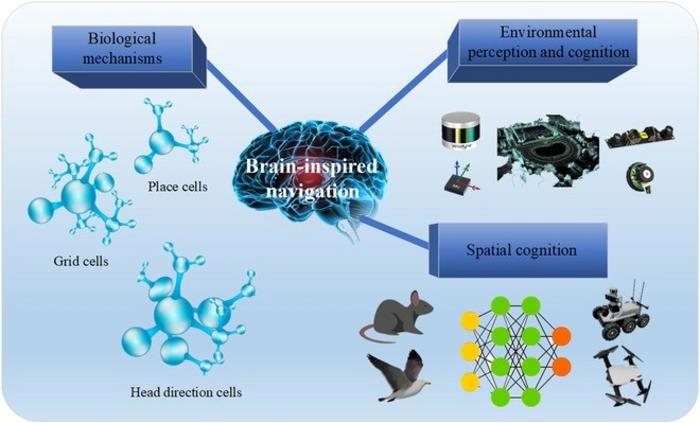
In the ever-evolving field of robotics, a groundbreaking approach has emerged, revolutionizing how robots perceive, navigate, and interact with their environments. This new frontier, known as brain-inspired navigation technology, integrates insights from neuroscience into robotics, offering enhanced capabilities and efficiency.

Credit: Yanan Bai, School of Computer Science and Engineering, Northeastern University
In the ever-evolving field of robotics, a groundbreaking approach has emerged, revolutionizing how robots perceive, navigate, and interact with their environments. This new frontier, known as brain-inspired navigation technology, integrates insights from neuroscience into robotics, offering enhanced capabilities and efficiency.
Brain-inspired navigation technologies are not just a mere improvement over traditional methods; they represent a paradigm shift. By mimicking the neural mechanisms of animals, these technologies provide robots with the ability to navigate through complex and unknown terrains with unprecedented accuracy and adaptability.
At the heart of this technology lies the concept of spatial cognition, which is central to how animals, including humans, navigate their environments. Spatial cognition involves the brain’s ability to organize and interpret spatial data for navigation and memory. Robots equipped with brain-inspired navigation systems utilize a multi-layered network model that integrates sensory data from multiple sources. This model allows the robot to create a ‘cognitive map’ of its surroundings, much like the neural maps created by the hippocampus in the human brain.
One of the significant advantages of brain-inspired navigation is its robustness in challenging environments. Traditional navigation systems often struggle with dynamic and unpredictable settings, where the reliance on pre-mapped routes and landmarks can lead to failures. In contrast, brain-inspired systems continuously learn and adapt, improving their navigational strategies over time. This capability is particularly beneficial in environments like disaster zones or extraterrestrial surfaces, where prior mapping is either impossible or impractical.
Moreover, these systems significantly reduce energy consumption and computational needs. By focusing only on essential data and employing efficient neural network models, robots can operate longer and perform more complex tasks without the need for frequent recharging or maintenance.
The technology’s applications are vast and varied. For instance, autonomous vehicles equipped with brain-inspired systems could navigate more safely and efficiently, reacting in real-time to sudden changes in traffic conditions or road layouts. Similarly, drones used for delivery services could plan their routes more effectively, avoiding obstacles and optimizing delivery times.
Despite its promising potential, the development of brain-inspired navigation technology faces several challenges. Integrating biological principles into mechanical systems is inherently complex, requiring multidisciplinary efforts from fields such as neuroscience, cognitive science, robotics, and artificial intelligence. Moreover, these systems must be scalable and versatile enough to be customized for different types of robotic platforms and applications.
As researchers continue to unravel the mysteries of the brain’s navigational capabilities, the future of robotics looks increasingly intertwined with the principles of neuroscience. The collaboration across disciplines promises not only to advance our understanding of the brain but also to pave the way for a new generation of intelligent robots. These robots will not only assist in mundane tasks but also perform critical roles in search and rescue operations, planetary exploration, and much more.
In conclusion, brain-inspired navigation technology represents a significant leap forward in robotics, merging the abstract with the applied, the biological with the mechanical, and the theoretical with the practical. As this technology continues to evolve, it will undoubtedly open new horizons for robotic applications, making machines an even more integral part of our daily lives and work.
The paper, “A Review of Brain-Inspired Cognition and Navigation Technology for Mobile Robots,” was published in the journal Cyborg and Bionic Systems on Jun 27, 2024, at DOI:
Journal
Cyborg and Bionic Systems
Cite Scienmag News
Denise Maddox. (August 22, 2024). The future of robotics: Brain-inspired technologies paving the way. Scienmag. https://scienmag.com/the-future-of-robotics-brain-inspired-technologies-paving-the-way/
Denise Maddox. "The future of robotics: Brain-inspired technologies paving the way." Scienmag, 22 August 2024, https://scienmag.com/the-future-of-robotics-brain-inspired-technologies-paving-the-way/. Accessed 4 September 2026.
Denise Maddox. "The future of robotics: Brain-inspired technologies paving the way." Scienmag. August 22, 2024. https://scienmag.com/the-future-of-robotics-brain-inspired-technologies-paving-the-way/

