


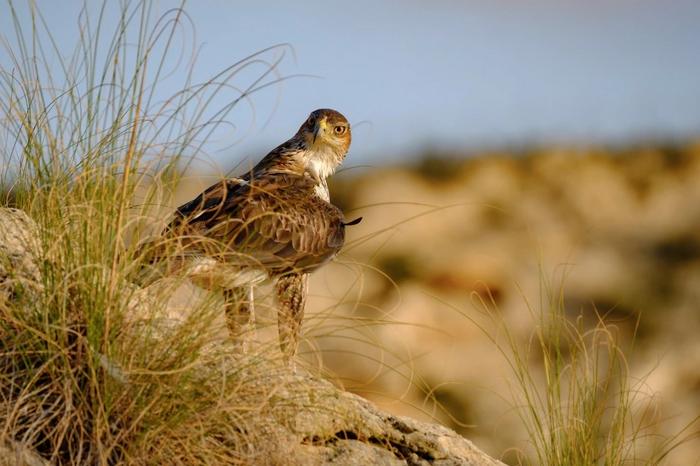
Spanish and Portuguese scientists have unraveled the ancestral history of one of the most iconic birds of prey in the current Iberian fauna, the Bonelli’s eagle (Aquila fasciata). The work, published in the scientific journal People and Nature, integrates evidence from various disciplines, such as paleontology, genetics, and ecology, to answer questions about when and why the Bonelli’s eagle, a species primarily found in tropical and subtropical regions, colonized the Mediterranean basin. The study is led by the University of Granada with participation from researchers in the Ecology area of the Miguel Hernández University of Elche (UMH).

Credit: Tony Peral.
Spanish and Portuguese scientists have unraveled the ancestral history of one of the most iconic birds of prey in the current Iberian fauna, the Bonelli’s eagle (Aquila fasciata). The work, published in the scientific journal People and Nature, integrates evidence from various disciplines, such as paleontology, genetics, and ecology, to answer questions about when and why the Bonelli’s eagle, a species primarily found in tropical and subtropical regions, colonized the Mediterranean basin. The study is led by the University of Granada with participation from researchers in the Ecology area of the Miguel Hernández University of Elche (UMH).
As Professor Marcos Moleón Paiz, from the Department of Zoology at UGR and the article’s lead author, explains, “The Bonelli’s eagle is a ‘newcomer’ to Europe. This species probably began establishing itself in the Mediterranean basin around 50,000 years ago. In contrast, others, like the golden eagle (A. chrysaetos), have been present here much longer, as fossil records attest.”
Spatial analyses conducted in the study show that Bonelli’s eagle is significantly disadvantaged during cold climatic periods, unlike the golden eagle. “During the last glacial period, the Bonelli’s eagle could only find refuge in warm coastal areas, precisely where its oldest fossils have been found.” Eva Graciá, a professor of Ecology at UMH, notes that “genetic analyses confirmed that around the last glacial maximum, the Mediterranean population of Bonelli’s eagles must have been formed by few individuals.” This ancestral population thrived as the temperature in the Mediterranean basin rose, and the human population grew and became sedentary.
Once the ‘when’ was resolved, the team sought to understand why Bonelli’s eagle began to establish itself in the Mediterranean during such a climatically challenging period and why it settled there during the last glacial cycle and not before.
The Role of Our Ancestors
According to Moleón, “After testing several alternative hypotheses, all pieces of the puzzle indicated that the early European settlers of our species (Homo sapiens) played a fundamental role.”
This study collected and analyzed the most comprehensive information on the competitive interactions between Bonelli’s eagles and golden eagles today. This allowed them to confirm that in this relationship, the golden eagle is the ‘dominant’ species and the Bonelli’s eagle the ‘subordinate’ species. The results showed that Bonelli’s eagles can only survive where golden eagles are scarce, mainly in highly humanized areas.
“Our mathematical models indicated that if we were able to eliminate all golden eagle pairs in climatically favorable areas, we would expect a strong increase in the number of Bonelli’s eagle pairs, but not vice versa,” the researchers explain. The study also states that golden eagles can kill Bonelli’s eagles and usurp their territories, which does not happen the other way around.
It is noteworthy that golden eagles are less tolerant of humans than Bonelli’s eagles. The authors hypothesize that with the arrival of the first anatomically modern humans in Europe, some of the golden eagle territories closest to human settlements were abandoned, and these ‘vacant’ territories began to be occupied by Bonelli’s eagles from the Middle East. In short, Bonelli’s eagles could not have established themselves in the Mediterranean before the arrival of the first Homo sapiens because the competitive pressure exerted by golden eagles and other species would have been too overwhelming.
Living Near or Far from Humans?
The researchers point out that humans can modify species distributions is nothing new. The novelty of this study lies in revealing a mechanism called ‘human-mediated competitive release’ by which our species, including our ancestors, could indirectly modify the distribution of other species, including long-lived ones. However, the advantage that living near humans once provided for the Bonelli’s eagle has turned against it today. “Ironically, the future of the Bonelli’s eagle in the Mediterranean is currently threatened by the relentless intensification of human activities in the environment, leading to mortality from power lines, prey scarcity, and disturbances in nesting areas, among other threats,” the authors conclude. “The conservation of threatened species like large eagles will undoubtedly benefit from knowledge derived from large-scale spatial and temporal ecological processes,” notes UMH Professor Toni Sánchez Zapata.
Journal
People and Nature
Method of Research
Computational simulation/modeling
Subject of Research
Animal tissue samples
Article Title
Wildlife following people: A multidisciplinary assessment of the ancient colonization of the Mediterranean Basin by a long-lived raptor
Article Publication Date
14-May-2024
Cite Scienmag News
Drew Townsend. (May 21, 2024). The first homo sapiens facilitated the establishment of the Bonelli’s eagle in the Mediterranean 50,000 years ago. Scienmag. https://scienmag.com/the-first-homo-sapiens-facilitated-the-establishment-of-the-bonellis-eagle-in-the-mediterranean-50000-years-ago/
Drew Townsend. "The first homo sapiens facilitated the establishment of the Bonelli’s eagle in the Mediterranean 50,000 years ago." Scienmag, 21 May 2024, https://scienmag.com/the-first-homo-sapiens-facilitated-the-establishment-of-the-bonellis-eagle-in-the-mediterranean-50000-years-ago/. Accessed 4 September 2026.
Drew Townsend. "The first homo sapiens facilitated the establishment of the Bonelli’s eagle in the Mediterranean 50,000 years ago." Scienmag. May 21, 2024. https://scienmag.com/the-first-homo-sapiens-facilitated-the-establishment-of-the-bonellis-eagle-in-the-mediterranean-50000-years-ago/

