


Understanding the spatiotemporal organization of the genome in the nucleus is crucial for advancing our knowledge of chromatin structure and its functional dynamics in both normal and diseased states. Chromatin organization plays a key role in gene expression, replication, and repair. Traditional methods like fluorescence in situ hybridization (FISH) have been the gold standard for visualizing specific genomic loci in fixed cells. However, FISH is limited by its complex, time-consuming protocols, and its inability to visualize chromatin dynamics in living cells.

Credit: Geik Yong Ang, Choo Yee Yu
Understanding the spatiotemporal organization of the genome in the nucleus is crucial for advancing our knowledge of chromatin structure and its functional dynamics in both normal and diseased states. Chromatin organization plays a key role in gene expression, replication, and repair. Traditional methods like fluorescence in situ hybridization (FISH) have been the gold standard for visualizing specific genomic loci in fixed cells. However, FISH is limited by its complex, time-consuming protocols, and its inability to visualize chromatin dynamics in living cells.
The advent of CRISPR/Cas9 technology has provided a new approach for genome visualization. Originally discovered as a bacterial adaptive immune system, the CRISPR/Cas9 system has been repurposed for various applications, including genome editing, transcriptional regulation, and now, live-cell imaging. This review explores how CRISPR/Cas9 has been adapted for imaging purposes and the advancements that have been made in this field.
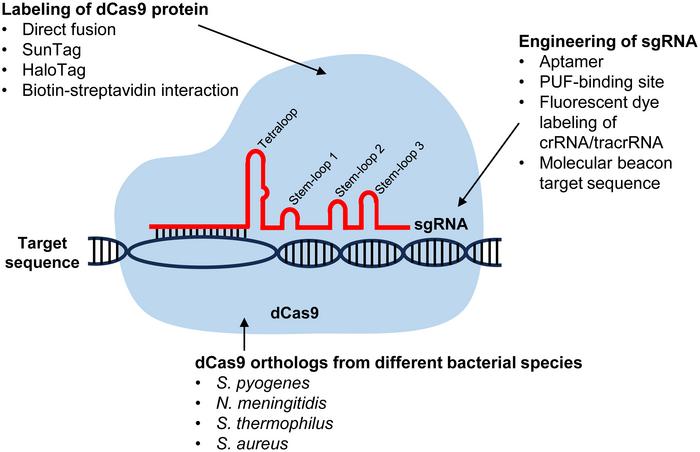
The CRISPR/Cas9 system consists of the Cas9 endonuclease and a single-guide RNA (sgRNA). The sgRNA is designed to match the sequence of a specific genomic locus, directing the Cas9 protein to this site. For imaging applications, modifications have been made to the CRISPR/Cas9 system to eliminate its DNA cleavage activity while retaining its ability to target specific genomic sequences.
Various strategies have been developed to enhance the imaging capabilities of CRISPR/Cas9. One approach involves fusing fluorescent proteins to deactivated Cas9 (dCas9), allowing for the visualization of genomic loci in living cells. Another strategy, CRISPR-Sirius, employs RNA scaffolds to recruit multiple fluorescent proteins, amplifying the signal and improving imaging resolution. These methodologies enable the real-time observation of chromatin dynamics and provide insights into the spatial organization of the genome.
Recent advancements have expanded the applications of the CRISPR/Cas9 system to live cell imaging, providing a robust tool for visualizing genomic loci in their native cellular context. Techniques such as CRISPRainbow allow for the labeling of multiple genomic loci with different fluorescent proteins, enabling the study of chromatin interactions and dynamics in living cells. These innovations have facilitated the study of chromatin dynamics and genome organization in real time, offering new insights into cellular processes and disease mechanisms.
For instance, CRISPR-based imaging has been used to study the movement and interactions of chromatin domains during the cell cycle, revealing dynamic changes that are crucial for understanding gene regulation and genome stability. Additionally, these techniques have been applied to investigate the spatial organization of chromatin in different cell types and under various conditions, providing a deeper understanding of the mechanisms underlying genome function and organization.
The integration of CRISPR/Cas9 technology into live cell imaging represents a significant leap forward in genomic research. By overcoming the limitations of traditional FISH methods, CRISPR-based imaging allows for the observation of genomic loci within living cells, providing a dynamic view of chromatin interactions and nuclear architecture. This real-time observation capability is particularly valuable for studying processes such as transcription, replication, and DNA repair, which are inherently dynamic and occur within the context of a living cell.
The ability to track these processes in real time opens new avenues for understanding the molecular basis of gene regulation, development, and disease. For example, CRISPR-based imaging has the potential to elucidate how chromatin organization changes during cell differentiation or in response to environmental stimuli. Moreover, it can reveal the alterations in chromatin structure associated with various diseases, such as cancer, providing new targets for therapeutic intervention.
The CRISPR/Cas9 system has revolutionized the field of genome imaging, enabling precise and dynamic visualization of genomic loci in both fixed and live cells. Its programmability and versatility make it a powerful tool for studying the spatiotemporal organization of the genome, offering unprecedented insights into chromatin structure and function. As the technology continues to evolve, it holds great promise for advancing our understanding of cellular processes and improving diagnostic and therapeutic strategies.
Future research will likely focus on further improving the resolution and sensitivity of CRISPR-based imaging techniques, as well as expanding their applications to study a wider range of genomic features and cellular processes. The continued development of these technologies will provide deeper insights into the complex relationship between genome organization and function, ultimately leading to new discoveries and innovations in biomedical research.
Full text
The study was recently published in the Gene Expression.
Gene Expression (GE) is an open-access journal. It was launched in 1991 by Chicago Medical School Press, and transferred to Cognizant Communication Corporation in 1994. From August 2022, GE is published by Xia & He Publishing Inc.
GE publishes peer-reviewed and high-quality original articles, reviews, editorials, commentaries, and opinions on its primary research topics including cell biology, molecular biology, genes, and genetics, especially on the cellular and molecular mechanisms of human diseases.
GE has been indexed in Medline (1991-2021), Scopus, Biological Abstracts, Biosis Previews, ProQuest, etc.
Follow us on X: @xiahepublishing
Follow us on LinkedIn: Xia & He Publishing Inc.
Journal
Gene Expression
Article Title
The Current Landscape of CRISPR-Cas9-based Technologies for Imaging of Genomic Loci in Fixed and Live Cells
Article Publication Date
21-May-2024
Cite Scienmag News
Juliet Wilcox. (August 9, 2024). The current landscape of CRISPR-Cas9-based technologies for imaging of genomic loci in fixed and live cells. Scienmag. https://scienmag.com/the-current-landscape-of-crispr-cas9-based-technologies-for-imaging-of-genomic-loci-in-fixed-and-live-cells/
Juliet Wilcox. "The current landscape of CRISPR-Cas9-based technologies for imaging of genomic loci in fixed and live cells." Scienmag, 9 August 2024, https://scienmag.com/the-current-landscape-of-crispr-cas9-based-technologies-for-imaging-of-genomic-loci-in-fixed-and-live-cells/. Accessed 5 September 2026.
Juliet Wilcox. "The current landscape of CRISPR-Cas9-based technologies for imaging of genomic loci in fixed and live cells." Scienmag. August 9, 2024. https://scienmag.com/the-current-landscape-of-crispr-cas9-based-technologies-for-imaging-of-genomic-loci-in-fixed-and-live-cells/

