


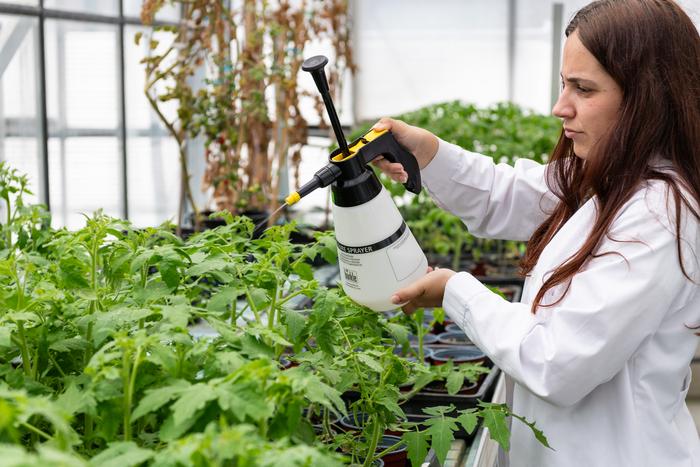
In a recent study published on the cover of the Plant Physiology journal, the IBMCP team has identified a new volatile compound – alpha-terpineol- that effectively protects plants from Pseudomonas syringae. This pathogenic bacterium causes severe damage to various crops. This finding could improve crop protection treatments by providing natural and highly effective plant protection.

Credit: UPV
In a recent study published on the cover of the Plant Physiology journal, the IBMCP team has identified a new volatile compound – alpha-terpineol- that effectively protects plants from Pseudomonas syringae. This pathogenic bacterium causes severe damage to various crops. This finding could improve crop protection treatments by providing natural and highly effective plant protection.
Julia Pérez-Pérez, a PhD student at the UPV and co-author of the study, explains that, as in human interaction, plants have their own way of communication and defence. “They emit volatile compounds to alert their neighbours to danger and use their sense of smell to perceive the message”.
To illustrate, Pérez-Pérez adds: Imagine a field of tomatoes where the bacteria penetrate the leaves of a plant through the stomata. As it spreads, the plant defends itself from attack by releasing volatiles such as terpene. Other parts of the plant itself and neighbouring plants ‘smell’ this chemical message and quickly close their stomata, preventing the entry of the pathogen and thus protecting the crop.
The same IBMCP team has already patented and licensed another volatile compound, HB, which also protects plants, with the company Meristem. Now, with the discovery of terpineol, they have a new method to strengthen the resistance of the crops. “Both compounds are part of what we call the aroma of resistance, which symbolises the smell of survival for tomato plants,” Pérez-Pérez adds.
It is a very simple, cheap and environmentally friendly application.
According to the IBMCP team, applying terpineol and HB would be very straighforwardand versatile: they can be sprayed directly on the plants or applied by diffuser devices. In fact, through a project conducted in collaboration with the company Meristem and with CDTI funding, they are exploring possible synergies between these and other volatile compounds to activate the defensive response of plants efficiently and very cheaply.
“The use of these compounds offers the agricultural sector a new economic, fast and highly effective alternative to improve the yield of such an important crop as tomato,” adds Purificación Lisón, IBMCP researcher and lecturer in the Biotechnology Department of the School of Agricultural Engineering and Environment (ETSIAMN) and co-author of the study.
In addition, applying these compounds in agricultural treatments would also reduce the use of chemical compounds. “This is not only beneficial for the environment but also promotes more sustainable agriculture,” adds Mª Pilar López Gresa, an IBMCP researcher and senior lecturer at ETSIAMN.
And also, against the drought
According to the researchers, this natural strategy could serve as a protective barrier against bacteria and other infections and even protect plants from the effects of drought.
This IBMCP discovery represents a significant breakthrough in crop protection, offering a natural, effective and environmentally friendly solution to today’s agricultural challenges,” conclude the IBMCP researchers.
Journal
PLANT PHYSIOLOGY
Method of Research
Experimental study
Article Title
Metabolic crosstalk between hydroxylated monoterpenes and salicylic acid in tomato defense response against bacteria
Article Publication Date
1-Jul-2024
Cite Scienmag News
Alan Morgan. (July 24, 2024). The aroma of tomato resistance. Scienmag. https://scienmag.com/the-aroma-of-tomato-resistance/
Alan Morgan. "The aroma of tomato resistance." Scienmag, 24 July 2024, https://scienmag.com/the-aroma-of-tomato-resistance/. Accessed 4 September 2026.
Alan Morgan. "The aroma of tomato resistance." Scienmag. July 24, 2024. https://scienmag.com/the-aroma-of-tomato-resistance/

