


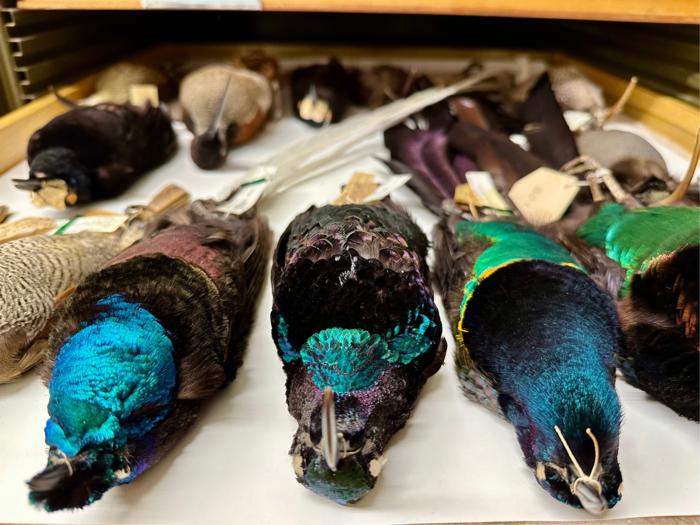
The color palette of the birds you see out your window depend on where you live. If you’re far from the Equator, most birds tend to have drab colors, but the closer you are to the tropics, you’ll probably see more and more colorful feathers. Scientists have long been puzzled about why there are more brilliantly-colored birds in the tropics than in other places, and they’ve also wondered how those brightly-colored birds got there in the first place: that is, if those colorful feathers evolved in the tropics, or if tropical birds have colorful ancestors that came to the region from somewhere else. In a new study published in the journal Nature Ecology and Evolution, scientists built a database of 9,409 birds to explore the spread of color across the globe. They found that iridescent, colorful feathers originated 415 times across the bird tree of life, and in most cases, arose outside of the tropics– and that the ancestor of all modern birds likely had iridescent feathers, too.

Credit: Kate Golembiewski, Field Museum
The color palette of the birds you see out your window depend on where you live. If you’re far from the Equator, most birds tend to have drab colors, but the closer you are to the tropics, you’ll probably see more and more colorful feathers. Scientists have long been puzzled about why there are more brilliantly-colored birds in the tropics than in other places, and they’ve also wondered how those brightly-colored birds got there in the first place: that is, if those colorful feathers evolved in the tropics, or if tropical birds have colorful ancestors that came to the region from somewhere else. In a new study published in the journal Nature Ecology and Evolution, scientists built a database of 9,409 birds to explore the spread of color across the globe. They found that iridescent, colorful feathers originated 415 times across the bird tree of life, and in most cases, arose outside of the tropics– and that the ancestor of all modern birds likely had iridescent feathers, too.
“For decades, scientists have had this hypothesis that there are brighter or more colorful species of birds in the tropics,” says Chad Eliason, a research scientist at the Field Museum in Chicago and the paper’s lead author. “We wanted to find the mechanism to help us understand these trends– how these bright colors got there and how they spread across the bird family tree over time.”
There are two main ways that color is produced in animals: pigments and structures. Cells produce pigments like melanin, which is responsible for black and brown coloration. Meanwhile, structural color comes from the way light bounces off different arrangements of cell structures. Iridescence, the rainbow shimmer that changes depending how light hits an object, is an example of structural color.
Tropical birds get their colors from a combination of brilliant pigments and structural color. Eliason’s work focuses on structural color, so he wanted to explore that element of tropical bird coloration. He and his colleagues combed through photographs, videos, and even scientific illustrations of 9,409 species of birds– the vast majority of the 10,000-ish living bird species known to science. The researchers kept track of which species have iridescent feathers, and where those birds are found.
The scientists then combined their data on bird coloration and distribution with a pre-existing family tree, based on DNA, showing how all the known bird species are related to each other. They fed the information to a modeling system to extrapolate the origins and spread of iridescence. “Basically, we did a lot of math,” says Eliason.
Given how modern species are related to each other and where they’re found, and overall patterns of how species form and how traits like colors change over time, the modeling software determined the most likely explanation for the bird colors we see today: colorful birds from outside the tropics often came to the region millions of years ago, and then branched out into more and more different species. The model also revealed a surprise about the ancestor of all modern birds.
For background, birds are a specialized group of dinosaurs– the earliest known bird, Archaeopteryx, lived 140 million years ago. A sub-group of birds called Neornithes evolved 80 million years ago, and this group became the only birds (and dinosaurs) to survive the mass extinction 66 million years ago. All modern birds are members of Neornithes. The model produced by Eliason and his colleagues suggests that the common ancestor of all Neornithes, 80 million years ago, had iridescent feathers that still glitter across the bird family tree.
“I was very excited to learn that the ancestral state of all birds is iridescence,” says Eliason. “We’ve found fossil evidence of iridescent birds and other feathered dinosaurs before, by examining fossil feathers and the preserved pigment-producing structures in those feathers. So we know that iridescent feathers existed back in the Cretaceous– those fossils help support the idea from our model that the ancestor of all modern birds was iridescent too.”
The discovery that the first Neornithes was likely iridescent could have important implications for paleontology. ”We’re probably going to be finding a lot more iridescence in the fossil record now that we know to look,” says Eliason.
While this new study sheds light on how iridescence spread through the bird family tree over the course of millions of years, some big questions remain. “We still don’t know why iridescence evolved in the first place,” says Eliason. “Iridescent feathers can be used by birds to attract mates, but iridescence is related to other aspects of birds’ lives too. For instance, tree swallows change color when the humidity changes, so iridescence could be related to the environment, or it might be related to another physical property of feathers, like water resistance. But knowing more about how there came to be so many iridescent birds in the tropics might help us understand why iridescence evolved.”
This study was contributed to by Chad M. Eliason of the Field Museum’s Grainger Bioinformatics Center and Negaunee Integrative Research Center, Michaël P.J. Nicolaï of Ghent University and the Royal Belgian Institute of Natural Sciences, Cynthia Bom of Vrije Universiteit Amsterdam, Eline Blom of Naturalis Biodiversity Center, Liliana D’Alba of Ghent University and Naturalis Biodiversity Center, and Matthew D. Shawkey of Ghent University.
###
Journal
Nature Ecology & Evolution
Article Title
Why are there so many structurally coloured bird species in the tropics?
Article Publication Date
26-Jul-2024
Cite Scienmag News
Drew Townsend. (July 26, 2024). The ancestor of all modern birds probably had iridescent feathers. Scienmag. https://scienmag.com/the-ancestor-of-all-modern-birds-probably-had-iridescent-feathers/
Drew Townsend. "The ancestor of all modern birds probably had iridescent feathers." Scienmag, 26 July 2024, https://scienmag.com/the-ancestor-of-all-modern-birds-probably-had-iridescent-feathers/. Accessed 4 September 2026.
Drew Townsend. "The ancestor of all modern birds probably had iridescent feathers." Scienmag. July 26, 2024. https://scienmag.com/the-ancestor-of-all-modern-birds-probably-had-iridescent-feathers/

