


On the Tibetan Plateau, two powerful forces are reshaping the landscape at the same time. Warming temperatures and rising carbon dioxide have driven a widespread greening of grasslands, which should, according to classical soil erosion theory, anchor the soil with stronger roots and reduce the amount of sediment washing into rivers. Yet measurements from gauging stations tell a different story: suspended sediment loads in most plateau basins have been climbing by roughly 10 to 20 percent per decade since around 2000. A new study published in Communications Earth & Environment offers a quantitative explanation for this puzzling decoupling, and the answer lies in one of the most dramatic forms of abrupt permafrost thaw on Earth.
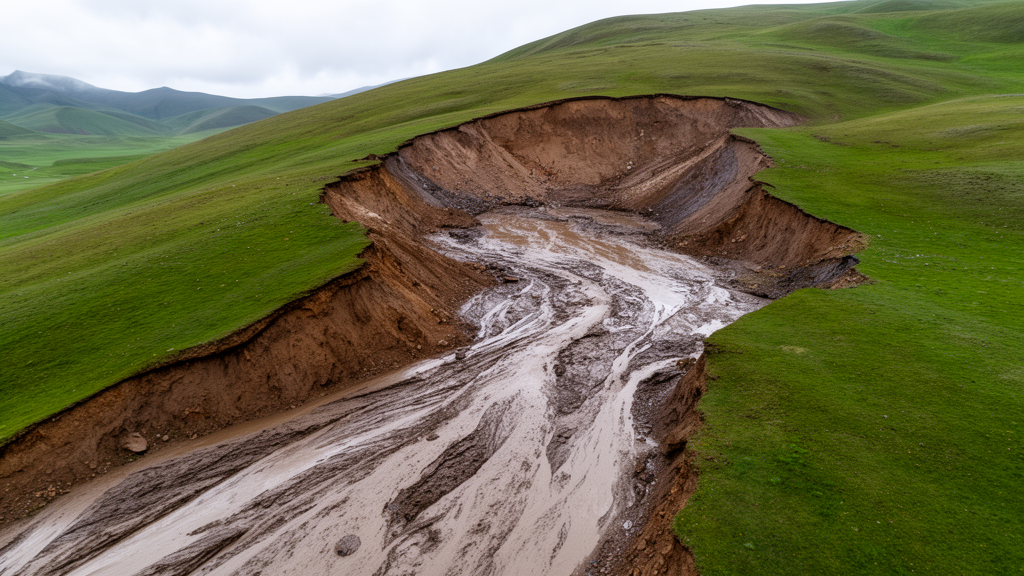
The research, led by Jiapei Ma of the Institute of Mountain Hazards and Environment together with colleagues at Sichuan University and Chang’an University, focuses on retrogressive thaw slumps, or RTSs. These are steep, actively retreating scars that form when ice-rich permafrost exposed on a hillslope begins to melt. As the exposed ground ice ablates, the thawed, unconsolidated sediment loses cohesion, slumps downward, and keeps exposing fresh ice in the headwall, sustaining a self-reinforcing cycle of erosion that can persist for decades. By 2022, the team had identified more than 3,200 of these slumps across the plateau, covering roughly 6,500 hectares, with about 72 percent of them concentrated in the Source Region of the Yangtze River.
The scale of sediment production from these features is extraordinary. In the Yangtze source region, the long-term average erosion rate on undisturbed hillslopes is about 2.1 tonnes per hectare per year from water and 67.4 tonnes per hectare per year from wind. By contrast, the mean erosion rate inside active thaw slumps reaches 1,293 tonnes per hectare per year, with some individual slumps exceeding 4,000 tonnes per hectare per year. That places slump erosion roughly two orders of magnitude above background wind erosion and three orders of magnitude above background water erosion. Even on the Inner Plateau, where slumps erode more slowly at around 436 tonnes per hectare per year, they still dwarf every other erosive process in the landscape.
Producing sediment, however, is only half the story. For slump-derived material to influence downstream rivers, it must actually reach the channel network. To test this, the researchers used high-resolution topographic differencing, comparing digital elevation models captured before and after disturbance at a representative slump cluster at Mati Hill. The differencing revealed widespread surface subsidence of up to four meters across the scar zones, with deposition largely confined to debris tongues at the slump toes. Calculating the fraction of eroded volume not retained within the slump, the team found that more than 60 percent of the material was delivered to nearby channels, either through direct connection or via evacuation channels carved by meltwater. Notably, this delivery efficiency showed no clear decline with slump age, indicating that active slumps keep exporting sediment year after year rather than stabilizing like ordinary landslides.
The downstream river network carries distinct fingerprints of this supply. At the Tuotuohe station, close to the densest slump clusters, the relationship between river discharge and suspended sediment concentration shifted abruptly around 2000. After that date, counter-clockwise hysteresis events, in which sediment concentrations remain high on the falling limb of a flood after peak discharge has passed, became far more frequent, rising from 6.3 percent of events before 2000 to 19.7 percent afterward. On dry August days, sediment concentrations correlated strongly with antecedent air temperature at a lag of about four days, and concentrations on heatwave days exceeded those on normal days by a widening margin. Together these signals point to a sediment supply that is thermally driven and delayed, exactly what melting ground ice would produce.
Satellite turbidity observations along the river network reinforced the case. Reaches fed only by glaciers showed a significant decline in suspended sediment after a change point near 2010, consistent with the depletion of readily mobilized sediment stock as glacier melt accelerated. But reaches downstream of slump-dense sectors did not inherit that decline; instead their turbidity remained elevated with a weak positive trend, while control reaches showed no comparable change. If glacial erosion were the dominant sediment source, the decline observed in glacier-only reaches should have propagated downstream. Instead, turbidity spiked only where the river passed the slumps, pointing to local sediment augmentation rather than a basin-wide change in meltwater supply.
To settle the competition between greening and thawing, the team built a cold-region soil erosion model and ran paired simulations with identical meteorology, one using the observed satellite vegetation record and one holding vegetation fixed at its pre-2000 state. Greening did reduce sediment delivery, cutting the effective erosion modulus from 1.26 to about 1.21 tonnes per hectare per year and removing a cumulative 14.6 megatonnes of sediment between 2000 and 2022. But the slumps delivered a cumulative 58.0 megatonnes of non-ice sediment to channels over the same period, nearly four times the vegetation-driven reduction. Even the lower bound of the slump estimate exceeded the upper bound of the vegetation effect, and a mass-balance check showed that only a modest fraction of the slump-derived sediment, between 12 and 53 percent depending on the closure target, needed to reach the basin outlet to explain the observed rise in sediment export.
Perhaps the most striking result is a threshold. Using Monte Carlo simulations spanning plausible erosion rates for the plateau and the circum-Arctic, the researchers estimated the critical slump coverage at which slump sediment delivery overtakes the sediment savings from vegetation recovery. The answer is astonishingly small: on the order of one part per thousand of basin area. For the Tibetan Plateau the median estimate is 0.14 per mille, and for the circum-Arctic 0.01 per mille, with even the upper confidence bounds remaining near 1.2 per mille. Independent observations support such a low threshold. A single small slump in an Alaskan catchment of less than one square kilometer delivered about 4,000 tonnes of sediment within two to three years, roughly eighteen times the export from a nearby undisturbed 132-square-kilometer basin over the same interval.
The mechanism behind this outsized influence is a unique coupling of three ingredients. Thaw slumps combine a massive supply of fine-grained, highly erodible permafrost sediment, efficient slope-to-channel connectivity through debris tongues and evacuation channels, and a steady transport agent in the form of daily meltwater pulses from ablating ground ice. The mixing of thawed sediment and meltwater forms concentrated mud slurries that flow readily into the drainage network, and because headwall ablation, slope failure, and evacuation reinforce one another, the sediment flux persists over decades rather than relaxing after a single pulse. Glacial discharge, by contrast, mainly supplies transport capacity while the sediment itself increasingly comes from the slumps downstream.
The implications extend well beyond sediment budgets. Slump erosion mobilizes particulate organic carbon long locked in frozen soils, creating biogeochemical hotspots disproportionate to the tiny disturbed area, and elevated sediment loads can accelerate reservoir sedimentation and abrade hydraulic infrastructure across High Mountain Asia. For land managers, the message is that abrupt thaw deserves attention long before it visibly transforms a landscape: a disturbance covering a tenth of a percent of a basin can flip the entire sediment regime from vegetation-buffered to thaw-dominated. As warming continues to thaw ice-rich permafrost across the plateau and the Arctic, the authors’ threshold framework offers a practical diagnostic for identifying which watersheds are approaching that tipping point next.
Subject of Research: Competing effects of retrogressive thaw slumps and vegetation greening on sediment export in permafrost basins of the Tibetan Plateau
Article Title: Abrupt permafrost thaw overwhelms vegetation-driven erosion reduction in sediment export on the Tibetan Plateau
Article References: Ma, J., Wang, G., Song, C., Li, J., Guo, L., Li, K., Huang, P., Wang, H., Kang, W., Deng, Z., & Sun, S. (2026). Abrupt permafrost thaw overwhelms vegetation-driven erosion reduction in sediment export on the Tibetan Plateau. Communications Earth & Environment, 7(1), Article 819. https://doi.org/10.1038/s43247-026-04125-3
Image Credits: AI Generated
DOI: 10.1038/s43247-026-04125-3
Keywords: permafrost, retrogressive thaw slumps, Tibetan Plateau, sediment export, erosion, vegetation greening, thermokarst, hydrology, remote sensing, digital elevation model differencing, climate change, Yangtze River source region
Cite Scienmag News
Violet Maxwell. (October 16, 2026). Thaw Slumps Overwhelm Greening in Tibet’s Sediment Surge. Scienmag. https://scienmag.com/thaw-slumps-overwhelm-greening-in-tibets-sediment-surge/
Violet Maxwell. "Thaw Slumps Overwhelm Greening in Tibet’s Sediment Surge." Scienmag, 16 October 2026, https://scienmag.com/thaw-slumps-overwhelm-greening-in-tibets-sediment-surge/. Accessed 16 October 2026.
Violet Maxwell. "Thaw Slumps Overwhelm Greening in Tibet’s Sediment Surge." Scienmag. October 16, 2026. https://scienmag.com/thaw-slumps-overwhelm-greening-in-tibets-sediment-surge/


