


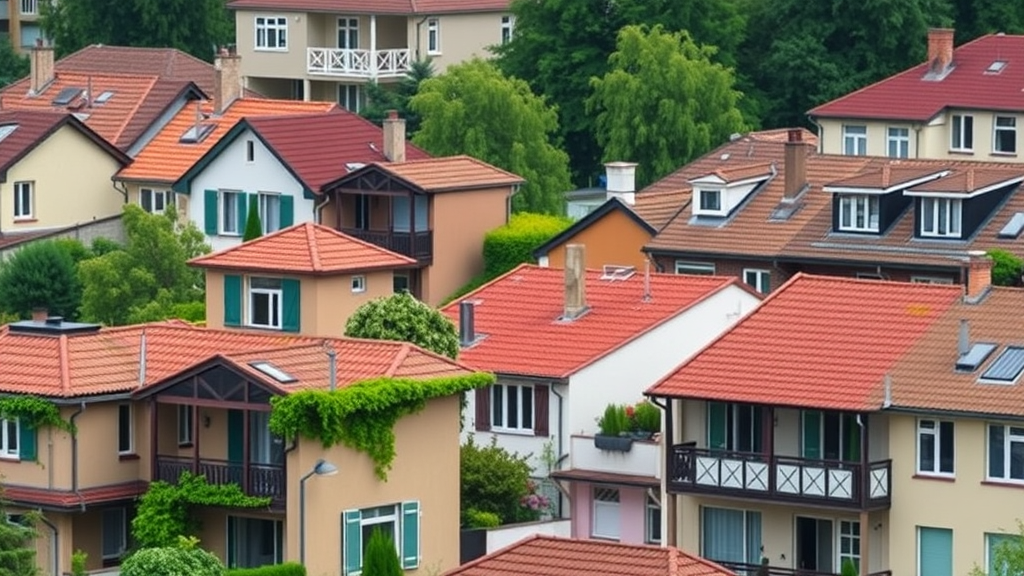
The Asian tiger mosquito, Aedes albopictus, has quietly become one of Germany’s most troublesome urban invaders, and a new study from Heidelberg shows that the architecture of city neighborhoods may be one of the strongest predictors of where it thrives. Researchers monitoring a suburban district of Pfaffengrund found that the type of residential buildings on a plot, particularly terraced houses, shapes both the number of mosquito breeding sites and the intensity of egg laying activity recorded in surveillance traps.
The invasive mosquito has expanded its range across German cities in recent years, creating a nuisance for residents and a genuine public health concern because the species can transmit pathogens such as dengue, chikungunya and Zika viruses under suitable conditions. While intensive control and monitoring programs have demonstrated that local populations can be suppressed, these efforts are labor-intensive and expensive, prompting scientists to search for ways to target limited resources more efficiently.
In the new research, published in the journal Parasites & Vectors, the team focused on a 121-hectare suburban area in Pfaffengrund where active mosquito control was already underway. As part of routine control measures, breeding sites on 1,455 land parcels were repeatedly recorded between May and September 2023, offering an unusually detailed census of where water-holding containers suitable for mosquito larvae could be found. In parallel, egg counts from 39 ovitraps, standard surveillance devices that attract gravid females to lay eggs on wooden paddles or similar substrates, provided a direct measure of egg-laying activity across the neighborhood.
The statistical analysis hinged on generalized linear models and generalized linear mixed models, tools that allowed the researchers to test how building type moderated the effect of control measures on breeding sites, and how the composition of the surrounding urban landscape influenced trap counts. For each ovitrap, the team examined circular buffers of 100, 200 and 300 meters, calculating the proportion of parcels occupied by single-family houses, terraced houses and multi-family buildings, along with breeding site availability and the presence of parcels that were not included in control activities. Separate models were fitted for each buffer size and their performance was compared to identify the spatial scale that best explained the observed patterns.
The results were striking in their consistency. Terraced building plots contained the largest number of breeding sites, while multi-family house plots contained the fewest. This pattern likely reflects the structural features of terraced housing, where small private gardens, narrow courtyards and dense rows of interconnected properties offer numerous sheltered niches for water-collecting containers, from flower pot saucers to rain barrels, while shared access can complicate inspection and control efforts.
Building type also shaped the landscape-level signal in the ovitrap data. A higher share of terraced building plots within the surrounding area was associated with higher maximum egg counts in nearby traps, indicating that females were finding more favorable oviposition opportunities in these microhabitats. The researchers interpreted maximum egg counts as a measure of peak reproductive pressure at a location, making it a sensitive indicator of where mosquito populations were concentrating their egg-laying effort.
Perhaps counterintuitively, maximum egg counts were lower when the share of uncontrolled building plots in the buffer was higher and when more large breeding sites were present. The authors suggest that when untreated parcels and substantial breeding habitats dominate an area, female mosquitoes may disperse their eggs across those natural and semi-natural containers rather than concentrating them in the artificial attractants of ovitraps, diluting the apparent trap signal even where actual mosquito abundance may be high. This underscores a key lesson of surveillance ecology: ovitrap counts reflect both mosquito activity and the availability of competing breeding options in the environment.
Scale mattered as well. The best model performance emerged at a buffer radius of 200 meters, suggesting that the relevant neighborhood for predicting egg-laying behavior extends a few hundred meters around any given trap. However, when the temporal variability of the egg count data was incorporated into the analysis, no single optimal buffer size could be identified, and the effect of breeding site abundance lost statistical significance. The researchers caution that the noisy, seasonally fluctuating nature of ovitrap data limits how precisely the spatial drivers of egg laying can be pinned down, and that the maximum-count approach, while informative, should be complemented by temporal modeling in future studies.
For mosquito control programs, the practical implications are considerable. Because terraced house plots are positively associated with both breeding site abundance and ovitrap egg counts, control measures could be prioritized in neighborhoods dominated by this building type to increase efficiency. In an era when municipal budgets for invasive species management are under pressure, being able to direct inspections, larvicide applications and community engagement toward the most productive habitats represents a meaningful gain in cost effectiveness. Rather than treating every parcel equally, authorities can use building structure, a feature already mapped in most European cities, as a rapid proxy for risk.
More broadly, the study highlights how the built environment itself functions as ecological infrastructure for invasive species. As Aedes albopictus continues its northward expansion in a warming climate, the interplay between housing form, human behavior and vector biology will increasingly determine which streets and courtyards become mosquito strongholds. The Heidelberg findings provide a template that other cities in Germany and beyond could adapt, combining parcel-level breeding site records with trap surveillance and spatial modeling to design smarter, more targeted control campaigns against one of the world’s most successful urban invaders.
Subject of Research: Effects of urban building structure on breeding site distribution and ovitrap egg counts of the invasive mosquito Aedes albopictus in Heidelberg, Germany
Article Title: Effects of urban building structures on the distribution of breeding sites and ovitrap egg counts of Aedes albopictus in Pfaffengrund, Heidelberg, Germany
Article References: Wahl, C., Lautenbach, S., Tokatlian Rodríguez, A., & Becker, N. (2026). Effects of urban building structures on the distribution of breeding sites and ovitrap egg counts of Aedes albopictus in Pfaffengrund, Heidelberg, Germany. Parasites & Vectors, 19(1), Article 393. https://doi.org/10.1186/s13071-026-07655-z
Image Credits: AI Generated
DOI: 10.1186/s13071-026-07655-z
Keywords: Aedes albopictus, Asian tiger mosquito, invasive species, mosquito control, urban ecology, breeding sites, ovitraps, terraced houses, vector-borne disease, Germany, urban structure, egg counts
Cite Scienmag News
Drew Townsend. (September 12, 2026). Terraced Houses Emerge as Hotspots for Invasive Tiger Mosquito Breeding in German City. Scienmag. https://scienmag.com/terraced-houses-emerge-as-hotspots-for-invasive-tiger-mosquito-breeding-in-german-city/
Drew Townsend. "Terraced Houses Emerge as Hotspots for Invasive Tiger Mosquito Breeding in German City." Scienmag, 12 September 2026, https://scienmag.com/terraced-houses-emerge-as-hotspots-for-invasive-tiger-mosquito-breeding-in-german-city/. Accessed 5 October 2026.
Drew Townsend. "Terraced Houses Emerge as Hotspots for Invasive Tiger Mosquito Breeding in German City." Scienmag. September 12, 2026. https://scienmag.com/terraced-houses-emerge-as-hotspots-for-invasive-tiger-mosquito-breeding-in-german-city/


