


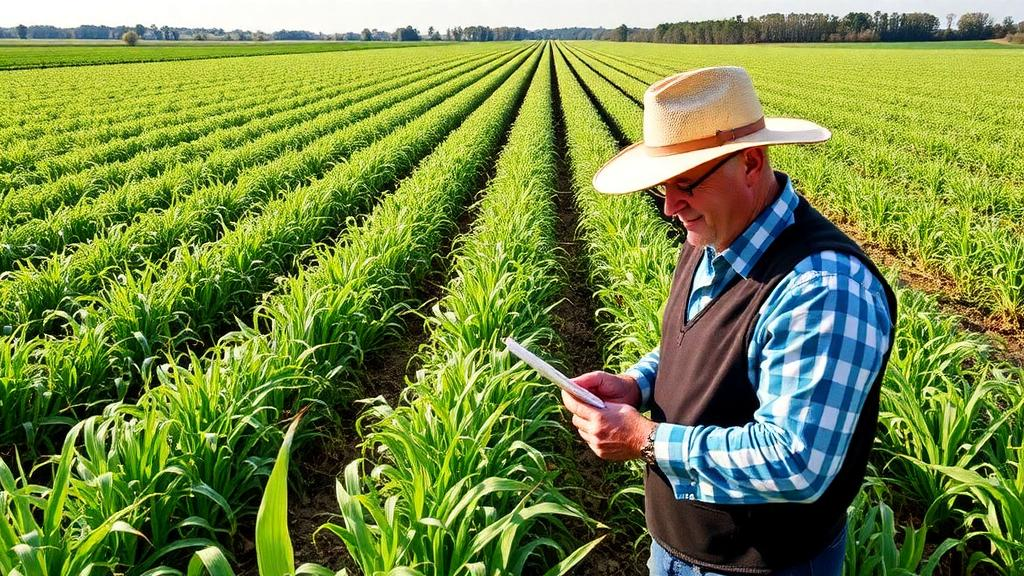
Precision agriculture has promised farmers a future in which every seed, every drop of fertilizer and every pass across the field is guided by data rather than habit. Yet for many producers, the question is no longer whether the technology exists, but whether it actually pays off on their own ground. That question now has a dedicated answer in Tennessee. The University of Tennessee Institute of Agriculture, known as UTIA, has appointed José Peiretti as its new row crop precision agriculture management Extension specialist, a position created to help growers across the state determine which of the many innovations on the market are genuinely worth the investment for their individual operations.
Peiretti joined the UT Department of Biosystems Engineering and Soil Science on September 1, bringing with him more than a decade of hands-on experience in precision agriculture, agricultural engineering and international outreach. His appointment places him at the West Tennessee AgResearch and Education Center in Jackson, a strategic location in the heart of the state’s row crop country, from which he will serve producers statewide. His Extension program will evaluate the cost-effectiveness and large-scale application of technologies spanning precision planting, nutrient management, and pest and plant disease control, among other areas of crop production.
The challenge Peiretti is arriving to address is one that resonates far beyond Tennessee. Farmers today are surrounded by claims about what precision technology can do: planters that adjust seeding rates on the fly, sensors that detect crop stress before the human eye can see it, and software platforms that promise to turn field variability into profit. Very little of that information, however, comes from independent trials conducted under local conditions. Peiretti has been explicit about the gap he intends to fill. According to the university’s announcement, he notes that growers are surrounded by claims about what precision technology can do, but very little of that information comes from Tennessee fields. His stated goal is to generate independent, local data so producers can decide which technologies actually pay off in their own operations, as well as get more out of the equipment they already own.
That second part of his mission, helping farmers extract more value from machinery they have already purchased, is often overlooked in discussions of agricultural innovation. Precision agriculture equipment represents a substantial capital investment, and its full capabilities are frequently underused in practice. An Extension specialist whose job is to bridge that gap between what a machine can do and what a farmer actually needs it to do occupies a distinctive position in the land-grant university system, where the Extension service exists precisely to translate research into practical guidance for the people who grow the state’s food and fiber.
Peiretti’s own trajectory gives him an unusually international perspective on the field. Before joining UTIA, he spent more than 11 years as a research scientist at Argentina’s National Institute of Agricultural Technology, known as INTA, the country’s national agricultural research agency. Based at the experiment station in Salta, in northwestern Argentina, he specialized in precision crop and livestock farming systems, work that exposed him to production environments and technological constraints quite different from those of the American Midwest or the Mississippi Delta region that shapes much of Tennessee agriculture.
In 2021, Peiretti began doctoral studies at Kansas State University, one of the leading institutions in the United States for biological and agricultural engineering. His doctoral research evaluated precision planters and involved designing sensor-based data collection systems for corn and soybean production, two crops whose planting operations are among the most technologically intensive steps in modern row crop farming. Precision planters, which control seed spacing, depth and population with remarkable accuracy, are a natural focal point for cost-benefit analysis, since they sit at the intersection of machinery investment, seed cost and yield response.
He completed his PhD in biological and agricultural engineering in 2025, and along the way earned graduate certificates in geographic information systems and applied statistics. Those credentials matter for the kind of work he is now undertaking. Geographic information systems allow researchers to map and analyze spatial variability across fields, which is the foundation of any site-specific management recommendation. Applied statistics provides the tools to determine whether an observed yield difference or input saving is a real effect of a technology or simply noise from weather, soil variation or chance. In a field where marketing claims often outpace the evidence, that statistical rigor is what separates an Extension program from a product demonstration.
Leadership at UTIA has framed the appointment as a significant addition to the institute’s capacity. Justin Rhinehart, dean of UT Extension, says Peiretti brings a unique skill set to the organization. As a member of the UTIA faculty, Rhinehart says, Dr. Peiretti will lead a statewide precision agriculture program focused on evaluating the latest row crop technologies by working directly with producers to ensure innovations are practical, effective and responsive to the needs of Tennessee’s diverse row crop industry. That emphasis on working directly with producers reflects the core philosophy of Extension work: technology is only valuable if it fits the realities of the farms expected to adopt it.
Shawn Hawkins, head of the UT Department of Biosystems Engineering and Soil Science, has highlighted the collaborative dimension of the new role. According to Hawkins, Dr. Peiretti will collaborate with some of the university’s top experts in agronomy, soil science, weed science, plant pathology and entomology, and his contributions will expand the capabilities of the department while furthering the mission of UTIA statewide and beyond. That interdisciplinary structure is essential to evaluating precision technologies in a meaningful way. A variable-rate nitrogen recommendation, for example, cannot be judged by machinery performance alone; it must be assessed against soil science and crop physiology. Similarly, sensor-based disease detection depends on plant pathology expertise to interpret what the sensors are actually seeing.
For Tennessee’s row crop producers, the practical significance of the appointment lies in the promise of locally grounded answers. The state’s row crop industry includes corn, soybean, cotton and wheat production across diverse soils and growing conditions, and a technology that delivers a clear return in one region may fail in another. By conducting evaluations under Tennessee conditions and publishing the results through Extension channels, Peiretti’s program aims to give growers the independent evidence they need to make confident purchasing and management decisions. The University of Tennessee Institute of Agriculture, which comprises the Herbert College of Agriculture, the UT College of Veterinary Medicine, UT AgResearch and UT Extension, carries out this translation of research into practice as part of its land-grant mission of teaching, research and outreach. More information about the Department of Biosystems Engineering and Soil Science is available at bess.tennessee.edu, and the latest UTIA row crop research can be found at utcrops.com. As precision agriculture continues to evolve at a rapid pace, the arrival of a specialist dedicated to testing what works, and what merely promises to work, offers Tennessee farmers something increasingly rare in the technology marketplace: answers rooted in their own fields.
Subject of Research: Appointment of a precision agriculture Extension specialist for row crop production in Tennessee
Article Title: UTIA appoints new precision agriculture Extension specialist for row crops
Article References: UTIA appoints new precision agriculture Extension specialist for row crops. (n.d.). Original publication
Image Credits: AI Generated
DOI: Not provided
Keywords: precision agriculture, row crops, Extension, University of Tennessee, José Peiretti, Biosystems Engineering and Soil Science, West Tennessee AgResearch and Education Center, Kansas State University, INTA, agricultural technology, cost-effectiveness, Tennessee growers
Cite Scienmag News
Alan Morgan. (October 4, 2026). Tennessee hires precision agriculture specialist to test what pays off for row crops. Scienmag. https://scienmag.com/tennessee-hires-precision-agriculture-specialist-to-test-what-pays-off-for-row-crops/
Alan Morgan. "Tennessee hires precision agriculture specialist to test what pays off for row crops." Scienmag, 4 October 2026, https://scienmag.com/tennessee-hires-precision-agriculture-specialist-to-test-what-pays-off-for-row-crops/. Accessed 4 October 2026.
Alan Morgan. "Tennessee hires precision agriculture specialist to test what pays off for row crops." Scienmag. October 4, 2026. https://scienmag.com/tennessee-hires-precision-agriculture-specialist-to-test-what-pays-off-for-row-crops/


