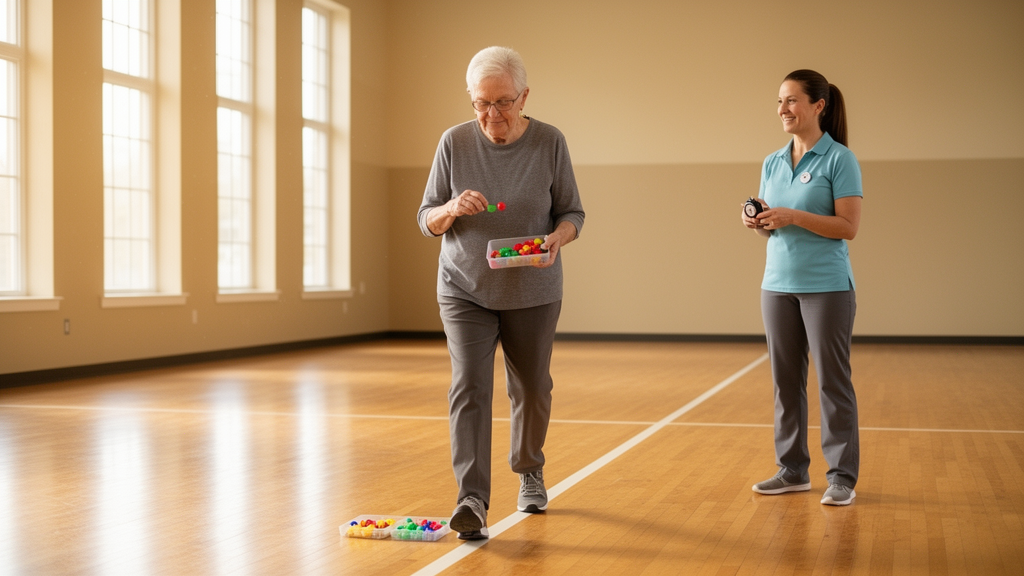
A 10-week healthy ageing program run through a regional university clinic was associated with meaningful gains in everyday functioning among community-dwelling adults aged 60 and over, according to a non-experimental pre-post observational study published in BMC Geriatrics. Fifty-eight participants completed the once-weekly program, which was delivered by allied health professionals with supervised students and built around activities that were individually graded, goal-directed and dual-task oriented.
The study addressed a gap the authors identified in the healthy ageing literature: many community programs target a single domain, and most dual-task training evaluations rely on standardised balance, gait or single-domain cognitive tests. Rarely do they ask whether benefits extend to everyday occupational performance, perceived cognition, or function at home.
The primary outcome was the Canadian Occupational Performance Measure, supplemented by secondary measures including the Patient-reported Evaluation of Cognitive State (PRECiS), the Timed Up and Go test, the Six Minute Walk Test and Lawton’s Instrumental Activities of Daily Living Scale. Change was analysed with paired t-tests and Cohen’s d effect sizes.
Self-reported occupational performance and satisfaction both improved significantly (p < 0.001), with medium to large effects (d = 0.59 and 0.85 respectively). Perceived cognitive difficulty in everyday life fell by five points on the PRECiS (p = 0.003; d = 0.40), and functional walking capacity rose by an average of 38 metres on the Six Minute Walk Test (p < 0.001; d = 0.67).
Not every measure moved. Instrumental activities of daily living showed only a small gain, and Timed Up and Go performance was unchanged. The authors characterised the improvements in occupational performance and satisfaction, mobility and perceived cognitive difficulties as significant and meaningful, while the balance-oriented Timed Up and Go result suggests the everyday-function benefits did not translate uniformly across all tested domains.
The design carries important limitations. As a single-cohort pre-test post-test study without a control group, it cannot establish that the program caused the observed changes; participants may have improved through practice effects, natural variation or other factors. The authors position the findings as a foundation for future clinical trials rather than definitive evidence of efficacy, and note that the program proved feasible in rural and regional settings.
What the study adds, the authors argue, is a perspective largely missing from the dual-task literature: outcomes captured through everyday-oriented measures rather than impairment alone. By asking whether cognitive-motor dual-task training, which suits the demands of everyday life, reaches the outcomes older people care about most, the study offers a template for evaluating community healthy ageing programs against real-world function rather than laboratory-style test performance alone.
Subject of Research: Outcomes of a regional university-led dual-task healthy ageing program for older adults
Article Title: Outcomes of a regional university-led healthy ageing program supporting everyday function, cognition and mobility in older adults: a non-experimental pre-post observational study
Article References: Nott, M., & Robson, K. (2026). Outcomes of a regional university-led healthy ageing program supporting everyday function, cognition and mobility in older adults: a non-experimental pre-post observational study. BMC Geriatrics. https://doi.org/10.1186/s12877-026-08591-4
Image Credits: AI Generated
DOI: 10.1186/s12877-026-08591-4
Keywords: healthy ageing, dual-task training, older adults, occupational performance, cognition, mobility, walking capacity, observational study, regional health, BMC Geriatrics, Outcomes, regional
Cite Scienmag News
Beatrice Stafford. (October 28, 2026). Ten-week dual-task healthy ageing program linked to better everyday function in older adults. Scienmag. https://scienmag.com/ten-week-dual-task-healthy-ageing-program-linked-to-better-everyday-function-in-older-adults/
Beatrice Stafford. "Ten-week dual-task healthy ageing program linked to better everyday function in older adults." Scienmag, 28 October 2026, https://scienmag.com/ten-week-dual-task-healthy-ageing-program-linked-to-better-everyday-function-in-older-adults/. Accessed 29 October 2026.
Beatrice Stafford. "Ten-week dual-task healthy ageing program linked to better everyday function in older adults." Scienmag. October 28, 2026. https://scienmag.com/ten-week-dual-task-healthy-ageing-program-linked-to-better-everyday-function-in-older-adults/