


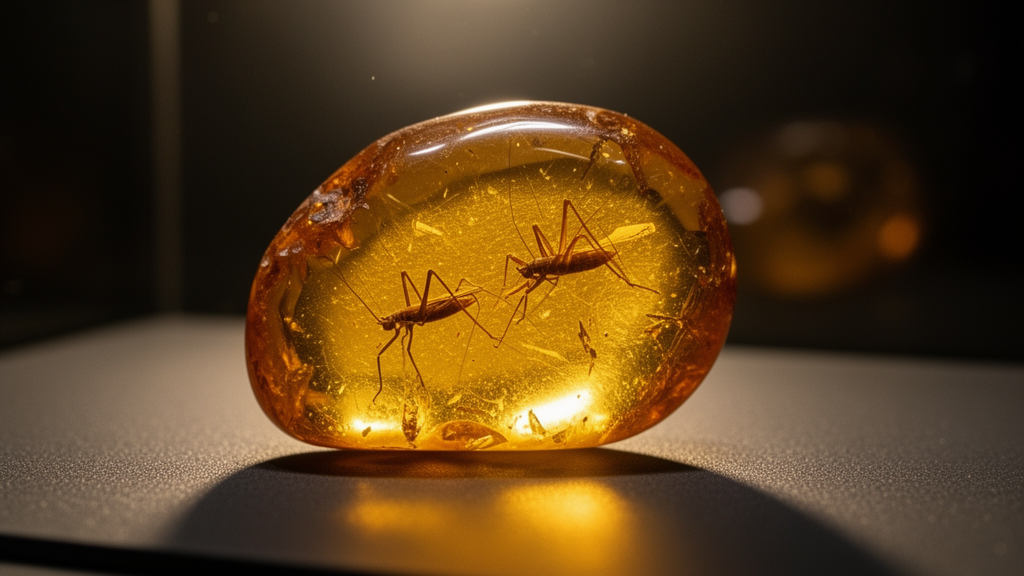
A fossil-based taxonomic study has described two new members of the extinct elcanid family from mid-Cretaceous amber originating in Myanmar: the species Pseudopanorpidium inversa and the new genus and species Thagyaminana atawedeia. The first specimen is a male assigned to Elcaninae, while the second is a female assigned to Archelcaninae. Together, they expand the documented diversity of Elcanidae in the tropical Cretaceous forest ecosystem represented by Burmese amber.
Elcanidae are an extinct family of Orthoptera with a predominantly Mesozoic fossil record and only singular putative occurrences from the Permian and Paleocene, according to the study. The family comprises two subfamilies, Elcaninae and Archelcaninae, distinguished in part by forewing venation: distal fusion of the veins 1A, CuPb and CuPaβ indicates placement in Elcaninae, whereas the absence of that fusion supports Archelcaninae. Burmese amber has become an important source of information on the family’s diversity, morphology and ecology.
The authors examined two amber specimens housed at the Leibniz Institute for the Analysis of Biodiversity Change in Hamburg. The exact discovery site is uncertain: the material came either from a mine near Tanai village in Kachin State or from a site near Hkamti village in Sagaing Division. Tanai amber is estimated to be 98.79 ± 0.62 million years old, while Hkamti amber is approximately 110 million years old, a difference of about 10 million years. The authors also note ethical concerns involving mining conditions in Myanmar and the possibility that fossil purchases may contribute to the country’s civil war.
Specimens were photographed with a Canon EOS 5Dsr camera fitted with a 65 mm lens, using magnification of 1× and 1.5×, and individual images were stacked to combine focal planes. Researchers then prepared interpretive drawings and added scale bars and image collections. The study’s taxonomic treatment follows the Orthoptera Species File, while wing-venation terminology follows the system described by Béthoux and Nel. Because the two amber sites differ in age and the precise origin of each specimen is uncertain, the fossils cannot be assigned to a single confidently dated horizon.
The male holotype of P. inversa, specimen GPIH07021, preserves parts of the pronotum, wings, abdomen and one metathoracic leg. Its preserved body length is 6.25 mm, its forewing is 14 mm long and its hindwing is 13.1 mm long. Distal fusion of CuPaβ, CuPb and 1A supports assignment to Elcaninae. The species is distinguished by two dark, round hindwing spots and a dark hindwing margin. The spots are 1.1 mm wide, measuring 1.2 mm and 0.84 mm in height, while the dark band reaches a maximum width of 2.5 mm. Its name derives from the Latin invertere, meaning “to invert” or “turn around,” in reference to this unusual wing coloration.
Additional features of P. inversa include a posteriorly pointed pronotum, a 6.8 mm metafemur, a 5.3 mm metatibia with nine small proximal denticles, and three pairs of ensiform metatibial spurs measuring approximately 0.7–1 mm. Its cerci are not setulose and terminate in hair-like tips. The inverted placement of the prominent wing markings is unusual within Elcanidae, although the authors note that comparable hindwing spotting occurs in Pterochroza ocellata and that many Oedipodinae have brightly colored hindwings with dark markings.
One unusual venation feature led the authors to reconsider the taxonomic value of the position of the RP stem. In the P. inversa specimen, it lies posterior to the second branch of MA1, whereas Panorpidium and Pseudopanorpidium are usually characterized by an RP stem between the two MA1 branches. Citing variation in this feature among Jurassic elcanids from Germany reported by Zessin in 1987, the authors argue that the diagnoses of Panorpidium and Pseudopanorpidium should permit the stem to occur either between MA1 branches or posterior to the second MA1 branch. They further suggest that Probaisselcana and Pseudoprobaisselcana may need reconsideration as possible synonyms, depending on how much intraspecific variation is accepted.
The second taxon, Thagyaminana atawedeia, is represented by the well-preserved female holotype GPIH07022. Its body length is about 7.8 mm, measured from the tip of the head to the base of the ovipositor, and its forewing is 13.5 mm long. The species has unfused 1A, CuPb and CuPaβ veins, placing it in Archelcaninae. Its forewing contains two central dark spots, with the anterior one larger than the posterior one at 1.6 versus 1.16 mm in height. Other diagnostic features include a broad, rounded posterior pronotum, leaf-like metatibial spurs, a 7.3 mm sword-shaped ovipositor and a long hindwing margin between CuPb and CuPaβ bearing numerous regular cross veins.
The genus name combines Thagyamin, the Buddhist god and king of heaven in Burmese tradition, with the commonly used elcanid ending “elcana.” The species name refers to tàwədèɪɰ̃ðà, the Burmese name of one of the heavens in Buddhist cosmology, and is intended as a homage to the specimen’s geographic origin and Theravada Buddhism. The description illustrates how amber can preserve combinations of coloration, wing venation, leg structure and reproductive anatomy that help distinguish fossil elcanids. However, both conclusions rest on one specimen per new taxon, and uncertainty about the precise mines and differing ages of the amber limit species-level conclusions about their exact paleoecological setting.
Subject of Research: Taxonomic description of two new Elcanidae from mid-Cretaceous Myanmar amber
Article Title: Two new members of the Elcanidae ( Insecta , Orthoptera ) from mid-Cretaceous amber
Article References: Schall, O.-K. O., Kotthoff, U., & Husemann, M. (2026). Two new members of the Elcanidae (Insecta, Orthoptera) from mid-Cretaceous amber. Journal of Orthoptera Research, 35(1), 63-68. https://doi.org/10.3897/jor.35.140770
Image Credits: AI Generated
Keywords: Elcanidae, fossil insects, Orthoptera, Myanmar amber, Cretaceous fossils, taxonomy, wing venation, archelcaninae, elcaninae, members, Insecta, mid-Cretaceous
Cite Scienmag News
Gavin Prescott. (October 20, 2026). Taxonomic study describes two new elcanid species from mid-Cretaceous Myanmar amber. Scienmag. https://scienmag.com/taxonomic-study-describes-two-new-elcanid-species-from-mid-cretaceous-myanmar-amber/
Gavin Prescott. "Taxonomic study describes two new elcanid species from mid-Cretaceous Myanmar amber." Scienmag, 20 October 2026, https://scienmag.com/taxonomic-study-describes-two-new-elcanid-species-from-mid-cretaceous-myanmar-amber/. Accessed 20 October 2026.
Gavin Prescott. "Taxonomic study describes two new elcanid species from mid-Cretaceous Myanmar amber." Scienmag. October 20, 2026. https://scienmag.com/taxonomic-study-describes-two-new-elcanid-species-from-mid-cretaceous-myanmar-amber/


