


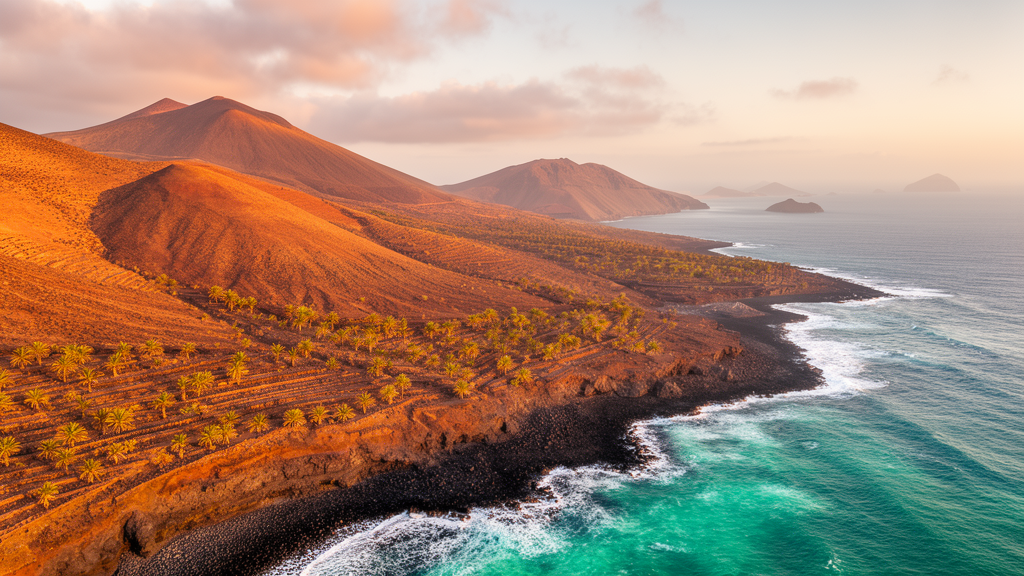
A perspective article argues that human-driven climate change is pushing the Holocene toward warmer conditions resembling the Eemian, the last interglacial, with signs already visible across the Canary Islands. The authors define “eemification” as the gradual transformation of Holocene conditions toward those of the Eemian, a process they say has accelerated in recent decades. The paper is a perspective that synthesizes published observations and projections rather than a new field study or systematic review.
The Eemian, which occurred approximately 130,000–120,000 years before present, was about 2–4 °C warmer than the Holocene and had sea level approximately 8–10 m above present. Higher sea-surface temperatures were associated with weakened coastal upwelling, and Senegalese marine molluscs, including Nerita senegalensis, Saccostrea cucullata, Tethystrombus coronatus and T. virleti, were present in the Canarian littoral zone. The perspective notes an important difference in greenhouse-gas concentrations: atmospheric carbon dioxide did not exceed 300 ppm during the Eemian, whereas it has reached 423 ppm, up from an estimated 278 ppm around 1750, while methane reached 1,912 ppb in 2022, 2.6 times its estimated pre-industrial value.
Sea-level records provide one of the clearest regional indicators. Tide-gauge records from the Lanzarote Geosciences Laboratory show a long-term rise of 0.33 ± 0.06 cm per year between July 2005 and May 2023, while satellite altimetry indicates a comparable trend across the Canary Current system during recent decades. Regional analyses cited by the authors report a marked increase in the rate of sea-level rise during 1993–2019 relative to earlier decades. Thermal expansion of seawater accounts for 56% of measured sea-level rise, with cryospheric processes accounting for the remainder.
The paper links this sea-level response to the strong inertia of cryospheric processes, which can persist over centuries to millennia through feedbacks involving temperature, albedo reduction and ice dynamics. As a result, sea-level rise is delayed relative to atmospheric warming and is not a simple linear response to temperature; it may continue even if global temperatures stabilize. Intergovernmental Panel on Climate Change projections cited in the perspective place end-of-century mean annual temperature increases at 1.4–5.7 °C and sea-level rise at 0.4–0.8 m above present levels, depending on scenario. These projections remain well below the Eemian sea level.
On land, the authors identify warming, changing moisture patterns and biological redistribution across Tenerife, Gran Canaria and the wider archipelago. Mean annual temperatures are increasing, as are the numbers of nights above 25 °C and 30 °C. Summit temperatures rose by an average of 0.3 °C per decade over the past half century. A comparison with upper range limits recorded for 23 vascular plants at the beginning of the nineteenth century found an average upward shift of 36.4 m per decade on Tenerife’s summit. The perspective also cites milder winters that are associated with lower winter mortality among invasive European rabbits, higher spring densities and increased browsing pressure on the endemic shrub Spartocytisus supranubius.
Fire conditions are also changing. The cited research projects that high fire-risk conditions will begin earlier and persist later under future warming scenarios. Historical fire statistics show that major wildfires in recent decades have increasingly occurred in June and July, whereas they were more frequent in late summer in earlier records. At the same time, the inversion layer that supports the trade-wind cloud sea has lowered in altitude, increasing exposure of laurel forests to dry conditions and drought stress. The Canary Islands’ total affected wildfire area is reported as 745,000 hectares across the period examined, with larger areas affected more recently, particularly over the last six years.
Marine observations show a parallel set of changes. Sea-surface temperature around the islands increased at about 0.1 °C per decade from 1958, while the surrounding ocean acidified at approximately 0.02 pH units per year between 1995 and 2013. During 150 years of tropical-storm monitoring before 2005, no storms passed close to the Canaries, but Delta and Vince occurred in 2005, Otto in 2010, Gordon and Nadine in 2012, and Leslie in 2018. The ichthyofauna is becoming more tropicalized: the Whale Shark has been a regular summer visitor since 1993, the Ocean Triggerfish has been recorded since 1990, and the Tropical Crab first appeared in 2016. These species are associated mainly with El Hierro and La Palma, where waters are warmer.
Other marine changes include the eastward redistribution of temperate organisms, including Gongolaria abies-marina macroalgae forests and Cymodocea nodosa seagrass prairies, toward the cooler waters around Lanzarote and Fuerteventura affected by the Canarian Upwelling System. Blooms of the microalga Trichodesmium erythraeum, associated with Saharan dust input and high sea-surface temperatures, occurred in 2004 and reappeared in 2011 and 2017. The perspective also reports that ciguatera, described in the source as a tropical fish disease affecting humans, was unknown in the Canaries until 2004 but has since reappeared almost annually in connection with consumption of large fish containing ciguatoxin, including Greater Amberjack.
Recent short-lived events have included sea-surface temperatures above 25 °C and land-air temperatures above 40 °C, conditions described as resembling those inferred for the Eemian and coinciding with weakened coastal upwelling. The authors present the Canary Islands as a natural laboratory in which warming, sea-level rise, altered rainfall, species redistribution and marine tropicalization can be observed together. Their perspective is bounded by the heterogeneous evidence assembled from different studies, periods and regions: the “eemification” framing is an interpretation of converging observations, not a demonstration that the archipelago has entered a distinct Eemian state. The authors nevertheless conclude that the direction of change is already evident and that the consequences of ice-sheet inertia and ocean feedbacks can persist for millennia.
Subject of Research: A perspective on human-driven Eemian-like climate signals in the Canary Islands
Article Title: Towards the human-induced “eemification” of the recent Holocene: a perspective from the Canary Islands
Article References: Fernández-Palacios, J. M., Martín-Esquivel, J. L., & Fernández-Palacios, E. (2026). Towards the human-induced “eemification” of the recent Holocene: a perspective from the Canary Islands. Frontiers of Biogeography, 19, Article e176249. https://doi.org/10.21425/fob.19.176249
Image Credits: AI Generated
Keywords: Canary Islands, Holocene, Eemian, climate change, sea-level rise, species redistribution, marine tropicalization, wildfire season, ocean acidification, perspective article, Towards, human-induced
Cite Scienmag News
Violet Maxwell. (October 20, 2026). Perspective identifies Eemian-like climate signals in the Canary Islands. Scienmag. https://scienmag.com/perspective-identifies-eemian-like-climate-signals-in-the-canary-islands/
Violet Maxwell. "Perspective identifies Eemian-like climate signals in the Canary Islands." Scienmag, 20 October 2026, https://scienmag.com/perspective-identifies-eemian-like-climate-signals-in-the-canary-islands/. Accessed 20 October 2026.
Violet Maxwell. "Perspective identifies Eemian-like climate signals in the Canary Islands." Scienmag. October 20, 2026. https://scienmag.com/perspective-identifies-eemian-like-climate-signals-in-the-canary-islands/


