


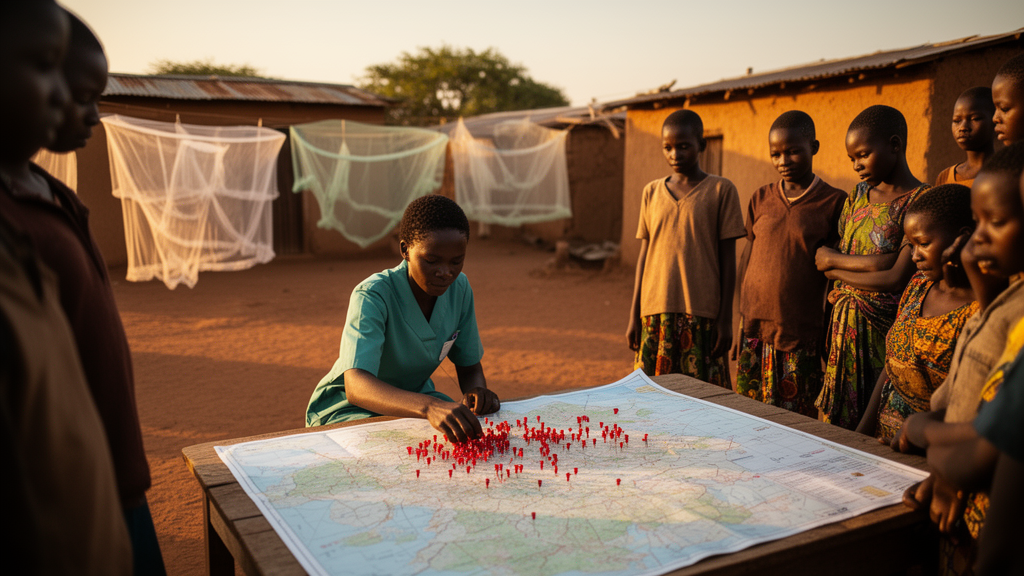
Malaria control has stalled across much of the world. After two decades of steady gains in the early twenty-first century, many countries have watched progress plateau, and conventional tools such as insecticide-treated bed nets and antimalarial drugs are no longer pushing transmission steadily downward. A new modeling study published in PLOS Computational Biology argues that part of the answer may lie in geography itself: rather than spreading interventions thinly across an entire district, health programs could concentrate them where the spatial structure of villages, roads, and transport networks makes them count the most.
The research team, led by Michelle V. Evans and colleagues, built a spatially explicit model of malaria transmission at the scale of individual communities in a district of southeastern Madagascar. Unlike most models of malaria control, which operate at coarse regional or national scales, this one was designed to answer a practical question that district health managers actually face: if you have enough resources to reach only some villages, which ones should you choose? The model divides the human population into two age classes, captures environmental heterogeneity between communities, and represents the spatial connections among villages that determine how parasites move through the landscape.
To ground the model in reality, the researchers calibrated it against field data, including case notifications collected by the health system and cross-sectional surveys of malaria prevalence. This fitting process ensured that the simulated epidemics reproduced observed patterns of infection in the district rather than resting on generic assumptions. Once validated, the model became a laboratory for testing intervention strategies that would be impossible to compare experimentally in the field, where randomized reallocation of scarce health resources is rarely feasible or ethical.
The team simulated three core interventions. Indoor residual spraying, or IRS, involves coating the interior walls of houses with insecticide that kills mosquitoes resting indoors. Long-lasting insecticide-treated nets, known as LLINs, protect individuals while they sleep and provide a community-level benefit when coverage is high enough. Active case detection, or ACD, sends health workers out to find and treat symptomatic infections before they fuel further transmission. Each intervention could be applied uniformly across the district or targeted to specific communities, allowing the researchers to compare five scenarios: no targeting at all, targeting villages nearest to clinics, targeting those furthest from clinics, targeting communities with the highest reported incidence, and targeting villages that are spatially central within the district’s network.
The results delivered a nuanced verdict. The non-targeted, district-wide intervention was generally the most effective at reducing malaria burden, a finding that echoes the epidemiological principle that broad coverage suppresses transmission everywhere at once. But it was also the least resource-efficient, demanding the greatest expenditure of personnel, insecticide, and transportation. In a low-income setting where every motorbike trip and every kilogram of insecticide must be budgeted carefully, effectiveness alone is not the deciding metric. The trade-off between total impact and cost per case averted sits at the heart of spatial targeting.
Among the targeted strategies, one stood out: prioritizing communities that are spatially central. Because centrally located villages are embedded in the network of human movement and parasite dispersal, intervening there reaches a larger share of the population’s effective transmission pathways while consuming fewer transportation resources than blanket coverage. This second-ranked strategy suggests that the geometry of a district, not just the raw number of cases in each village, can guide where a program’s limited capacity will do the most good. It is a counterintuitive result in the best sense: the villages with the most cases are not necessarily the ones whose treatment yields the greatest system-wide benefit.
Targeting communities nearest to clinics or furthest from clinics produced weaker performance in the simulations, and targeting by highest incidence, while intuitively appealing, did not outperform the centrality-based approach. These findings matter because they challenge the default logic of many health programs, which often allocate resources either by proximity to existing infrastructure or by raw case counts. The model suggests that both heuristics can leave transmission pathways untouched, whereas a network-aware view of the district captures the structure that actually sustains the epidemic.
The study also probed the limits of what community-level interventions can achieve. No combination of the three interventions, at any level of spatial targeting, was able to eliminate malaria from the district entirely. This sobering result reflects the persistence of low-level transmission that is difficult to detect and interrupt with the tools currently available. However, active case detection showed a striking capability: at high detection rates, finding and treating symptomatic cases could avert 100 percent of severe malaria cases. Severe malaria is the form of the disease that kills, driven largely by infections in young children and other vulnerable groups, so preventing severe outcomes even without eliminating transmission represents a substantial humanitarian gain.
The implications extend beyond Madagascar. Community health worker programs have expanded rapidly across sub-Saharan Africa and other malaria-endemic regions, and they represent the operational backbone for delivering interventions at the village scale. Yet most modeling studies that inform policy operate at coarser spatial resolutions, leaving a gap between what models recommend and what programs can actually implement. By building the model at the community scale, the researchers aligned the analytical lens with the operational unit of real health systems, making the findings directly actionable for district health teams deciding where to send their next spray campaign or net distribution.
The work also highlights the value of coupling epidemiological models with real transport networks and environmental data. In rural Madagascar, where roads are sparse and travel between villages can be slow and costly, the logistics of reaching communities shape what interventions are feasible. A strategy that looks optimal on paper but requires traversing difficult terrain to reach scattered villages may underperform a strategy that concentrates on accessible, central communities. By embedding these constraints directly into the model, the researchers produced results that reflect the practical realities of implementation rather than an idealized world of unlimited reach. As malaria programs worldwide confront stagnating progress and finite budgets, the message from this study is that spatial structure is not a nuisance to be averaged away but a resource to be exploited, one that can stretch limited resources further and bring the goal of malaria control closer within reach.
Subject of Research: Spatially targeted community-scale malaria interventions modeled in southeastern Madagascar
Article Title: Leveraging spatial structure to design spatially-targeted malaria interventions at the community-scale
Article References: Evans, M. V., Roche, B., Herbreteau, V., Révillion, C., Catry, T., Bonds, M. H., Finnegan, K. E., Mitsinjoniala, E., Ihantamalala, F. A., Randriamihaja, M., Raobela, O., & Garchitorena, A. (2026). Leveraging spatial structure to design spatially-targeted malaria interventions at the community-scale. PLOS Computational Biology, 22(10), e1014857. https://doi.org/10.1371/journal.pcbi.1014857
Image Credits: AI Generated
DOI: 10.1371/journal.pcbi.1014857
Keywords: malaria, spatial targeting, mathematical modeling, Madagascar, community health workers, indoor residual spraying, insecticide-treated nets, active case detection, disease elimination, PLOS Computational Biology, epidemiology, health policy
Cite Scienmag News
Phoebe Ingram. (October 16, 2026). Targeting Malaria Interventions by Geography Could Stretch Scarce Health Budgets. Scienmag. https://scienmag.com/targeting-malaria-interventions-by-geography-could-stretch-scarce-health-budgets/
Phoebe Ingram. "Targeting Malaria Interventions by Geography Could Stretch Scarce Health Budgets." Scienmag, 16 October 2026, https://scienmag.com/targeting-malaria-interventions-by-geography-could-stretch-scarce-health-budgets/. Accessed 16 October 2026.
Phoebe Ingram. "Targeting Malaria Interventions by Geography Could Stretch Scarce Health Budgets." Scienmag. October 16, 2026. https://scienmag.com/targeting-malaria-interventions-by-geography-could-stretch-scarce-health-budgets/


