


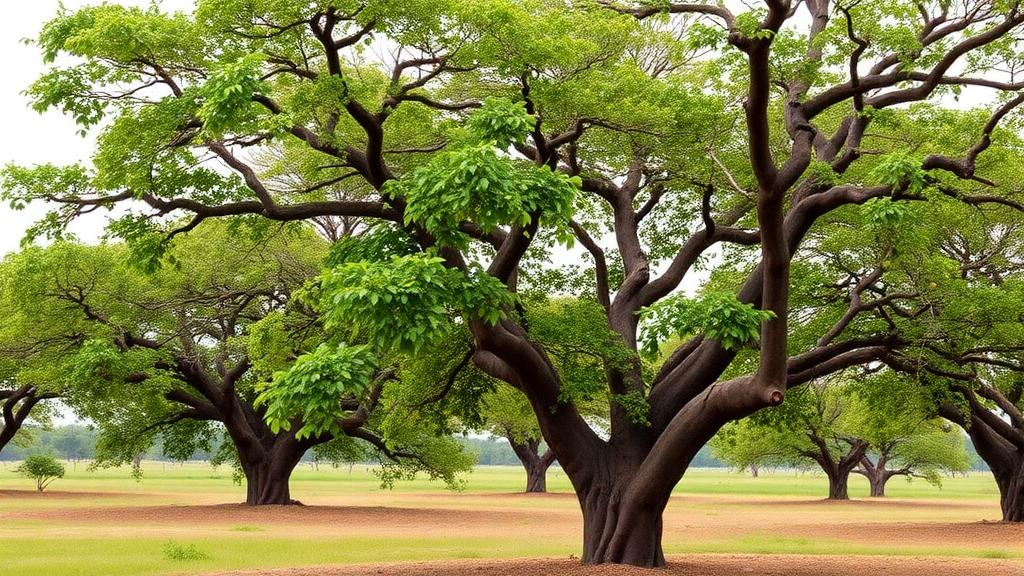
Deep in the cashew belt of southern Tanzania, where the trees were planted long before anyone released an improved variety, scientists have been quietly taking the measure of some of the oldest and most overlooked crop plants in the country. A new study of traditional cashew populations from the Nachingwea and Newala districts has found that these unimproved trees harbor a striking amount of phenotypic variation, the raw material on which every successful breeding program ultimately depends. The findings, published in the journal Discover Plants, suggest that the humble farm trees of Lindi and Mtwara regions may hold genetic resources that could shape the future of cashew production in East Africa and beyond.
Cashew, Anacardium occidentale, is one of Tanzania’s most economically important cash crops, generating income at both the household and national levels. Although improved varieties are available, traditional cashews still dominate more than half of the country’s cashew-cultivating area, particularly in the southern regions of Lindi, Mtwara, Pwani, and Ruvuma. Nachingwea district in Lindi region and Newala district in Mtwara region sit squarely within the cashew belts that together contribute over 87 percent of Tanzania’s national output. Yet despite their agronomic importance, the traditional trees scattered across these districts had never been systematically assessed for the morphological diversity they contain.
To fill that gap, researchers Hashim M. Mangosongo of the University of Dar es Salaam and Hussein R. Chiumbi of Dar es Salaam University College of Education sampled 120 traditional cashew trees, 60 from each district, across eight privately owned farms in eight different wards. The farms were deliberately kept within 10 kilometers of one another at each site, a distance chosen to ensure that only trees connected by gene flow were sampled. That constraint matters because cashew pollen moves primarily via insect pollinators, which studies show can travel up to 13.5 kilometers. At each farm, the first tree was selected at random and the remaining fourteen were chosen systematically along a diagonal crossing pattern, with 10 meters maintained between sampled trees.
The characterization itself relied on the morphological descriptors for cashew developed by the International Board for Plant and Genetic Resources in 1986, a standardized toolkit that allows researchers around the world to describe trees in comparable terms. The team assessed six qualitative characters, including tree habit, trunk surface, leaf shape, leaf size, leaf margin, and leaf apex, alongside four quantitative traits: tree height, tree spread, crotch angle, and leaf petiole angle. These traits were chosen because they are permanent rather than seasonal, easily recognized by farmers, and directly tied to cashew productivity. For leaf measurements, the researchers collected 88 leaves per tree, 22 from each of four canopy positions, measuring their dimensions with a foot ruler and comparing their shapes against the descriptor reference forms.
The results revealed a remarkable mosaic of forms. Tree habits fell into two categories, spreading and upright-and-open, with the spreading habit dominating both populations: 75 percent of Nachingwea trees and 90 percent of Newala trees spread their branches wide. That trait is commercially significant, because a broader canopy is linked to higher nut yields. Every single tree sampled had a rough, cracked trunk surface, deep at the base and shallower higher up, a pattern associated with old age and suggesting that these populations contain a large proportion of aging trees, a finding with urgent implications for conservation before the oldest germplasm is lost.
The leaves told an equally rich story. Five leaf shapes appeared across the study area, obovate, oblong, oblanceolate, elliptical, and wide elliptical, but each district contained only four of them: the oblong shape was unique to Nachingwea, while the oblanceolate form was found only in Newala. Obovate leaves were the most common in both populations, accounting for 70 percent of leaves in Nachingwea and 60 percent in Newala, figures that echo patterns recorded in Brazilian and Indian cashew collections. Leaf apices came in four types, round, indented, blunt-pointed, and flat, with the blunt-pointed apex exclusive to Nachingwea and the flat apex exclusive to Newala. Round apices, which help plants conserve water, dominated both populations at over 60 percent, consistent with the warm climates in which they grow.
Quantitative traits varied widely within each population even though the two populations did not differ significantly from each other. Tree heights ranged from 6.60 to 15.20 meters in Nachingwea and 5.80 to 14.20 meters in Newala, while tree spreads reached as much as 22 meters. Crotch angles, the angle between a tree’s two main branches, ranged from 29 to 68 degrees in Nachingwea and 29 to 72 degrees in Newala, all acute, in contrast to the obtuse angles reported in Indian accessions. Leaf petiole angles spanned from 17 to 105 degrees across the study, a range that reflects how cashew leaves orient themselves to capture sunlight without shading their neighbors. Notably, the Newala population, which sits at a higher altitude of about 625 meters compared with Nachingwea’s 474 meters, contained a larger proportion of small-leaved trees, matching global patterns in which plants at higher elevations tend to have smaller leaves to reduce water loss.
Perhaps the most intriguing result came from the multivariate analyses. Principal Coordinate Analysis captured 98.63 percent of the total variation on its first two axes, with the first axis alone accounting for 91.03 percent, and Linear Discriminant Analysis attributed 94 percent of variation to its first two axes. In both analyses, and in a UPGMA cluster analysis that grouped the trees into two major clusters at a Nei’s genetic distance of 0.24, individuals from the two districts intermingled regardless of their geographic origin. Only five trees, all from Nachingwea and all sharing the distinctive blunt-pointed leaf apex, formed a separate group. The researchers attribute the blending of the two populations to gene flow, most likely through the transfer of seed by farmers, and note that a companion molecular study of the same trees reached the same conclusion.
One correlation stood out with practical clarity: tree height and tree spread were significantly and positively correlated, meaning that taller trees also tend to have broader canopies. Because canopy spread is a strong predictor of nut yield, selecting a taller phenotype automatically selects for a more productive one. That kind of linked trait information is exactly what breeders need when choosing parent material, allowing them to improve multiple yield-related characteristics simultaneously rather than one at a time.
The broader message of the study is a call to action. The high variation within both populations means each is a potentially rich source of germplasm for future cashew breeding, capable of providing the adaptive flexibility that crops will need as climates shift. But the same old trees that carry this diversity are aging, and their genetic legacy is not guaranteed to survive. The authors recommend both in-situ conservation, keeping the traditional trees alive in the landscapes where farmers grow them, and ex-situ conservation, preserving germplasm in collections, to secure these resources for sustainable cashew breeding in Tanzania. In the orchards of Nachingwea and Newala, the country’s next generation of improved cashews may already be growing, one gnarled old tree at a time.
Subject of Research: Phenotypic variation in traditional cashew populations in southern Tanzania
Article Title: Phenotypic characterization of the traditional cashew (Anacardium occidentale L.) populations from Nachingwea and Newala districts, Tanzania
Article References: Mangosongo, H. M., & Chiumbi, H. R. (2026). Phenotypic characterization of the traditional cashew (Anacardium occidentale L.) populations from Nachingwea and Newala districts, Tanzania. Discover Plants, 3(1), Article 429. https://doi.org/10.1007/s44372-026-00900-w
Image Credits: AI Generated
DOI: 10.1007/s44372-026-00900-w
Keywords: cashew, Anacardium occidentale, Tanzania, phenotypic variation, morphological descriptors, plant breeding, genetic resources, conservation, Nachingwea, Newala, germplasm, agrobiodiversity
Cite Scienmag News
Alan Morgan. (September 30, 2026). Tanzania’s Old Cashew Trees Reveal a Hidden Trove of Genetic Diversity. Scienmag. https://scienmag.com/tanzanias-old-cashew-trees-reveal-a-hidden-trove-of-genetic-diversity/
Alan Morgan. "Tanzania’s Old Cashew Trees Reveal a Hidden Trove of Genetic Diversity." Scienmag, 30 September 2026, https://scienmag.com/tanzanias-old-cashew-trees-reveal-a-hidden-trove-of-genetic-diversity/. Accessed 4 October 2026.
Alan Morgan. "Tanzania’s Old Cashew Trees Reveal a Hidden Trove of Genetic Diversity." Scienmag. September 30, 2026. https://scienmag.com/tanzanias-old-cashew-trees-reveal-a-hidden-trove-of-genetic-diversity/


