


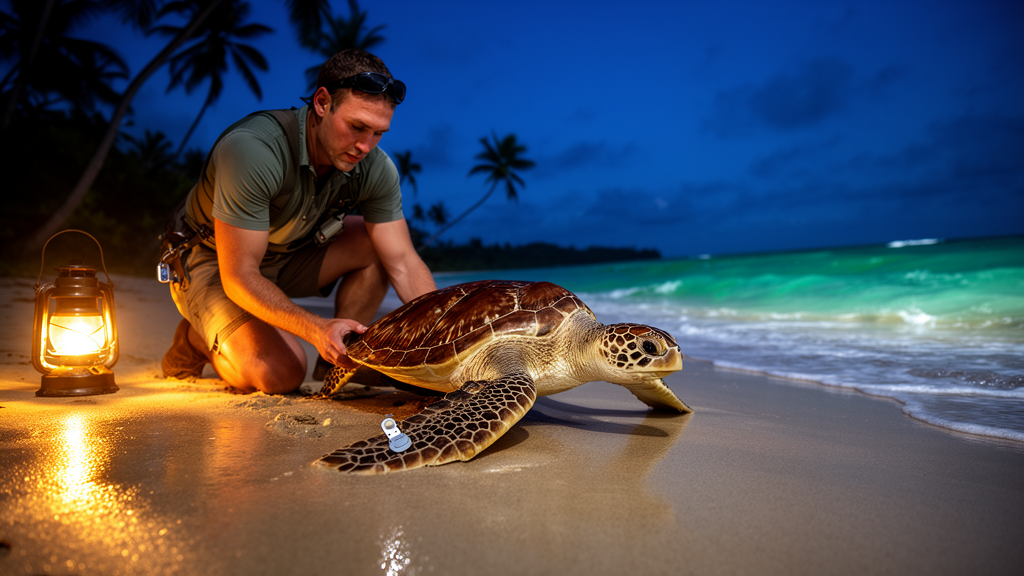
Off the southwestern coast of Trinidad’s neighbor Venezuela, in the warm, sediment-rich waters of the Gulf of Paria, a single sea turtle has just rewritten a small but meaningful piece of Caribbean conservation science. A male hawksbill turtle, first captured and tagged in June 2023 near Los Garzos Bay, turned up again in June 2025 in an artisanal longline near the Las Garcitas Islets, roughly 1.6 to 2 kilometers from where scientists had originally released him. The 727-day gap between captures may sound modest, but for researchers studying one of the ocean’s most elusive animals, it represents something rare: the first local flipper-tag recapture of an adult male hawksbill turtle near a major rookery in the region, and one of the very few direct glimpses anywhere into the hidden lives of male hawksbills during the breeding season.
The reason this single record matters so much lies in a stubborn asymmetry of sea turtle biology. Nesting females are, in a sense, the easiest turtles in the world to study. They haul themselves onto beaches in predictable numbers, dig conspicuous nests, and obligingly present themselves to teams of researchers who count, measure, and tag them season after season. Males never come ashore. Once hatchlings reach the sea, male sea turtles may not touch land again for decades, remaining fully aquatic and eluding the beach-based monitoring programs that have generated nearly everything science knows about sea turtle demography. As a result, adult males are among the least studied segments of any sea turtle population, and basic questions about where they live, how long they stay near breeding grounds, how often they return to mate, and how many reproductively active males are available in a given season remain largely unanswered, especially for hawksbills in the Caribbean.
Those questions are not academic curiosities. The number and availability of reproductively active males during a breeding season determine what ecologists call the operational sex ratio, a measure of the ratio of fertilizable females to sexually active males in a population. The operational sex ratio shapes mating competition, influences reproductive success, and feeds directly into estimates of population viability. Male behavior also underpins gene flow and patterns of multiple paternity, which have been documented in marine turtles through genetic studies showing that females may mate with several males across a season. If males are scarce, or if they visit breeding areas only intermittently, the reproductive output of a rookery could be affected in ways that female-focused nesting counts would never reveal. Understanding males is therefore essential to managing populations, particularly in key regions such the Caribbean Sea, where the hawksbill, a critically endangered species, still nests on scattered beaches.
The Gulf of Paria is exactly the kind of place where such knowledge is needed. Its hawksbill rookery ranks as the second largest for the species in the southern Caribbean Sea, yet it has shown worrying nesting declines in earlier assessments, raising questions about the population’s long-term prospects. Venezuelan sea turtle research has historically concentrated on nesting females, whether leatherbacks on the Paria Peninsula, green turtles at Aves Island, or the hawksbills of the Gulf of Paria itself. In-water research, the approach that can actually reach males, has been almost entirely absent from the country; the only comparable neritic study to date focused on hawksbill habitat in Los Roques Archipelago National Park. Against that backdrop, a team led by Clemente Balladares of Universidad Central de Venezuela, together with Marco Garcia-Cruz, José Alio, and Hector Barrios-Garrido, set out in April 2023 to gather whatever preliminary data they could on adult male hawksbills near the rookery, publishing their findings in Frontiers in Amphibian and Reptile Science.
Their method combined two deliberately separate sampling streams. The first was researcher-led: stationary net hauls conducted roughly every two weeks off Los Garzos Bay, adjacent to the main nesting beach. Each net, measuring 100 meters long by 10 meters deep with a fine 15-centimeter mesh, was set perpendicular to the coastline about 50 meters offshore in water 4 to 12 meters deep, and each two-hour haul began after sunrise, between 5 and 7 in the morning. Of 40 planned hauls, 33 were completed between April 2023 and November 2024, with the rest cancelled by rough seas or drifting Sargassum mats, yielding 60 hours of effective sampling effort. The second stream was fishery-dependent: from September 2023 to June 2025, trained local assistants validated reports from artisanal fishers landing their catch near Aricagua Bay, Calera, and the Las Garcitas Islets, recording species, measurements, photographs, gear type, tag numbers, and the condition of any turtles caught incidentally. The two datasets were never pooled, because their designs, effort levels, and detection probabilities differ too much to support combined analyses of abundance or residency.
Every captured turtle was brought aboard, disentangled, measured for curved carapace length and width, checked for injuries and buoyancy problems, and kept shaded and wet to minimize stress. Sexing an adult male relies on a visible anatomical signal: the tail of a mature male grows long enough to extend well beyond the rear edge of the carapace, a secondary sexual characteristic absent in females and juveniles. Turtles without tags received new Inconel tags on both front flippers, and photographs of carapace, head, and tags were taken before release to support future photo-identification. The research-led surveys captured nine turtles in total, six juvenile green turtles, one adult male green turtle, and two adult male hawksbills, for a capture rate of 0.15 turtles per hour. Meanwhile, the validated fishery records documented 15 incidental captures involving three gear types: stationary nets, single hooks, and a 250-meter longline, with stationary nets accounting for most reports.
The headline result came from one of those two male hawksbills. Tagged as V001M and V002M on 26 June 2023 in Los Garzos Bay, with a curved carapace length of 75 centimeters and width of 64 centimeters, he was recaptured on 22 June 2025 near the Las Garcitas Islets after becoming entangled in an artisanal longline. By then only one of his original tags remained, but tag V001M was enough to confirm his identity; he received two new tags and was released in good condition, his measurements essentially unchanged and his elongated tail again confirming his status as an adult male. Crucially, the recapture date fell at the peak of the nesting season, and the research team had also repeatedly observed solitary hawksbills and small groups of up to four individuals surfacing and engaging in courtship and mating near the Las Garcitas Islets during their surveys. Together, these observations provide the first preliminary evidence that adult male hawksbills occur in the Los Garzos Bay–Las Garcitas area during the breeding period, close to the rookery they would presumably serve.
The authors are careful, however, about what this record does and does not prove. A single recapture, however evocative, cannot demonstrate continuous residency, seasonal site fidelity, remigration periodicity, local male abundance, or reproductive connectivity between the males and the nesting females of the rookery. The fishery-dependent reports are opportunistic and subject to unknown reporting bias, so they document interactions rather than distribution. Two competing hypotheses now frame the next phase of work: either some adult males return repeatedly to the area across successive breeding seasons, or they appear only in breeding years separated by one or more skipped seasons, which would also produce a multi-year gap between sightings. Both possibilities echo questions better studied in male green and loggerhead turtles, whose breeding periodicity and breeding-area fidelity have been examined in places like the southern Great Barrier Reef. Environmental context may matter too: the Gulf of Paria’s anticyclonic circulation could help retain turtles locally, while seasonal productivity peaks during the June-to-November rainy season may shape the availability of the sponges and other benthic prey that hawksbills favor. A separate, remarkable record adds regional texture: a hawksbill originally tagged in Puerto Rico was recovered in Los Garzos Bay some 1,200 kilometers away, showing that at least some turtles using the gulf participate in much broader regional movements.
Turning to the future, the team argues that these findings justify neither immediate fishery closures nor the formal designation of the area as confirmed male habitat. Instead, they position the Las Garcitas Islets–Los Garzos Bay zone as a candidate site for targeted monitoring and participatory risk assessment with local fishers. Because the focal male was recaptured in fishing gear, the priority actions are practical: strengthening fisher reporting networks, promoting safe handling and release protocols, training crews, systematically documenting gear interactions, and encouraging photographic records of every capture. The researchers also lay out the technical toolkit needed to move from anecdote to evidence: satellite telemetry to trace male movements and residence times, multi-season mark–recapture programs to estimate abundance and fidelity, photo-identification to track individuals non-invasively, and genetic analyses to test whether the males near Las Garcitas actually fertilize clutches on the adjacent nesting beaches. Funding from the New England Aquarium’s Marine Conservation Action Fund, the International Sea Turtle Society, and Conservation Connect supported the work, and the collaboration of Macuro’s fishing communities proved indispensable at every step.
For now, one turtle’s two-year journey of barely two kilometers stands as a small, hard-won data point in a vast gap of knowledge. But its implications ripple outward. If male hawksbills gather near rookeries during breeding seasons, then the waters adjacent to nesting beaches, precisely the zones where artisanal fisheries operate, may be critical habitat that current conservation frameworks, built almost entirely around beaches and nesting females, simply do not see. Every additional recapture, every validated fisher report, and every satellite track from the Gulf of Paria will help determine whether the Gulf’s males are loyal residents of these shallow waters or intermittent visitors from distant foraging grounds, and whether protecting them requires seasonal measures negotiated with the very fishers whose nets and lines keep bringing these ghostly males back into view.
Subject of Research: First local flipper-tag recapture of an adult male hawksbill turtle near the Gulf of Paria rookery in Venezuela
Article Title: First local flipper-tag recapture of a male hawksbill turtle near a major rookery in the Gulf of Paria, Venezuela
Article References: Balladares, C., Garcia-Cruz, M., Alio, J., & Barrios-Garrido, H. (2026). First local flipper-tag recapture of a male hawksbill turtle near a major rookery in the Gulf of Paria, Venezuela. Frontiers in Amphibian and Reptile Science, 4, Article 1818436. https://doi.org/10.3389/famrs.2026.1818436
Image Credits: AI Generated
DOI: 10.3389/famrs.2026.1818436
Keywords: hawksbill turtle, sea turtles, male sea turtle ecology, mark-recapture, Gulf of Paria, Venezuela, operational sex ratio, artisanal fisheries, bycatch, rookery, Caribbean, conservation
Cite Scienmag News
Margaret Porter. (October 15, 2026). Tagged Male Hawksbill Turtle Returns to Venezuelan Rookery After Two Years at Sea. Scienmag. https://scienmag.com/tagged-male-hawksbill-turtle-returns-to-venezuelan-rookery-after-two-years-at-sea/
Margaret Porter. "Tagged Male Hawksbill Turtle Returns to Venezuelan Rookery After Two Years at Sea." Scienmag, 15 October 2026, https://scienmag.com/tagged-male-hawksbill-turtle-returns-to-venezuelan-rookery-after-two-years-at-sea/. Accessed 15 October 2026.
Margaret Porter. "Tagged Male Hawksbill Turtle Returns to Venezuelan Rookery After Two Years at Sea." Scienmag. October 15, 2026. https://scienmag.com/tagged-male-hawksbill-turtle-returns-to-venezuelan-rookery-after-two-years-at-sea/


