

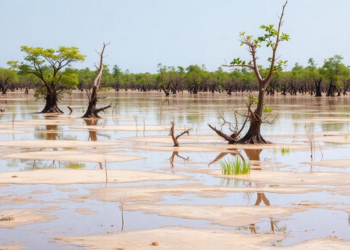
Wetlands pay back: sponge landscapes prove their socio-economic worth
Cost–benefit analysis of three European wetland projects shows monetised benefits exceeding costs, with payback periods from one to fifteen years.
Cost–benefit analysis of three European wetland projects shows monetised benefits exceeding costs, with payback periods from one to fifteen years.

A 2024 survey documents 202 White Stork nesting pairs in Georgia, a 40% increase over previously censused settlements, alongside 55 ...
A new survey of 24 Aegean island wetlands reveals that salinity, protection status, and sea barriers jointly structure phytoplankton communities, ...
Deep in the highlands of West Gojam, Ethiopia, a wetland the size of a small city is quietly disappearing. Denbiq ...
A new synthesis argues that India must move beyond expanding protected areas toward climate-adaptive, landscape-scale conservation that prioritises ecological quality, ...
The distinction between deep water and shallow water classes in the Bahr Al-Najaf classification scheme reflects a challenge familiar to ...
A five-year study of the Danube Delta's reedbeds shows the common reed stores up to 8.6 tonnes of carbon per ...
Wastewater treatment is undergoing a quiet revolution, and it smells like flowers rather than chemicals. A team of researchers from ...
A new version of the widely used MAGICC climate model incorporates a temperature-driven wetland methane feedback, raising projected warming slightly ...
A proactive digital PCR surveillance system in southern France detected West Nile and Usutu virus RNA in wetland waters and ...

Embark on a thrilling journey of discovery with Scienmag.com—your ultimate source for cutting-edge breakthroughs. Immerse yourself in a world where curiosity knows no limits and tomorrow’s possibilities become today’s reality!