

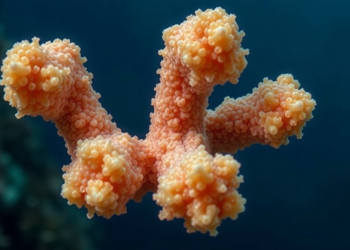
Deep-Sea Protein Survives Crushing Pressure by Assembling Into Threes
Researchers at Kyushu University found that the deep-sea protein PoXeR withstands extreme hydrostatic pressure by assembling into stabilizing trimeric structures.
Researchers at Kyushu University found that the deep-sea protein PoXeR withstands extreme hydrostatic pressure by assembling into stabilizing trimeric structures.

Stevens Institute of Technology researchers have calculated that a train of twelve weak, precisely timed laser pulses can control quantum ...
Researchers have shown that tuning the superposition of multiple Fano interferences in plasmonic nanostructures can significantly improve the efficiency of ...
Chemists have created a novel family of mixed-ligand copper, manganese, iron and zinc complexes from naphthoquinone Schiff bases that combine ...
A review explains how three-dimensional non-local thermodynamic equilibrium radiation-transfer models can improve interpretations of stars, exoplanets, and kilonovae.

Embark on a thrilling journey of discovery with Scienmag.com—your ultimate source for cutting-edge breakthroughs. Immerse yourself in a world where curiosity knows no limits and tomorrow’s possibilities become today’s reality!