

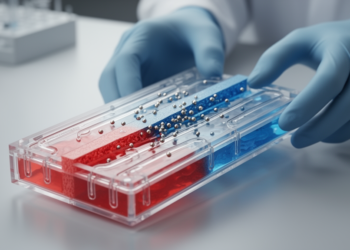
Placenta-on-a-chip reveals how toxic metals cross from mother to fetus
A microfluidic model built from primary human placental cells shows how cadmium undermines placental function at doses that cause no ...
A microfluidic model built from primary human placental cells shows how cadmium undermines placental function at doses that cause no ...

Researchers at the University of Otago have encapsulated antimicrobial mānuka oil and β-triketones in chitosan nanoparticles that release the compounds ...
Researchers at Xi'an Jiaotong University have developed a bioinspired fluidic strain sensor whose drum-shaped microstructures harness the Poisson effect to ...
Researchers at Rice University have developed 3D-nanoprinted reflective micromirror inserts that enable single-objective light sheet microscopy in commercially available sample ...
Researchers at Sungkyunkwan University have built a 444-chamber microfluidic chip that physically recreates viral transmission, social distancing effects, and herd-immunity-like ...
Fluorescent defects in atomically thin hexagonal boron nitride can detect and identify individual ions in liquids through spectral shifts, enabling ...
Researchers at Peking University have developed a horizontal-up manifold microchannel cooler that uses the dielectric fluid HFE-7100 to achieve a ...
Researchers in Portugal have developed a passive microfluidic multiplexer that mixes fluids at flow rate ratios up to 1:6 and ...
A microfluidic nanoblade device that slices open the membranes of thousands of cells at once reveals that cells prioritize repairing ...
A Stanford-led review in Nature Biomedical Engineering maps how multi-organ tissue chips that preserve each organ's native niche could transform ...

Embark on a thrilling journey of discovery with Scienmag.com—your ultimate source for cutting-edge breakthroughs. Immerse yourself in a world where curiosity knows no limits and tomorrow’s possibilities become today’s reality!