

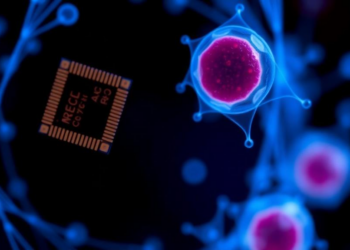
Microfluidic Chip and Deep Learning Join Forces to Catch Rare Tumor Cells in Blood
Researchers at Taiyuan University of Technology and Shanxi Bethune Hospital have developed a label-free platform that combines inertial microfluidic cell ...
Researchers at Taiyuan University of Technology and Shanxi Bethune Hospital have developed a label-free platform that combines inertial microfluidic cell ...

A new review in Advanced Composites and Hybrid Materials outlines how hybridizing polydiacetylene polymers with inorganic scaffolds, polymer matrices, and ...
Researchers at Chungnam National University have shown that the size of retroreflective Janus particles critically determines DNA detection performance, achieving ...
A commentary in LabMed Discovery examines a CRISPR-assisted nanodroplet platform that combines broad-range amplification with species-specific recognition to enable rapid, ...
A 3D bioprinted human coronary artery equivalent reproduces Kawasaki disease vasculitis using patient serum and enables rapid drug screening.
Researchers at the University of Southampton show that a mild saponin-based lysis protocol preserves the viability of Gram-positive bacteria extracted ...
Researchers have engineered an elliptical inertial microfluidic device that isolates circulating tumor cells from blood with high efficiency and minimal ...
A new perspective in Biocontaminant outlines an integrated biosensing framework for shifting aquatic pathogen monitoring from periodic single-target laboratory tests ...
A new microfluidic method called spatial Hi-C maps genome-wide 3D chromatin folding directly within intact brain tissue sections, revealing lobule-specific ...
A new hybrid simulation framework shows that a cancer cell's shape sets its deformation pathway in blood flow while membrane ...

Embark on a thrilling journey of discovery with Scienmag.com—your ultimate source for cutting-edge breakthroughs. Immerse yourself in a world where curiosity knows no limits and tomorrow’s possibilities become today’s reality!