

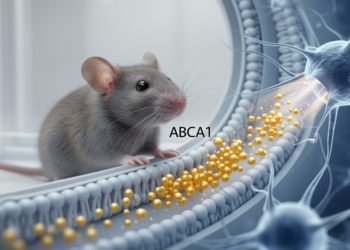
ABCA1 cholesterol trafficking implicated in Parkinson’s neurodegeneration in mice
Human postmortem tissue, cultured cells and mouse experiments implicated abnormal ABCA1-dependent cholesterol trafficking in Parkinson’s-related neurodegeneration.
Human postmortem tissue, cultured cells and mouse experiments implicated abnormal ABCA1-dependent cholesterol trafficking in Parkinson’s-related neurodegeneration.

Researchers at Amsterdam UMC report that disrupting the lysosomal enzyme PLA2G15 reduces stress-induced senescence and reshapes BMP phospholipid metabolism in ...
Researchers at the Federal University of Rio de Janeiro have built a primary chick muscle cell culture model in which ...
A new study of human skin fibroblasts from donors aged 20 to 96 shows that autophagy's early stages remain intact ...
A new review argues that the same molecular features that make fluorescent probes bright and targetable also perturb the living ...
New research shows that the age-related decline of the mitochondrial protein CHCHD2 disrupts the mitochondria-lysosome axis and drives proteostatic collapse ...
Researchers discovered that the bacterium Pseudomonas aeruginosa exploits neuronal signaling in C. elegans to impair lysosomal function and disrupt collagen ...
New research in Nature Aging shows that the age-related decline of chaperone-mediated autophagy distorts the senescent cell secretome and disables ...
New research reveals that the nutrient sensor CPT1C protects hypothalamic neurons by restraining the BMP-hydrolyzing enzyme ABHD6, preserving the endolysosomal ...
A Nature study from TIGEM reveals a previously unknown TBK1-ULK1 signaling pathway that controls the master recycling regulator TFEB, exposing ...

Embark on a thrilling journey of discovery with Scienmag.com—your ultimate source for cutting-edge breakthroughs. Immerse yourself in a world where curiosity knows no limits and tomorrow’s possibilities become today’s reality!