


DESI Data Suggests Dark Energy May Be Evolving
DESI data suggests dark energy may be evolving, challenging the standard cosmological model and prompting new theoretical frameworks.
DESI data suggests dark energy may be evolving, challenging the standard cosmological model and prompting new theoretical frameworks.

Researchers have constrained modified teleparallel gravity models using baryon acoustic oscillation and gravitational wave data, finding viable alternatives to standard ...

Relativistic calculations reveal that magnetic pressure anisotropy from Landau quantization significantly contracts white dwarf radii while leaving maximum masses largely ...

A quasiparticle model of magnetized strange quark matter predicts strange quark star masses rising from 1.66 to 2.19 solar masses ...

A new theoretical study finds that a periodic axion dark energy model yields stable late-time cosmic acceleration within its observationally ...
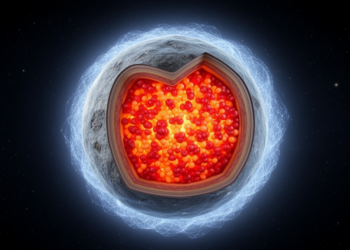
A theoretical study finds that an axion field would shift the hadron-quark phase transition in hybrid stars to lower densities, ...
A theoretical analysis finds that the apparent preference for evolving dark energy over a cosmological constant is modest and depends ...
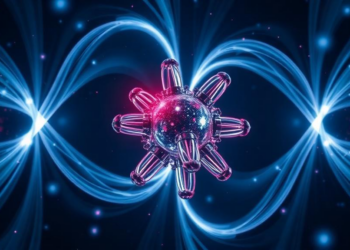
A new one-loop hard-dense-loop calculation reveals that cold quark matter under ultra-strong magnetic fields becomes paramagnetic and develops strongly anisotropic ...

A new theoretical analysis shows that a maximally charged thin shell in Einstein gravity coupled to Born–Infeld electrodynamics can be ...

A lattice-constrained effective model reveals sharp peaks in specific heat and a rapid stiffening of the isentropic bulk modulus as ...


Embark on a thrilling journey of discovery with Scienmag.com—your ultimate source for cutting-edge breakthroughs. Immerse yourself in a world where curiosity knows no limits and tomorrow’s possibilities become today’s reality!