


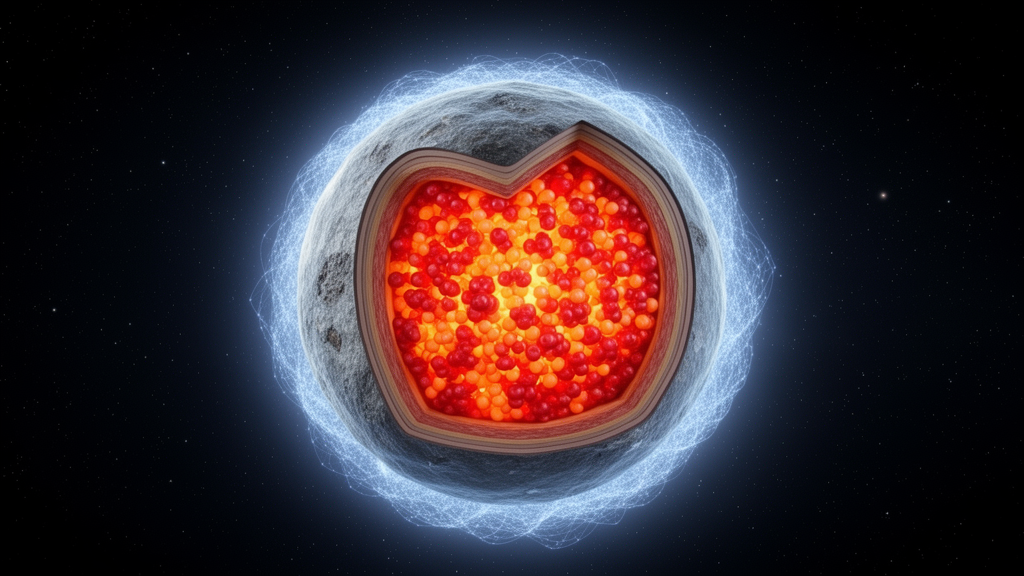
A new theoretical study suggests that axions, hypothetical particles often proposed as dark matter candidates, could dramatically reshape the interiors of the universe’s densest stars. According to calculations published in The European Physical Journal C, an axion field would push the transition from hadronic matter to quark matter to much lower densities inside hybrid stars, allowing quark cores to appear earlier and grow far larger than in models without axions. In the most extreme case considered, the quark core of a maximum-mass hybrid star swells to hold roughly 0.36 solar masses of matter, with a radius exceeding five kilometres, approaching half of the star’s total radius.
The work, led by Yu-Heng Liu, He Liu, Hong-Ming Liu, Min Ju, Xu-Hao Wu and Peng-Cheng Chu, addresses one of the most stubborn open questions in nuclear physics and astrophysics: what happens to matter at densities far beyond anything achievable in laboratory experiments. The equation of state of strongly interacting matter, which encodes how pressure and energy density relate to one another, determines the structure of compact objects such as neutron stars. Whether a transition from hadrons to deconfined quarks occurs in the cores of these stars remains unresolved, and first-principles lattice QCD calculations cannot currently reach the cold, dense regime because of the so-called sign problem.
To explore the problem, the team constructed a hybrid-star equation of state using the Maxwell construction, in which the hadronic and quark phases share the same pressure and baryon chemical potential at the transition but differ in their energy and number densities, producing a sharp first-order phase transition. The hadronic phase was described with the improved isospin- and momentum-dependent interaction (ImMDI) model, using a fixed parameter set chosen to be compatible with empirical constraints on nuclear matter and sufficiently stiff to support massive neutron stars. The quark phase was modelled with a three-flavor Nambu–Jona-Lasinio (NJL) framework, an effective low-energy description of QCD that captures the essential chiral dynamics of dense quark matter.
The crucial innovation lies in how the axion enters the quark-matter description. The QCD axion was originally introduced through the Peccei-Quinn mechanism to solve the strong charge-parity problem, and it is now widely regarded as a promising dark-matter candidate. Because axions couple to the QCD sector, they modify the thermodynamics of dense quark matter. In the NJL Lagrangian, the axion field appears as a chiral rotation angle in the Kobayashi-Maskawa-‘t Hooft (KMT) determinant interaction, which breaks the axial U(1)_A symmetry and couples different quark flavours. A nonzero axion field mixes the scalar and pseudoscalar condensate channels, so the constituent quark masses acquire both scalar and pseudoscalar contributions determined self-consistently from modified gap equations.
The team treated the scaled axion field a/f_a, where f_a is the axion decay constant, as a control parameter ranging from zero to pi, reflecting the periodic nature of the chiral rotation angle. The vector coupling G_V in the quark sector was varied independently as a second control parameter. Because the axion modifies the KMT interaction, the calculation also introduces pseudoscalar condensates alongside the usual scalar condensates, and the thermodynamic potential acquires terms proportional to both the cosine and the sine of the axion angle, which couple the two sectors explicitly.
The central result concerns the location of the hadron-quark phase transition. Increasing the axion field shifts the transition point to significantly lower baryon densities and pressures, meaning quark matter would appear earlier in the star’s evolution as central density rises. At the same time, the axion slightly stiffens the equation of state of the quark phase itself, increasing the pressure at a given energy density in a way that is nearly independent of density. These two effects compete: the stiffening of the quark phase pushes against the softening introduced by the earlier onset of the first-order transition, and during the transition the softening can dominate, making the overall hybrid-star equation of state softer.
This behaviour contrasts sharply with the role of the vector interaction between quarks. Increasing G_V stiffens the quark equation of state and simultaneously pushes the onset of the first-order transition to higher densities and pressures, making the entire hybrid-star equation of state stiffer. In the calculations, the vector interaction turned out to be the dominant influence on the maximum mass of hybrid stars: as G_V increases, the maximum mass rises significantly, with all maximum masses close to or exceeding two solar masses and corresponding radii in the range of twelve to thirteen kilometres. The axion field, by comparison, has only a very weak effect on the maximum mass, producing only minor fluctuations, because the maximum mass primarily constrains the equation of state near the transition at densities of two to five times nuclear saturation density, where the axion’s competing effects partially cancel.
The most striking consequences appear in the structure of the quark core. Using the Tolman-Oppenheimer-Volkoff equations for spherically symmetric, static stars, the team computed the mass-radius relations of hybrid stars and tracked the growth of the quark core as central density increases. When the vector coupling is zero, increasing the axion field from zero to pi raises the quark core mass from 0.04 to 0.36 solar masses and grows its radius from 2.3 to 5.1 kilometres, approaching half of the total stellar radius. The axion achieves this by substantially lowering the onset density of the quark phase, allowing the core to appear at lower central densities and expand outward as density increases. Conversely, as the vector coupling increases, the quark core shrinks significantly and may even disappear entirely, at which point the axion’s influence on the star vanishes as well.
To characterise the dense matter further, the authors examined the squared speed of sound and the polytropic index, two quantities considered useful approximate criteria for identifying quark matter in neutron stars. At saturation density, the squared speed of sound is well below the conformal limit of one third and the polytropic index is close to three, consistent with mainstream hadronic models. In the high-density quark phase, the axion field has only a very mild effect on both quantities, slightly reducing the polytropic index, which indicates that the axion-induced pressure increase is nearly independent of density. The primary role of the axion, from this perspective, is to shift the onset and density range of the first-order transition rather than to alter the intrinsic stiffness of the quark phase. With zero vector coupling, both quantities converge toward the conformal limit at high density, while nonzero vector coupling drives them to increase and even exceed the conformal limit of a free Fermi gas.
The study also checked its results against multi-messenger observational constraints, including Bayesian analyses of the pulsars PSR J0030+0451 and PSR J0740+6620 and the gravitational-wave signal from the neutron-star merger GW170817, whose tidal deformability measurement for a 1.4 solar mass neutron star bounds the allowed equation of state. Masses and radii of the hybrid stars in all parameter sets considered were found to be mostly consistent with these constraints. Notably, in every parameter set, stars of 1.4 solar masses contain no quark core, so the axion has no effect on such stars in this model; the effects emerge only in the most massive stars. The authors emphasise that their Maxwell construction describes a sharp first-order transition and, like the alternative Gibbs construction, neglects finite-size effects such as surface and Coulomb contributions, which they identify as a target for future work. As multi-messenger observations improve, combining more precise tidal deformability and radius measurements with theoretical predictions of this kind may, they suggest, help constrain the strength of the axion-quark coupling and potentially reveal other signatures of physics beyond the Standard Model in dense matter.
Subject of Research: Theoretical modelling of axion effects on the hadron-quark phase transition and quark cores in hybrid neutron stars
Article Title: Axion effects on hybrid stars: earlier hadron-quark phase transition and larger quark-matter cores
Article References: Liu, Y.-H., Liu, H., Liu, H.-M., Ju, M., Wu, X.-H., & Chu, P.-C. (2026). Axion effects on hybrid stars: earlier hadron-quark phase transition and larger quark-matter cores. The European Physical Journal C, 86(10), Article 1232. https://doi.org/10.1140/epjc/s10052-026-16460-y
Image Credits: AI Generated
DOI: 10.1140/epjc/s10052-026-16460-y
Keywords: axions, hybrid stars, neutron stars, quark matter, hadron-quark phase transition, equation of state, NJL model, Maxwell construction, speed of sound, dark matter, compact stars, dense matter
Cite Scienmag News
Katie Riggs. (October 27, 2026). Axions Could Grow Giant Quark Cores Inside Neutron Stars, Theoretical Study Finds. Scienmag. https://scienmag.com/axions-could-grow-giant-quark-cores-inside-neutron-stars-theoretical-study-finds/
Katie Riggs. "Axions Could Grow Giant Quark Cores Inside Neutron Stars, Theoretical Study Finds." Scienmag, 27 October 2026, https://scienmag.com/axions-could-grow-giant-quark-cores-inside-neutron-stars-theoretical-study-finds/. Accessed 27 October 2026.
Katie Riggs. "Axions Could Grow Giant Quark Cores Inside Neutron Stars, Theoretical Study Finds." Scienmag. October 27, 2026. https://scienmag.com/axions-could-grow-giant-quark-cores-inside-neutron-stars-theoretical-study-finds/


