


Deepfake Image Tracing Framework Achieves High Accuracy Through Latent Feature Analysis
A new latent feature analysis method attributes manipulated face images to specific deepfake sources with high accuracy.
A new latent feature analysis method attributes manipulated face images to specific deepfake sources with high accuracy.

A study of 1,505 participants reveals that need for cognition and need for affect show distinct associations with self-reported responses ...

Brown University researchers have mapped the digital ecosystem enabling AI-generated non-consensual intimate images, arguing that current laws fail to address ...

A new narrative review argues that generative AI simultaneously produces, detects, corrects, and amplifies the consequences of health misinformation across ...

A scoping review of 50 studies finds that Egypt's cybercrime law recognizes digital evidence but lacks mandatory tool validation, laboratory ...

Across four experiments, pooling group judgements improved deepfake detection while confidence weighting hurt accuracy and people readily followed incorrect algorithmic ...

Research indicates that political deepfakes are more likely to be reported than real videos because they are perceived as less ...
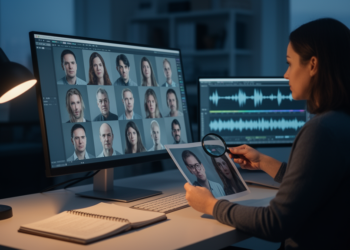
Researchers propose a five-pillar Information-Integrity Readiness framework to assess whether states can preserve trustworthy information ecosystems under pervasive synthetic media, ...

A new editorial synthesizing ten studies argues that artificial intelligence is transforming social engineering from human-devised deception into an AI-mediated ...
A conceptual five-layer framework proposes that calibrated trust in AI-era photojournalism depends on evidence, traceability, institutional accountability, and audience interpretation ...


Embark on a thrilling journey of discovery with Scienmag.com—your ultimate source for cutting-edge breakthroughs. Immerse yourself in a world where curiosity knows no limits and tomorrow’s possibilities become today’s reality!