

Wednesday, November 18, 2026
Science
No Result
View All Result
  • Login
  • HOME
  • SCIENCE NEWS
  • CONTACT US
  • HOME
  • SCIENCE NEWS
  • CONTACT US
No Result
View All Result
Scienmag
No Result
View All Result
Home Science News Medicine

Deepfake Image Tracing Framework Achieves High Accuracy Through Latent Feature Analysis

November 11, 2026
in Medicine
Ophelia Keating
By Ophelia Keating Scienmag Editorial Profile - Health Services Research
Reading Time: 2 mins read
0
Deepfake Image Tracing Framework Achieves High Accuracy Through Latent Feature Analysis

Deepfake Image Tracing Framework Achieves High Accuracy Through Latent Feature Analysis

65
SHARES
587
VIEWS
Share on FacebookShare on Twitter
ADVERTISEMENT

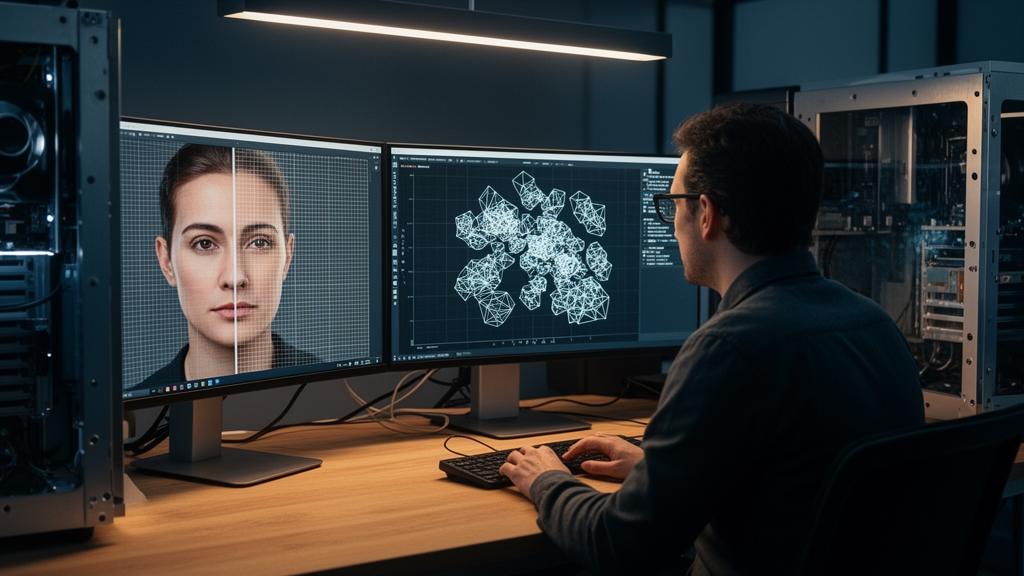
Researchers Tianli Guo and Yunqi Tang have presented a deepfake face image source tracing framework that achieved an overall tracing accuracy of 0.9911 through the analysis of discriminative latent features. Published in the International Journal of Legal Medicine, the study directly addresses a notable shortcoming in contemporary multimedia forensics, where conventional research remains largely focused on binary authenticity classification. While binary tools can determine whether a given face image is authentic or synthetic, that binary output fails to satisfy practical judicial tracing demands. In forensic identification, identifying the specific deepfake generation method responsible for an image is critical for extending the evidentiary value of digital evidence in legal and investigative contexts. To bridge this gap, the authors developed a fine-grained prototype designed to trace forged face images back to their underlying generation mechanisms.

To establish and evaluate the source tracing system, the authors assembled an extensive experimental dataset spanning 31 distinct categories and 620,000 images representing mainstream facial forgery mechanisms. This collection comprised one real-face class alongside 30 separate deepfake classes. To extract discriminative latent features from this varied imagery, the researchers designed a multi-classification neural network based on the EfficientNet-B4 architecture.

The proposed framework converts the latent feature representations into 31-dimensional confidence vectors corresponding to the classification categories. To establish structured reference points for attribution, the researchers carried out hierarchical clustering on these latent feature-derived confidence vectors. This clustering analysis identified 10 optimal clusters across the feature space. The team then designated the geometric cluster centers as tracing anchors.

In experimental evaluations, the multi-classification model combining the base EfficientNet-B4 network with hard-class weighting achieved an accuracy of 0.9568. Performance across individual categories was consistently high, with nearly all classes attaining Top-3 accuracy above 0.97. Furthermore, all 30 deepfake forgery classes demonstrated homologous consistency rates exceeding 0.95, contributing to the framework’s overall tracing accuracy of 0.9911. Beyond testing on known manipulation classes, the investigators evaluated the framework’s behavior against previously unencountered manipulation techniques using the Roop face-swap tool. That validation confirmed the preliminary feasibility of the tracing framework when confronted with one type of unseen forgery.

The authors concluded that the framework successfully upgrades digital face forensics from simple binary authenticity discrimination to a fine-grained source-tracing prototype, establishing technical foundations for future applications in digital forensic identification and criminal investigation. Nevertheless, the study highlighted clear operational boundaries prior to practical forensic deployment. The current implementation remains an experimental prototype, and the authors explicitly identified two priorities for future research: expanding the category dataset to encompass a wider spectrum of emerging manipulation techniques and optimizing the model’s adaptability under variable, real-world forensic conditions before active deployment can be realized.

Subject of Research: Forensic source tracing of deepfake face images via latent feature analysis

Article Title: Deepfake face image source tracing via latent feature analysis

Article References: Guo, T., & Tang, Y. (2026). Deepfake face image source tracing via latent feature analysis. International Journal of Legal Medicine. https://doi.org/10.1007/s00414-026-04060-0

Image Credits: AI Generated

DOI: 10.1007/s00414-026-04060-0

Keywords: deepfakes, forensic identification, image forensics, latent feature analysis, source tracing, EfficientNet-B4, digital evidence, facial manipulation, Deepfake, face, image, source

Cite Scienmag News

Ophelia Keating. (November 11, 2026). Deepfake Image Tracing Framework Achieves High Accuracy Through Latent Feature Analysis. Scienmag. https://scienmag.com/deepfake-image-tracing-framework-achieves-high-accuracy-through-latent-feature-analysis/

Ophelia Keating. "Deepfake Image Tracing Framework Achieves High Accuracy Through Latent Feature Analysis." Scienmag, 11 November 2026, https://scienmag.com/deepfake-image-tracing-framework-achieves-high-accuracy-through-latent-feature-analysis/. Accessed 18 November 2026.

Ophelia Keating. "Deepfake Image Tracing Framework Achieves High Accuracy Through Latent Feature Analysis." Scienmag. November 11, 2026. https://scienmag.com/deepfake-image-tracing-framework-achieves-high-accuracy-through-latent-feature-analysis/

Tags: deepfakedeepfakesdigital evidenceEfficientNet-B4facefacial manipulationforensic identificationimageimage forensicslatent feature analysissourcesource tracing
Share26Tweet16
Previous Post

Ciprofloxacin Resistance Fell While Amikacin Resistance Rose in Karachi Hospital Study

Next Post

Integrated Training Programme Enhances Prosthodontic Resident Knowledge and Clinical Skills

Related Posts

Seven-Day Recall Tests Reveal Accelerated Long-Term Memory Forgetting in Multiple Sclerosis
Medicine

Seven-Day Recall Tests Reveal Accelerated Long-Term Memory Forgetting in Multiple Sclerosis

November 18, 2026
Enhanced Recovery Protocols Reduce Intravenous Infusion Volumes After Pancreaticoduodenectomy Surgery
Medicine

Enhanced Recovery Protocols Reduce Intravenous Infusion Volumes After Pancreaticoduodenectomy Surgery

November 18, 2026
Five Clinical Measures Help Distinguish Ulcerative Colitis From Crohn’s Disease
Medicine

Five Clinical Measures Help Distinguish Ulcerative Colitis From Crohn’s Disease

November 18, 2026
Adult GLUT1 Deficiency Syndrome Diagnosis Reveals Broad Phenotypic Diversity
Medicine

Adult GLUT1 Deficiency Syndrome Diagnosis Reveals Broad Phenotypic Diversity

November 18, 2026
Scoping Review Identifies Effectiveness Evidence Across Twenty Years of One Health Interventions
Medicine

Scoping Review Identifies Effectiveness Evidence Across Twenty Years of One Health Interventions

November 18, 2026
Geospatial Proxies Reveal Stable Peri-Urban Health Units in Coastal Kenya
Medicine

Geospatial Proxies Reveal Stable Peri-Urban Health Units in Coastal Kenya

November 18, 2026
Next Post
Integrated Training Programme Enhances Prosthodontic Resident Knowledge and Clinical Skills

Integrated Training Programme Enhances Prosthodontic Resident Knowledge and Clinical Skills

  • Mothers who receive childcare support from maternal grandparents show more optimized

    Mothers who receive childcare support from maternal grandparents show more parental warmth, finds NTU Singapore study

    27656 shares
    Share 11059 Tweet 6912
  • University of Seville Breaks 120-Year-Old Mystery, Revises a Key Einstein Concept

    1061 shares
    Share 424 Tweet 265
  • Bee body mass, pathogens and local climate influence heat tolerance

    682 shares
    Share 273 Tweet 171
  • Researchers record first-ever images and data of a shark experiencing a boat strike

    546 shares
    Share 218 Tweet 137
  • Groundbreaking Clinical Trial Reveals Lubiprostone Enhances Kidney Function

    531 shares
    Share 212 Tweet 133
Science

Embark on a thrilling journey of discovery with Scienmag.com—your ultimate source for cutting-edge breakthroughs. Immerse yourself in a world where curiosity knows no limits and tomorrow’s possibilities become today’s reality!

RECENT NEWS

  • Traditional Leaders in Lesotho View Depression Through Social and Psychosocial Lenses
  • Optical Pre-Sensor Computing Processes Visual Data Directly Within Incident Light Fields
  • Nanomaterial Integration Enhances Trace Heavy Metal Detection Across Electrochemical and Optical Platforms
  • Seven-Day Recall Tests Reveal Accelerated Long-Term Memory Forgetting in Multiple Sclerosis

Categories

  • Agriculture
  • Anthropology
  • Archaeology
  • Athmospheric
  • Biology
  • Biotechnology
  • Blog
  • Bussines
  • Cancer
  • Chemistry
  • Climate
  • Earth Science
  • Editorial Policy
  • Marine
  • Mathematics
  • Medicine
  • Pediatry
  • Policy
  • Psychology & Psychiatry
  • Science Education
  • Science News
  • Social Science
  • Space
  • Technology and Engineering

Subscribe to Blog via Email

Enter your email address to subscribe to this blog and receive notifications of new posts by email.

Join 5,151 other subscribers

© 2026 Scienmag - Science Magazine

Welcome Back!

Login to your account below

Forgotten Password?

Retrieve your password

Please enter your username or email address to reset your password.

Log In
No Result
View All Result
  • HOME
  • SCIENCE NEWS
  • CONTACT US

© 2026 Scienmag - Science Magazine

Discover more from Science

Subscribe now to keep reading and get access to the full archive.

Continue reading

