

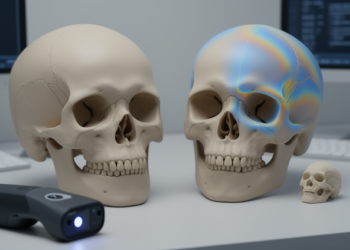
3D scan method quantifies skull remodelling in two craniosynostosis cases
A three-stage computational workflow used 3D scans to measure skull remodelling during craniosynostosis surgery in two infants, with registration errors ...
A three-stage computational workflow used 3D scans to measure skull remodelling during craniosynostosis surgery in two infants, with registration errors ...

A statistical shape model aligned three displaced fragments in 10 controlled pseudo-fractures with near-millimetric accuracy, but real-fracture validation remains necessary ...
A new FEA-driven algorithm selectively reinforces high-stress zones of 3D-printed titanium jaw reconstruction plates, cutting peak stress by up to ...
A staged, uncertainty-aware registration framework called PSRR outperformed standard algorithms in 120 water-tank phantom trials, cutting ultrasound-to-CT alignment error by ...
Dutch researchers have developed a deep learning system that automatically divides CT scans into the thirteen anatomical regions used for ...
Researchers at the Technical University of Munich have applied the Functional Resonance Analysis Method quantitatively to surgical scheduling for the ...
Researchers at RWTH Aachen University tested private 5G and Wi-Fi 6 networks for cable-free surgical navigation and found that Wi-Fi ...
Researchers in London have developed NeuralShift, a deep learning framework that predicts brain deformation during temporal lobe resection for epilepsy ...
Researchers have developed an AI framework that learns to automatically guide an ultrasound probe to liver target views by imitating ...

Embark on a thrilling journey of discovery with Scienmag.com—your ultimate source for cutting-edge breakthroughs. Immerse yourself in a world where curiosity knows no limits and tomorrow’s possibilities become today’s reality!