


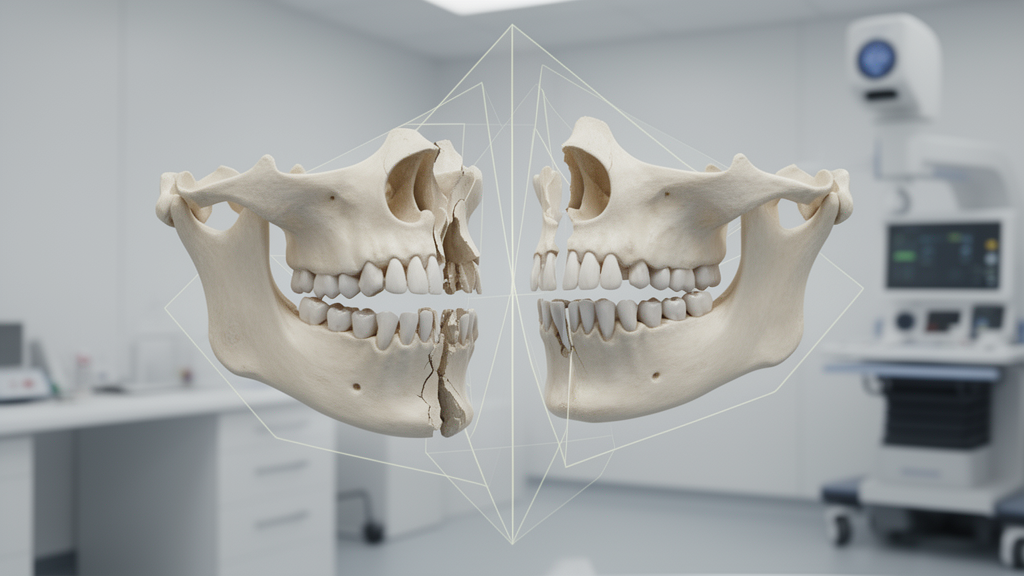
A statistical shape model that estimates an intact mandibular form and uses it to reposition displaced bone fragments achieved near-millimetric geometric accuracy in a controlled proof-of-concept study of 10 pseudo-fractured mandibles. The Japanese research team used CT-derived models in which intact jaws were divided into three pieces and displaced to mimic fracture fragments. After automated virtual reduction with corresponding sex-specific models, the reconstructed mandibles differed from the intact ground truth by a mean symmetric chamfer distance of 0.712 ± 0.210 mm and a mean symmetric root-mean-square error of 0.855 ± 0.231 mm.
The findings support technical feasibility under controlled conditions, but the study did not test real fractures or establish clinical benefit. The study addresses a demanding part of computer-assisted mandibular fracture planning, where three-dimensional CT can show the relationship among bone fragments but segmentation, separation, alignment and selection of a reduction target still depend substantially on manual work and surgical judgment. Contralateral mirroring can supply an anatomical reference in some cases, but it is unsuitable when the opposite side is affected or markedly asymmetric.
The new approach instead uses population-derived information to estimate a patient-adaptive target while simultaneously estimating the relative positions of multiple fragments. For this single-center retrospective methodological study, investigators at Tokai University Hospital in Japan collected maxillofacial CT scans acquired between January 2021 and March 31, 2024. The broader cohort contained 289 patients aged 18 to 63 years: 178 males and 111 females, with a mean age of 34.54 ± 13.85 years.
Patients were excluded if they had mandibular fractures, deformities, pathological osseous lesions, severe metal artifacts or extensive tooth loss, because the investigators required intact mandibular geometry. Ten cases—five male and five female, with a mean age of 38.20 ± 16.56 years—were reserved for pseudo-fracture evaluation. The remaining 279 cases, comprising 173 males and 106 females, were used to train the statistical models.
The institutional review committee approved the study, and written consent was waived under an opt-out policy for anonymized, pre-existing data. The researchers first converted the CT data into three-dimensional mandibular surface meshes. A previously reported automated deep-learning model performed segmentation, after which the results were manually refined in 3D Slicer and exported as STL files.
Separate male and female statistical shape models were constructed, along with a combined-sex model used as an exploratory baseline. Non-rigid registration with Bayesian coherent point drift established corresponding points across the jaw surfaces, while repeated atlas updating reduced dependence on the initial template. Principal component analysis then represented population variation around a mean shape through a mean configuration, eigenvectors, eigenvalues and principal component scores.
The number retained for each model was the minimum required to explain 95% of cumulative variance. Left–right mirrored shapes were included during model construction to balance morphology in the two directions and reduce directional bias in atlas and principal component analysis. This augmentation produced 346 male shapes from 173 original training mandibles and 212 female shapes from 106 originals.
The combined-sex model contained 558 shapes derived from 279 training cases. It was important to note that mirroring increased the number of shape configurations but did not increase the number of independent patients. The minimum numbers of principal components required to reach 95% cumulative explained variance were 28 for the male model, 32 for the female model and 29 for the combined-sex model.
Their template meshes contained 34,830, 33,026 and 34,830 vertices, respectively. To create the controlled evaluation dataset, the researchers divided each of the 10 intact validation mandibles into three fragments using two manually defined planar osteotomies. The cut planes were positioned with reference to clinically common fracture regions while avoiding extremely small pieces that would be unsuitable for algorithmic assessment.
The fragments were then separated and displaced with case-specific rigid translations and rotations. Each pseudo-fracture configuration was processed with the corresponding sex-specific statistical shape model and with the combined-sex model. Because the original intact mandible remained available for each case, it could serve as subject-specific ground truth and permit direct measurement of reconstruction error.
During reduction, each fragment mesh was converted into a point cloud, with points allocated in proportion to fragment surface area and 30,000 points sampled across the three fragments. Global and fragment-level iterative closest point registration provided an initial alignment with the model’s mean shape. The covariance matrix adaptation evolution strategy, a gradient-free stochastic method designed for nonconvex objective functions, then jointly optimized 18 rigid parameters—three rotations and three translations for each of the three fragments—together with the statistical model’s shape coefficients.
This joint search estimated both the candidate anatomical target and the configuration of the fragments. It did not use an individual patient’s unaffected jaw as a direct mirrored template, although its objective function did not explicitly enforce physical contact, collision avoidance, occlusion, condylar position or fracture-surface correspondence. Symmetric chamfer distance was defined as the mean of bidirectional nearest-neighbor distances between the reconstruction and ground truth.
Symmetric root-mean-square error was calculated as the average of the two directional root-mean-square nearest-neighbor errors. The sex-specific models produced mean symmetric chamfer distances of 0.712 ± 0.210 mm and mean symmetric root-mean-square errors of 0.855 ± 0.231 mm. For male cases, the corresponding mean chamfer and root-mean-square values were 0.635 ± 0.111 mm and 0.769 ± 0.127 mm; for female cases, they were 0.788 ± 0.268 mm and 0.942 ± 0.293 mm.
Qualitative comparisons assessed whether the reductions reproduced the mandibular body, ramus, condylar regions and overall contour. The combined-sex model yielded numerically larger mean errors: 0.778 ± 0.309 mm for symmetric chamfer distance and 0.937 ± 0.358 mm for symmetric root-mean-square error. Sex-specific models produced lower errors in six of the 10 cases for chamfer distance and seven of 10 for root-mean-square error.
The paired mean difference between the combined and sex-specific approaches was 0.067 mm for chamfer distance, with a bootstrap 95% confidence interval of −0.011 to 0.148 mm, and 0.082 mm for root-mean-square error, with an interval of −0.008 to 0.180 mm. Exact two-sided Wilcoxon signed-rank tests gave p = 0.232 and p = 0.193, respectively. Because only five validation cases were assigned to each sex-specific subgroup and the analysis was exploratory, the numerical differences did not demonstrate a statistically significant advantage for modeling the sexes separately.
Fixed-scale surface-distance maps showed that reduced models generally reproduced the broad shape of the mandible, while also revealing local shortcomings. Some cases retained gaps between fragments or showed interpenetration despite an anatomically plausible overall outline. The distance-based optimization could therefore reward a coherent global contour without guaranteeing that fragment surfaces met appropriately or did not overlap.
The investigators proposed adding collision penalties, contact-aware distance terms and constraints based on fracture surfaces, occlusion and condylar positioning. They also identified possible computational improvements, including early stopping, coarse-to-fine optimization, better initial registration, GPU-accelerated nearest-neighbor calculation and adaptive point sampling. The current system required approximately 23 minutes for each reduction run, which is more consistent with offline planning than with time-critical intraoperative use.
Several limitations prevent the surface-distance results from being interpreted as evidence of accuracy in real fractures. The pseudo-fractures consisted of three pieces separated by two straight cuts and did not reproduce irregular fracture geometry, comminution, bone loss, metal or dental artifacts, restorations or different fragment counts. No fracture patient in the available cohort had suitable pre-trauma CT data that could provide an intact ground truth, so the framework was not evaluated with real injuries.
The models also did not explicitly incorporate age, ethnicity, dentition status, mandibular atrophy, occlusal relationships, condylar position, biomechanical stability or fracture-interface constraints. The retrospective design came from one institution, and larger external cohorts, predefined test sets or cross-validation are needed to assess robustness and generalizability. The study therefore demonstrates a promising computational method for aligning fragments in controlled pseudo-fractures, but it does not show that the method can improve fixation planning, occlusal restoration or patient outcomes in clinical care.
Subject of Research: Proof-of-concept evaluation of statistical shape models for automated virtual reduction of pseudo-fractured mandibles
Article Title: Automated virtual reduction of pseudo-fractured mandibles using sex-specific statistical shape models: a proof-of-concept study
Article References: Morita, D., Nemoto, H., Otake, Y., Tsunoda, Y., Hanai, U., & Kono, T. (2026). Automated virtual reduction of pseudo-fractured mandibles using sex-specific statistical shape models: a proof-of-concept study. International Journal of Computer Assisted Radiology and Surgery. https://doi.org/10.1007/s11548-026-03806-w
Image Credits: AI Generated
DOI: 10.1007/s11548-026-03806-w
Keywords: mandibular pseudo-fractures, statistical shape models, virtual fracture reduction, computed tomography, three-dimensional reconstruction, CMA-ES optimization, principal component analysis, computer-assisted surgery, maxillofacial imaging, fragment alignment, Automated, virtual
Cite Scienmag News
Ophelia Keating. (October 20, 2026). Automated virtual reduction of pseudo-fractured mandibles using sex-specific models. Scienmag. https://scienmag.com/automated-virtual-reduction-of-pseudo-fractured-mandibles-using-sex-specific-models/
Ophelia Keating. "Automated virtual reduction of pseudo-fractured mandibles using sex-specific models." Scienmag, 20 October 2026, https://scienmag.com/automated-virtual-reduction-of-pseudo-fractured-mandibles-using-sex-specific-models/. Accessed 20 October 2026.
Ophelia Keating. "Automated virtual reduction of pseudo-fractured mandibles using sex-specific models." Scienmag. October 20, 2026. https://scienmag.com/automated-virtual-reduction-of-pseudo-fractured-mandibles-using-sex-specific-models/


