


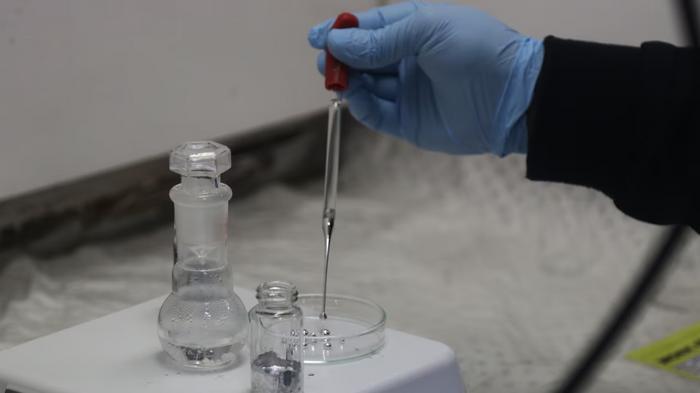
University of Sydney researchers are proposing a new way to curb industrial emissions, by tapping into the “atomic intelligence” of liquid metals to deliver greener and more sustainable chemical reactions.

Credit: University of Sydney/Philip Ritchie
University of Sydney researchers are proposing a new way to curb industrial emissions, by tapping into the “atomic intelligence” of liquid metals to deliver greener and more sustainable chemical reactions.
Despite global efforts towards renewable energy and electrification, chemical production accounts for approximately 10-15 percent of total greenhouse gas emissions. More than 10 percent of the world’s total energy is used in chemical factories, with these numbers rising.
This is due to the large amounts of energy required to cause chemical reactions used to make different products. Published today in Science, researchers have developed a road map which demonstrates how chemical processing can be transformed by changing the nature in which reactions occur.
Head of School of Chemical Engineering Professor Kourosh Kalantar-Zadeh, who led the research said: “People often forget that chemical reactions are at the heart of all we have and use; almost all modern products are created using some sort of chemical reaction. From high-grade plastics for medical implements through to ammonia for agriculture, the current process in which they are created requires significant amounts of energy leading to growing greenhouse gas emissions.
Numerous chemical reactions, including those for green hydrogen production, the synthesis of chemicals with specific structures such as polymers used to make household products, and the decomposition of various materials like microplastics and persistent substances including per- and polyfluoroalkyl substances (PFAS) are all potential targets for improvement using liquid metals.
“Using liquid metals for chemical reactions is still a very new concept; most chemical reactions still rely on decades old processes. Tapping into the ‘atomic intelligence’ of metals in liquid form to drive reactions remains largely unexplored but holds huge potential for transforming the future of chemical industries,” said Professor Kalantar-Zadeh.
His team last year tested a technique using liquid metals they hope will replace energy-intensive chemical engineering processes that use solid catalysts – solid metals or compounds that cause chemical reactions – to create a range of products including plastics, fertilisers, fuels and feedstock. His team recently demonstrated the possibility of using liquid metal alloys derived from numerous metals for hydrogen production.
The team’s approach means chemical reactions can be incited at lower temperatures, unlike current techniques which require metals to be heated to up to several thousand degrees centigrade. Liquid metals instead dissolve catalytic metals – metals that cause reactions – like tin, copper, silver and nickel at low temperatures, creating alloys that promote chemical reactions at low energy.
DECLARATION:
The authors declare no competing interests.
Journal
Science
Method of Research
Observational study
Subject of Research
Not applicable
Article Title
The atomic intelligence of liquid metals
Article Publication Date
25-Jul-2024
COI Statement
This work was supported by the Australian Research Council Laureate Fellowship (grant FL180100053). K.K.-Z. and J.T. contributed equally to this work. T.D. helped strengthen the discussions.
Cite Scienmag News
Bethany Barker. (July 25, 2024). Tackling industrial emissions begins at the chemical reaction. Scienmag. https://scienmag.com/tackling-industrial-emissions-begins-at-the-chemical-reaction/
Bethany Barker. "Tackling industrial emissions begins at the chemical reaction." Scienmag, 25 July 2024, https://scienmag.com/tackling-industrial-emissions-begins-at-the-chemical-reaction/. Accessed 5 September 2026.
Bethany Barker. "Tackling industrial emissions begins at the chemical reaction." Scienmag. July 25, 2024. https://scienmag.com/tackling-industrial-emissions-begins-at-the-chemical-reaction/

