


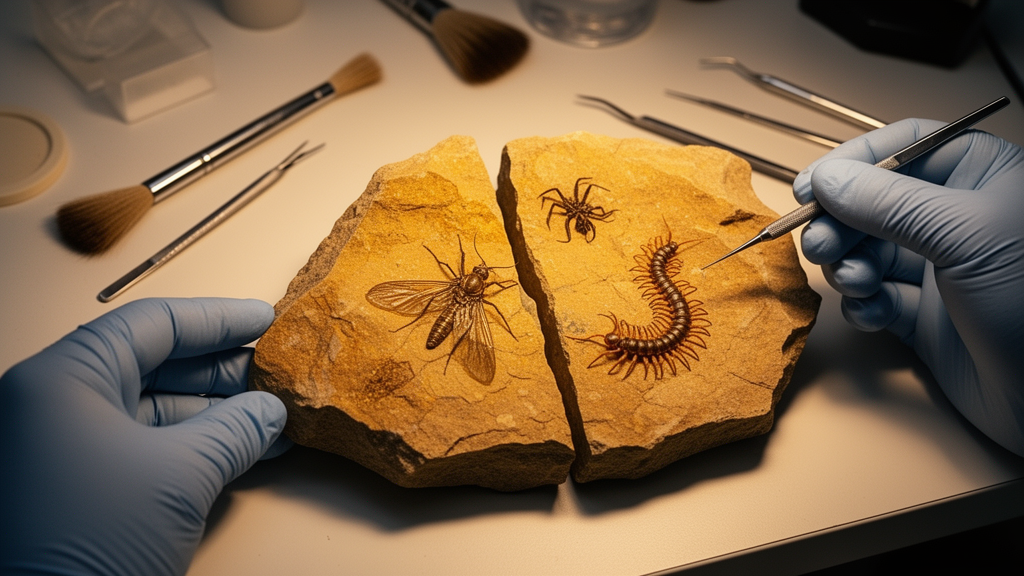
A systematic literature review and species and ichnospecies checklist identifies 93 publications concerning fossil insects and related terrestrial arthropods from Chile, including 65 primary sources and 28 secondary sources. The reviewed record spans Carboniferous trace fossils through Quaternary insect assemblages and contains 726 nominal records: 707 insects, 18 arachnids and one myriapod.
The authors searched Web of Science and Google Scholar in Spanish and English using combinations of terms including “Chile,” “fossil insects,” “fossil beetles,” “plant–insect interaction,” “aDNA” and “Chironomidae.” They assessed books, book sections, peer-reviewed articles, theses and conference contributions, classifying publications as primary reports or secondary sources and citing original records rather than later compilations. Their broad definition of fossil evidence included impressions, inclusions, preserved carcasses, ancient DNA, plant–insect interactions and other traces.
Primary research is geographically concentrated in south-central Chile. Los Lagos has the most studies, with 16, chiefly focused on the Pilauco site dated to approximately 16,500–12,700 years before present. Magallanes and La Araucanía each have five studies, while Arica y Parinacota has four and Coquimbo three. The review attributes this distribution to differences in research attention and the availability of suitable fossil-bearing localities.
The temporal record is similarly uneven. Forty-one primary studies concern the Quaternary, especially the late Pleistocene and Holocene, and largely involve Coleoptera and Diptera, including Chironomidae preserved in lake sediments, peat and rodent middens. Seven studies cover the Triassic, seven the Cretaceous and seven span multiple periods. The Paleozoic record is limited to trace fossils from two localities, with no continental arthropod body fossils reported.
Triassic body-fossil records include the beetles Ischichucasyne santajuanaensis and Ademosyne sp., both assigned to the extinct family Permosynidae, and the hemipteran Bandelnielsenia chilena, assigned to Dysmorphoptilidae. These imprints come from the Carnian–Norian Santa Juana Formation, dated to 237–201 million years ago. Two Paleoovoididae ichnospecies, Paleoovoidus contactus and Paleoovoidus megaovoidius, were recorded from Norian deposits of the La Ternera Formation and associated with odonate egg-laying scars on fossil leaves.
Cretaceous evidence includes the beetle Doroteus guidensis from the Maastrichtian Dorotea Formation and Australocerambyx chilensis, the first ichnotaxon documented from Chile. The latter was described from galleries in petrified wood attributed to a cerambycid-type beetle larva, probably in a gymnosperm trunk. Its geological age remains uncertain, although geographic proximity supports a provisional Cretaceous attribution. Cretaceous deposits on Nelson Island also preserve galls and leaf-mining traces in Nothofagus leaves.
The Quaternary literature is dominated by studies of fossil beetles and chironomids. Work at southern Chilean sites, including Rupanco, Puerto Octay, Puerto Varas, Dalcahue and Río Caunahue, documented assemblages containing species with living counterparts. Older assemblages included insects associated with southern forests and northern Patagonian tundra, whereas assemblages younger than 14,500 years before present contained components typical of the Valdivian temperate rainforest. At Monte Verde, near Puerto Montt, an insect assemblage from approximately 15,000 years before present indicated environmental and temperature conditions comparable with those of the present day.
Three dung beetle taxa were described from Upper Pleistocene deposits at Pilauco: Onthophagus pilauco, Scybalophagus brellenthinae and Gomphocopris ashworthi. O. pilauco was reported as the southernmost record of its genus in the Americas, while S. brellenthinae was considered a third Chilean species and presumed extinct. The authors suggested that the local extinction of these dung specialists accompanied the loss of large mammals because their developmental substrate diminished.
The checklist found Coleoptera to be the most family-diverse insect order, with 53 families represented; Curculionidae, Carabidae and Staphylinidae had 64, 34 and 33 records, respectively. Chironomidae accounted for 55 records. Many entries remained indeterminate at finer taxonomic levels, reflecting limitations in specimen identification, preservation and taxonomic assessment. The review also questioned several historical records, including Schweigger’s purported Chilean copal inclusions, an insect interpretation of a mollusk from the Los Molles Formation, and insect remains reported from the Navidad Formation that later authors considered probable contaminants.
Repository information was incomplete. Thirty-seven studies specified where studied material was housed, while 25 did not. The Museo Nacional de Historia Natural de Chile and Museo Pleistocénico Chuyaca were each cited nine times, and international repositories also held studied material. The authors identified understudied regions, incomplete ichnotaxonomic work and inconsistent curatorial information as major limitations, and called for broader exploration, modern re-examination of known localities, accessible databases and recognized repositories for Chilean fossil insects and allied arthropods.
Subject of Research: Systematic review and checklist of Chile’s fossil insects, arachnids and myriapods
Article Title: Fossil insects of Chile, including arachnids and myriapods: a systematic literature review and checklist
Article References: Tello, F., Nieto, A., Martel-Cea, A., Lara, M. B., & Moisan, P. (2025). Fossil insects of Chile, including arachnids and myriapods: a systematic literature review and checklist. Fossil Record, 28(2), 485-509. https://doi.org/10.3897/fr.28.168711
Image Credits: AI Generated
DOI: 10.3897/fr.28.168711
Keywords: fossil insects, Chile, paleoentomology, systematic review, arthropod fossils, trace fossils, Quaternary fossils, Triassic fossils, Cretaceous fossils, fossil collections, Fossil, insects
Cite Scienmag News
Gavin Prescott. (October 20, 2026). Systematic review maps Chile’s fossil insects and allied arthropods. Scienmag. https://scienmag.com/systematic-review-maps-chiles-fossil-insects-and-allied-arthropods/
Gavin Prescott. "Systematic review maps Chile’s fossil insects and allied arthropods." Scienmag, 20 October 2026, https://scienmag.com/systematic-review-maps-chiles-fossil-insects-and-allied-arthropods/. Accessed 20 October 2026.
Gavin Prescott. "Systematic review maps Chile’s fossil insects and allied arthropods." Scienmag. October 20, 2026. https://scienmag.com/systematic-review-maps-chiles-fossil-insects-and-allied-arthropods/


