


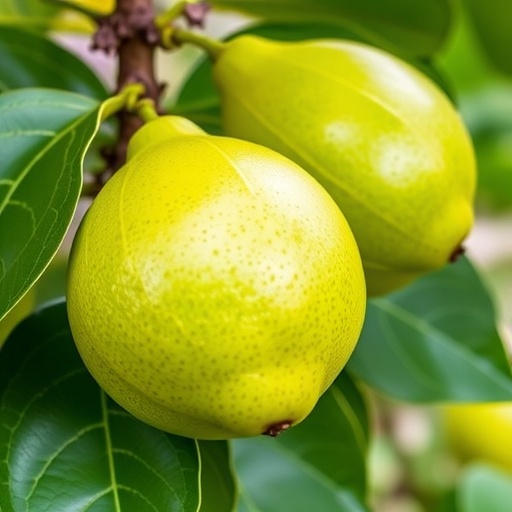
In a groundbreaking advancement in the preservation of fresh produce, a team of researchers from Vietnam has unveiled an innovative edible coating composed entirely of natural components that significantly improves the postharvest shelf life and quality of guava fruit. This cutting-edge development holds the promise to revolutionize the way tropical fruits are preserved, reducing the massive global losses incurred during transportation and storage, and potentially transforming supply chains from farm to table. The study, published in the reputable journal Food Science and Biotechnology in 2025, meticulously explores the synergistic effects of this natural coating, positioning it as an eco-friendly and food-safe alternative to traditional synthetic preservatives.
Postharvest loss remains one of the most critical challenges in the global food supply chain, particularly for climacteric fruits like guava that are highly perishable. Guava, prized for its rich vitamin content and aromatic qualities, often suffers from rapid spoilage due to microbial decay, enzymatic browning, and moisture loss. Historically, preservation techniques have relied on refrigeration or application of chemical fungicides, both bearing environmental costs and potential health risks. The research team’s innovative solution hinges on harnessing natural biopolymers and plant-derived antimicrobials to create a synergistic edible coating that combats spoilage while maintaining fruit freshness.
The coating formulation developed integrates a blend of natural polysaccharides and proteins with potent organic compounds from plant extracts, carefully engineered to form a semi-permeable, protective barrier around the guava surface. This barrier restricts gas exchange and moisture loss, critical factors that trigger metabolic deterioration in fruit postharvest. More importantly, the plant extracts embedded within the coating exhibit antimicrobial properties that actively inhibit the growth of common fruit pathogens such as Penicillium and Botrytis species, which are notorious for causing rot in guava. This multifaceted approach not only extends shelf life but also safeguards the fruit’s nutritional and sensory attributes.
Employing sophisticated analytical techniques — including scanning electron microscopy to elucidate the microstructure of the coating and gas chromatography-mass spectrometry to profile the bioactive components — the researchers validated the chemical integrity and functional prowess of their edible film. The coating demonstrated uniform coverage and optimal adhesion to the guava skin, critical factors that prevent microbial infiltration. In controlled storage experiments, coated guavas maintained firmness and displayed markedly reduced weight loss compared to uncoated controls. This physical preservation was complemented by suppressed activity of polyphenol oxidase, an enzyme responsible for enzymatic browning, thus preserving the fruit’s vibrant color and consumer appeal.
What sets this study apart is the synergistic effect observed when combining different natural ingredients. The isolated application of each component yielded modest preservation benefits, but when combined in the specific ratios formulated, the researchers observed a multiplicative effect that substantially enhanced overall performance. This synergy likely results from complementary mechanisms: polysaccharides maintaining barrier properties, proteins strengthening film integrity, and bioactive plant compounds inhibiting microbial metabolism. Such a holistic approach underlines how biomimetic materials can be tuned at the molecular level to achieve superior preservation outcomes.
A pivotal part of the study evaluated the sensory quality and consumer acceptance of the coated guavas. Conducted through blind taste tests and expert panel evaluations, the results confirmed that the treatment did not impart any off-flavors or undesirable textures — a common concern with preservative coatings. Instead, the natural coating preserved the characteristic aroma and sweetness, affirming its suitability for commercial adoption. Given the increasing consumer demand for natural and health-conscious food preservation methods, this innovation addresses an urgent market need.
The environmental implications are equally compelling. The natural components utilized in this coating are biodegradable and derived from renewable sources, in stark contrast to synthetic waxes and plastic-based packaging films ubiquitously used in current fruit preservation methods. Adoption of such edible coatings can reduce plastic waste, lower carbon footprints associated with refrigeration, and eliminate pesticide residues, making this research aligned with sustainable agriculture and circular economy principles. Furthermore, because the coating is edible and composed of GRAS (Generally Recognized As Safe) substances, regulatory hurdles for commercialization are expected to be manageable.
An additional layer of novelty is reflected in the coating’s mechanism of action at the cellular level within the guava. By limiting oxygen permeability and reducing respiration rates, the coating effectively delays the fruit’s ripening process, which is tightly linked to enzymatic activity and volatile organic compound emissions. This controlled atmosphere-like effect, achieved without refrigeration, suggests potential applications in regions lacking cold chain infrastructure, enabling longer transportation times and reducing food insecurity. The study’s quantitative data show that the coated guavas maintained acceptable quality for up to 15 days postharvest, a significant increase over the typical 7-day shelf life.
The researchers also conducted microbiological assays to detail the antimicrobial spectrum of the coating. Results indicated robust inhibition of bacterial species such as Escherichia coli and Listeria monocytogenes, alongside fungi, highlighting its potential as a broad-spectrum postharvest preservative. This characteristic is particularly important for guava, which is prone to both fungal and bacterial contamination during extended storage and distribution. The edible coating thereby serves a dual purpose: physical preservation and active microbial control.
In the context of global postharvest management, such natural coatings could substantially reduce food loss percentages which currently hover around 20–40% for tropical fruits at various stages from field to consumer. This loss not only represents a squandering of resources and economic value but also exacerbates food security challenges and environmental burdens. The technology introduced by Nguyen and colleagues thus offers a scalable, cost-effective, and sustainable intervention that could be adapted to other perishable fruits and vegetables.
From an industry perspective, the innovation holds promise for enhancing export potential of tropical fruits by maintaining quality throughout long-distance shipments. Given the global demand for exotic fruits in temperate markets, the capacity to prolong freshness without refrigeration could open new supply routes and reduce reliance on energy-intensive cold storage. It also aligns with consumer trends favoring natural, additive-free products, providing marketers with a compelling value proposition rooted in science and sustainability.
The research team envisions further refinement of the edible coating, including exploring the incorporation of nanomaterials to enhance barrier properties and controlled release systems that modulate bioactive compound delivery over time. They also aim to conduct large-scale field trials to assess performance variability across different guava cultivars, climates, and handling conditions, vital steps toward commercialization.
This development epitomizes the convergence of food science, materials engineering, and natural product chemistry, demonstrating how interdisciplinary research can tackle entrenched challenges in agriculture and food supply chains. The edible coating technology elevates the preservation capabilities beyond mere physical protection, tapping into bioactivity and molecular synergy to create a multifunctional defense system for fresh produce.
Beyond guava, the principles elucidated in this study pave the way for developing tailored edible coatings for a wide array of fruits prone to rapid deterioration, including mangoes, strawberries, and avocados. With customization, smallholder farmers and agribusinesses in tropical regions could benefit from extended shelf life, reduced shrinkage, and enhanced profits, contributing to broader socioeconomic gains.
Overall, the innovative edible coating strategy presented in this research represents a timely solution that reconciles consumer health, environmental sustainability, and economic viability. By championing natural, multifunctional coatings derived from renewable materials, the study heralds a new era in postharvest technology — one where synergy in natural components leads to superior preservation without compromise.
Cite Scienmag News
Drew Townsend. (September 10, 2025). Synergistic Natural Edible Coatings Enhance Guava Preservation. Scienmag. https://scienmag.com/synergistic-natural-edible-coatings-enhance-guava-preservation/
Drew Townsend. "Synergistic Natural Edible Coatings Enhance Guava Preservation." Scienmag, 10 September 2025, https://scienmag.com/synergistic-natural-edible-coatings-enhance-guava-preservation/. Accessed 4 September 2026.
Drew Townsend. "Synergistic Natural Edible Coatings Enhance Guava Preservation." Scienmag. September 10, 2025. https://scienmag.com/synergistic-natural-edible-coatings-enhance-guava-preservation/


