


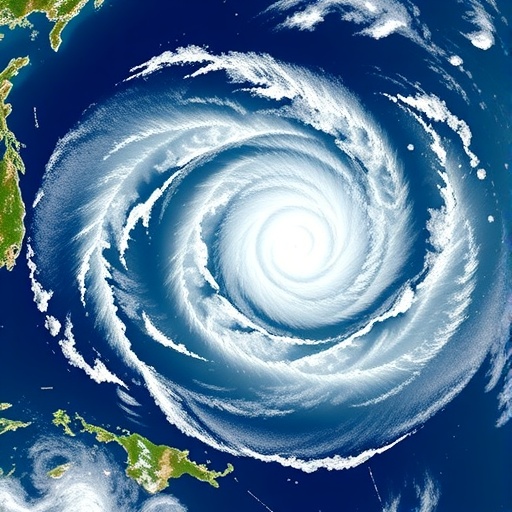
A groundbreaking study published in 2026 has unveiled compelling evidence that tropical cyclone activity in the western Pacific Ocean has followed a remarkably symmetrical pattern between the Northern and Southern Hemispheres since the mid-Holocene epoch. This research offers a novel perspective on long-term climate dynamics and deepens our understanding of cyclogenesis in a critical region renowned for its intense storm activity.
For decades, tropical cyclone research has largely focused on contemporary patterns, seasonal variability, and the influence of climate change on storm frequency and intensity. However, the historical context, particularly spanning thousands of years, has remained elusive due to limited high-resolution paleo-records. This new study by Tao, Liu, Qi, and colleagues bridges that gap by synthesizing sedimentary and geochemical proxy data, shedding light on the millennial-scale symmetrical behavior of cyclone activity across hemispheres.
The researchers employed a multidisciplinary approach, integrating marine sediment cores, isotopic composition analyses, and advanced climate modeling to reconstruct past tropical cyclone occurrences. These data sets allow a precise timeline stretching back to approximately 6,000 years ago, the mid-Holocene period, a critical era characterized by relatively stable climate conditions. Through this reconstruction, they observed a striking mirroring of cyclone activity peaks and troughs between the Northern and Southern Hemispheres in the western Pacific basin.
This symmetry implies a coupling mechanism in the atmospheric and oceanic processes influencing tropical cyclone genesis and trajectory. Understanding these underlying controls is pivotal, as the western Pacific is among the most cyclone-prone regions globally, profoundly affecting millions of lives through storms such as typhoons in East Asia and cyclones impacting Southeast Asia and the Pacific Islands. The research challenges previous assumptions that cyclone patterns are more chaotic and dominantly hemisphere-specific, suggesting instead a synchronized, hemispheric-scale climatic driver.
Key atmospheric phenomena, such as the Intertropical Convergence Zone (ITCZ), the Walker Circulation, and sea surface temperature (SST) gradients, may explain the synchronous behavior observed. The study posits that the oscillation of these factors between hemispheres could facilitate a rheostatic balance, promoting simultaneous elevations or decreases in storm activity. This rheostatic mechanism highlights the intricate feedback loops operating within Earth’s climate system, emphasizing the hemispheric teleconnections governing tropical cyclone formation.
Further analysis demonstrated that the peaks in tropical cyclone frequency corresponded with periods of intensified monsoonal activity and shifts in ocean-atmosphere coupling patterns, particularly in relation to the El Niño Southern Oscillation (ENSO). The symmetric pattern suggests that when the Northern Hemisphere experienced heightened cyclone activity coinciding with specific ENSO phases, the Southern Hemisphere exhibited a mirrored response, albeit with geographically distinct but temporally aligned impacts.
By extending the temporal scale of cyclone activity assessment, the study also informs future climate adaptation planning. Understanding cyclical patterns spanning millennia offers valuable insight into the natural variability superimposed on anthropogenic climate change effects. These patterns serve as critical background conditions for interpreting recent and forthcoming tropical cyclone trends amid global warming scenarios.
Moreover, the research methodology sets a new standard for paleo-meteorological reconstructions, combining sedimentological records with robust climate models to elucidate the complex interplay between oceanic and atmospheric dynamics. This cross-disciplinary integration reinforces the importance of holistic environmental data to decode climatic phenomena that transcend short-term observational windows.
Beyond regional implications, the findings offer a global context for understanding tropical cyclone behavior. The western Pacific, due to its vast expanse and complex interplay of climatological factors, serves as a natural laboratory for studying cyclone genesis mechanisms. The hemispheric symmetry revealed may be a fundamental characteristic applicable to other ocean basins, inviting comparative research in the Atlantic, Indian Ocean, and beyond.
For climate scientists, this discovery challenges existing paradigms related to the asymmetric nature of tropical cyclone activity and encourages reconsideration of modeling approaches. Incorporating symmetrical hemispheric patterns may improve predictive models, allowing more accurate estimations of future cyclone frequency and intensity under various climate scenarios. This is particularly critical for disaster preparedness and mitigation efforts across cyclone-prone nations.
The study also underscores the dynamic nature of Earth’s climatic equilibrium, where feedback mechanisms operate over extended periods to sustain balanced states across hemispheres. Such insights deepen the scientific community’s appreciation for natural variability and the resilience of global climate systems in the face of perturbations.
Importantly, the research reveals that tropical cyclone activity is not merely a response to localized environmental triggers but is intertwined with global-scale oscillations and atmospheric circulation patterns. This interconnectedness underscores the complexity of meteorological phenomena and the necessity for integrated climate research frameworks.
In summary, Tao, Liu, Qi, and colleagues have provided a transformative contribution to the field of climatology and tropical meteorology. Their work unveils a hitherto unrecognized symmetry in tropical cyclone activity across the hemispheres in the western Pacific spanning the last six millennia, reframing long-term storm behavior in a global climatic context. This not only enhances theoretical understanding but also sharpens practical forecasting and risk management strategies crucial for vulnerable populations.
As climate change continues to evolve, understanding the natural rhythms and symmetrical dynamics of tropical cyclone activity will be paramount. This research opens new avenues for investigation, encouraging a reevaluation of global cyclone monitoring and modeling methodologies, ultimately contributing to more resilient societies facing future climatic challenges in some of the world’s most hazard-prone regions.
Cite Scienmag News
Violet Maxwell. (June 11, 2026). Symmetrical Tropical Cyclone Activity in Western Pacific. Scienmag. https://scienmag.com/symmetrical-tropical-cyclone-activity-in-western-pacific/
Violet Maxwell. "Symmetrical Tropical Cyclone Activity in Western Pacific." Scienmag, 11 June 2026, https://scienmag.com/symmetrical-tropical-cyclone-activity-in-western-pacific/. Accessed 3 September 2026.
Violet Maxwell. "Symmetrical Tropical Cyclone Activity in Western Pacific." Scienmag. June 11, 2026. https://scienmag.com/symmetrical-tropical-cyclone-activity-in-western-pacific/


