


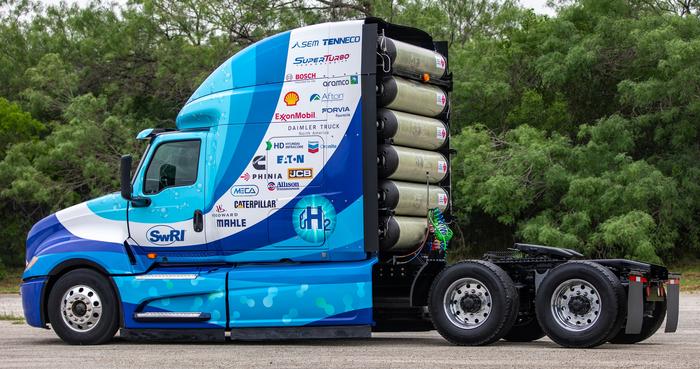
SAN ANTONIO — May 20, 2024—Southwest Research Institute (SwRI) has successfully completed development of a hydrogen-fueled Class-8 demonstration vehicle, built as part of its industry-supported H2-ICE consortium. The central focus of the demonstration includes development of a Hydrogen Internal Combustion Engine (H2-ICE) that produces ultra-low NOx and CO2 emissions while still providing enough torque and power for most heavy-duty applications.
Launched in November 2022, the H2-ICE consortium gathered transportation industry leaders — including engine and truck manufacturers, fuels and lubricants providers, and Tier-I suppliers — with a unified vision of advancing sustainable mobility through innovative hydrogen engine technology. The consortium focused on demonstrating the potential for H2-ICE vehicles to complement other zero-emission vehicle technologies on the industry’s decarbonization roadmap.
To achieve the consortium’s goals, the engine needed to demonstrate industry leading nitrogen oxide (NOx) emissions in addition to the low carbon dioxide (CO₂) emissions expected from hydrogen combustion. Despite a relatively short 18-month timeline, the SwRI team set an aggressive target of meeting the California Air Resource Board’s (CARB) Ultra-Low NOx designation of 0.02 g/hp-hr (grams per horsepower-hour).
“We wanted the program to align with the Environmental Protection Agency’s Phase-3 greenhouse gas policy, so we knew our timeline was ambitious,” said Ryan Williams, an SwRI Powertrain Engineering Division manager and the H2-ICE consortium’s program manager. “It took incredible planning by the integration teams to ensure that the build proceeded smoothly.”
SwRI consortia are hubs for industry collaboration. The SwRI consortium pulled together experts from within the consortium’s membership to advance development and overcome technical hurdles related to hydrogen combustion. SwRI converted an X15N natural gas engine provided by consortium member Cummins to run on port-injected hydrogen using components supplied by other consortium members.
“From custom-built parts and prototype components to specially formulated lubricants, this has truly been an industry-wide effort,” said Williams. “We could never have completed the demonstration vehicle in the short time that we did without the support and collaboration of the consortium.”
The H2-ICE vehicle represents a compelling zero-GHG option in the difficult-to-decarbonize long-haul trucking market. Its 370-horsepower engine produces 2,025 Newton-meters (nm) of torque, which is considered ideal for most heavy-duty trucking applications. Engine efficiency is above 40%, peaking at 43%. Only trace amounts of carbon emissions have been measured in the exhaust, totaling about 1.5 grams of CO₂ per horsepower-hour (g/hp-hr).
SwRI built on experience from previous heavy-duty low-NOx projects to develop a novel aftertreatment system specifically adapted to the hydrogen exhaust environment. Paired with the H2-ICE’s already low engine emissions, the addition of the aftertreatment system reduces NOx emissions to 0.008 with aged catalysts, well below the 2027 EPA limit of 0.035 g/hp-hr and an industry first.
“The NOx emissions produced by the H2-ICE platform are already at or below the best numbers achieved in our previous diesel low-NOx programs,” said SwRI Institute Engineer Chris Sharp, who led the aftertreatment calibration effort. “We anticipate the H2-ICE reaching near-zero tailpipe NOx emissions, with single digit mg/hp-hr levels under nearly all operating conditions. I am extremely proud of the team’s accomplishments and excited for the project’s future.”
The completed demonstration vehicle is on display at the 2024 ACT Expo in Las Vegas, May 20-24, where it will be showcased alongside other leading low-carbon and zero-emissions technologies. It will next be on display at the California Hydrogen Leadership Summit on June 16-17 in Sacramento, Calif.
Click here to watch a video highlighting the H2-ICE technology.
For more information, visit the https://www.swri.org/industry/hydrogen-powered-vehicles/hydrogen-internal-combustion-engine-h2-ice-consortium.

Credit: Southwest Research Institute
SAN ANTONIO — May 20, 2024—Southwest Research Institute (SwRI) has successfully completed development of a hydrogen-fueled Class-8 demonstration vehicle, built as part of its industry-supported H2-ICE consortium. The central focus of the demonstration includes development of a Hydrogen Internal Combustion Engine (H2-ICE) that produces ultra-low NOx and CO2 emissions while still providing enough torque and power for most heavy-duty applications.
Launched in November 2022, the H2-ICE consortium gathered transportation industry leaders — including engine and truck manufacturers, fuels and lubricants providers, and Tier-I suppliers — with a unified vision of advancing sustainable mobility through innovative hydrogen engine technology. The consortium focused on demonstrating the potential for H2-ICE vehicles to complement other zero-emission vehicle technologies on the industry’s decarbonization roadmap.
To achieve the consortium’s goals, the engine needed to demonstrate industry leading nitrogen oxide (NOx) emissions in addition to the low carbon dioxide (CO₂) emissions expected from hydrogen combustion. Despite a relatively short 18-month timeline, the SwRI team set an aggressive target of meeting the California Air Resource Board’s (CARB) Ultra-Low NOx designation of 0.02 g/hp-hr (grams per horsepower-hour).
“We wanted the program to align with the Environmental Protection Agency’s Phase-3 greenhouse gas policy, so we knew our timeline was ambitious,” said Ryan Williams, an SwRI Powertrain Engineering Division manager and the H2-ICE consortium’s program manager. “It took incredible planning by the integration teams to ensure that the build proceeded smoothly.”
SwRI consortia are hubs for industry collaboration. The SwRI consortium pulled together experts from within the consortium’s membership to advance development and overcome technical hurdles related to hydrogen combustion. SwRI converted an X15N natural gas engine provided by consortium member Cummins to run on port-injected hydrogen using components supplied by other consortium members.
“From custom-built parts and prototype components to specially formulated lubricants, this has truly been an industry-wide effort,” said Williams. “We could never have completed the demonstration vehicle in the short time that we did without the support and collaboration of the consortium.”
The H2-ICE vehicle represents a compelling zero-GHG option in the difficult-to-decarbonize long-haul trucking market. Its 370-horsepower engine produces 2,025 Newton-meters (nm) of torque, which is considered ideal for most heavy-duty trucking applications. Engine efficiency is above 40%, peaking at 43%. Only trace amounts of carbon emissions have been measured in the exhaust, totaling about 1.5 grams of CO₂ per horsepower-hour (g/hp-hr).
SwRI built on experience from previous heavy-duty low-NOx projects to develop a novel aftertreatment system specifically adapted to the hydrogen exhaust environment. Paired with the H2-ICE’s already low engine emissions, the addition of the aftertreatment system reduces NOx emissions to 0.008 with aged catalysts, well below the 2027 EPA limit of 0.035 g/hp-hr and an industry first.
“The NOx emissions produced by the H2-ICE platform are already at or below the best numbers achieved in our previous diesel low-NOx programs,” said SwRI Institute Engineer Chris Sharp, who led the aftertreatment calibration effort. “We anticipate the H2-ICE reaching near-zero tailpipe NOx emissions, with single digit mg/hp-hr levels under nearly all operating conditions. I am extremely proud of the team’s accomplishments and excited for the project’s future.”
The completed demonstration vehicle is on display at the 2024 ACT Expo in Las Vegas, May 20-24, where it will be showcased alongside other leading low-carbon and zero-emissions technologies. It will next be on display at the California Hydrogen Leadership Summit on June 16-17 in Sacramento, Calif.
Click here to watch a video highlighting the H2-ICE technology.
For more information, visit the https://www.swri.org/industry/hydrogen-powered-vehicles/hydrogen-internal-combustion-engine-h2-ice-consortium.
Cite Scienmag News
Denise Maddox. (May 21, 2024). SwRI’s H2-ICE consortium demonstrates ultra-low emissions from hydrogen-fueled heavy-duty engine. Scienmag. https://scienmag.com/swris-h2-ice-consortium-demonstrates-ultra-low-emissions-from-hydrogen-fueled-heavy-duty-engine/
Denise Maddox. "SwRI’s H2-ICE consortium demonstrates ultra-low emissions from hydrogen-fueled heavy-duty engine." Scienmag, 21 May 2024, https://scienmag.com/swris-h2-ice-consortium-demonstrates-ultra-low-emissions-from-hydrogen-fueled-heavy-duty-engine/. Accessed 3 September 2026.
Denise Maddox. "SwRI’s H2-ICE consortium demonstrates ultra-low emissions from hydrogen-fueled heavy-duty engine." Scienmag. May 21, 2024. https://scienmag.com/swris-h2-ice-consortium-demonstrates-ultra-low-emissions-from-hydrogen-fueled-heavy-duty-engine/

