


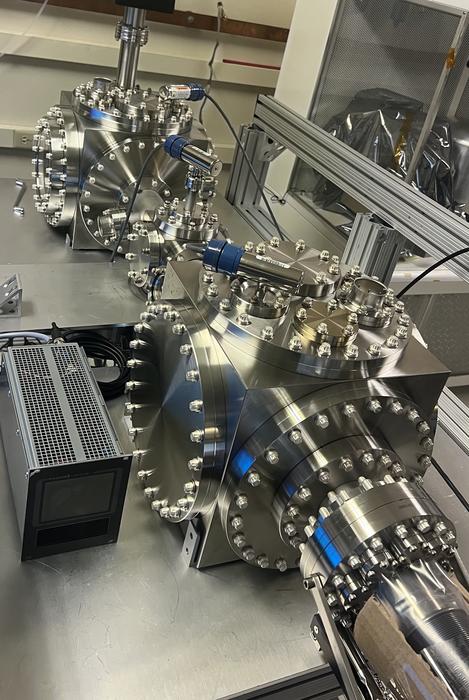
SAN ANTONIO — July 16, 2024 — Researchers from Southwest Research Institute (SwRI) and The University of Texas at Dallas (UTD) are collaborating to evaluate a next-generation sensor designed to measure neutral gas velocities in the Earth’s upper atmosphere. The project, led by SwRI’s Dr. Joo Hwang and UTD’s Dr. Phillip Anderson, is supported by a grant from the new SwRI/UTD Seed Projects for Research, INnovation, and Technology (SPRINT) Program. Another SPRINT project is researching domestic lithium independence, looking at tectonic controls on critical emerging lithium deposits.
Geospace, the boundary region made up of the Earth’s upper atmosphere and nearby outer space, contains ionized and neutral components that are separately studied and defined as the ionosphere and thermosphere, respectively. Neutral winds largely drive the dynamics of the region, serving as the primary regulators and redistributors of the mass, momentum and energy and activating geospace weather at all latitudes.
“Understanding the dynamics of neutral wind and its coupling with ionospheric plasmas is critical for protecting military and commercial space-based assets in low Earth orbit from space weather events,” said Hwang, a staff scientist in SwRI’s Space Science Division. “We will leverage our new Molecular Beam Facility (MBF) to validate and enhance the measurement capabilities of UTD’s Neutral Wind Meter (NWM), establish development procedures, and significantly improve the signal-to-noise ratio.”
The project offers a unique opportunity to verify sensor performance and demonstrate its technical readiness level, which in turn makes the instrument more likely to be selected for upcoming missions. The integration of novel sensor technologies and molecular beam testing methodologies underscores a well-reasoned and innovative strategy to address critical gaps in understanding space weather impacts.
“Protoflight sensor hardware has been constructed and tested in the laboratory environment, and numerical simulations have confirmed the instrument’s operational principles and robust approach for measuring neutral gas velocities. The opportunity to test it in an environment that simulates the actual conditions in space is extremely valuable,” said Anderson, director of UTD’s William B. Hanson Center for Space Sciences. “A version of our instrument scheduled to fly for the first time on a rocket in 2025 will be evaluated at SwRI early next year.”
The only other MBF is at the University of Bern in Switzerland. SwRI has leveraged its unique expertise to establish a molecular beam accelerator at its San Antonio headquarters to meet the critical necessity for a domestic facility to verify the functionality and effectiveness of similar space sensors.
The facility creates a neutral gas beam at velocities of 3-6 kilometers per second, temperatures up to 1,000 C and pressures of hundreds of pounds per square inch to simulate the motion of instruments in tenuous atmospheres. A small 10-micron opening delivers a narrow beam of gas into the expansion chamber where the central portion of the beam is extracted by a skimmer with a one-millimeter orifice and a filter that can create a higher velocity tail. Adjusting the nozzle-skimmer distance controls the beam’s downstream width and flux, while large turbomolecular pumps maintain high vacuum.
“SwRI will optimize settings for UTD’s NWM, determining the velocity filter settings needed to create a molecular beam close to the relative velocity of the neutral gas spacecraft experience in low-Earth orbit,” Hwang said. “Through dedicated testing with updated software, MBF will verify/support the measurement capabilities of UTD’s NWM.”
SwRI’s Executive Office and UTD’s Office of Research and Innovation developed SPRINT to enhance greater scientific and engineering collaboration between the two institutions. This program provides opportunities for researchers to work together, addressing issues of mutual interest and need while bringing together the capabilities, facilities and expertise from both organizations. Funded projects include at least one principal investigator from each institution.
For more information, visit https://www.swri.org/heliophysics.

Credit: Southwest Research Institute
SAN ANTONIO — July 16, 2024 — Researchers from Southwest Research Institute (SwRI) and The University of Texas at Dallas (UTD) are collaborating to evaluate a next-generation sensor designed to measure neutral gas velocities in the Earth’s upper atmosphere. The project, led by SwRI’s Dr. Joo Hwang and UTD’s Dr. Phillip Anderson, is supported by a grant from the new SwRI/UTD Seed Projects for Research, INnovation, and Technology (SPRINT) Program. Another SPRINT project is researching domestic lithium independence, looking at tectonic controls on critical emerging lithium deposits.
Geospace, the boundary region made up of the Earth’s upper atmosphere and nearby outer space, contains ionized and neutral components that are separately studied and defined as the ionosphere and thermosphere, respectively. Neutral winds largely drive the dynamics of the region, serving as the primary regulators and redistributors of the mass, momentum and energy and activating geospace weather at all latitudes.
“Understanding the dynamics of neutral wind and its coupling with ionospheric plasmas is critical for protecting military and commercial space-based assets in low Earth orbit from space weather events,” said Hwang, a staff scientist in SwRI’s Space Science Division. “We will leverage our new Molecular Beam Facility (MBF) to validate and enhance the measurement capabilities of UTD’s Neutral Wind Meter (NWM), establish development procedures, and significantly improve the signal-to-noise ratio.”
The project offers a unique opportunity to verify sensor performance and demonstrate its technical readiness level, which in turn makes the instrument more likely to be selected for upcoming missions. The integration of novel sensor technologies and molecular beam testing methodologies underscores a well-reasoned and innovative strategy to address critical gaps in understanding space weather impacts.
“Protoflight sensor hardware has been constructed and tested in the laboratory environment, and numerical simulations have confirmed the instrument’s operational principles and robust approach for measuring neutral gas velocities. The opportunity to test it in an environment that simulates the actual conditions in space is extremely valuable,” said Anderson, director of UTD’s William B. Hanson Center for Space Sciences. “A version of our instrument scheduled to fly for the first time on a rocket in 2025 will be evaluated at SwRI early next year.”
The only other MBF is at the University of Bern in Switzerland. SwRI has leveraged its unique expertise to establish a molecular beam accelerator at its San Antonio headquarters to meet the critical necessity for a domestic facility to verify the functionality and effectiveness of similar space sensors.
The facility creates a neutral gas beam at velocities of 3-6 kilometers per second, temperatures up to 1,000 C and pressures of hundreds of pounds per square inch to simulate the motion of instruments in tenuous atmospheres. A small 10-micron opening delivers a narrow beam of gas into the expansion chamber where the central portion of the beam is extracted by a skimmer with a one-millimeter orifice and a filter that can create a higher velocity tail. Adjusting the nozzle-skimmer distance controls the beam’s downstream width and flux, while large turbomolecular pumps maintain high vacuum.
“SwRI will optimize settings for UTD’s NWM, determining the velocity filter settings needed to create a molecular beam close to the relative velocity of the neutral gas spacecraft experience in low-Earth orbit,” Hwang said. “Through dedicated testing with updated software, MBF will verify/support the measurement capabilities of UTD’s NWM.”
SwRI’s Executive Office and UTD’s Office of Research and Innovation developed SPRINT to enhance greater scientific and engineering collaboration between the two institutions. This program provides opportunities for researchers to work together, addressing issues of mutual interest and need while bringing together the capabilities, facilities and expertise from both organizations. Funded projects include at least one principal investigator from each institution.
For more information, visit https://www.swri.org/heliophysics.
Cite Scienmag News
Grant Pearson. (July 16, 2024). SwRI, UTD jointly fund project to evaluate space sensor in unique facility. Scienmag. https://scienmag.com/swri-utd-jointly-fund-project-to-evaluate-space-sensor-in-unique-facility/
Grant Pearson. "SwRI, UTD jointly fund project to evaluate space sensor in unique facility." Scienmag, 16 July 2024, https://scienmag.com/swri-utd-jointly-fund-project-to-evaluate-space-sensor-in-unique-facility/. Accessed 4 September 2026.
Grant Pearson. "SwRI, UTD jointly fund project to evaluate space sensor in unique facility." Scienmag. July 16, 2024. https://scienmag.com/swri-utd-jointly-fund-project-to-evaluate-space-sensor-in-unique-facility/

