


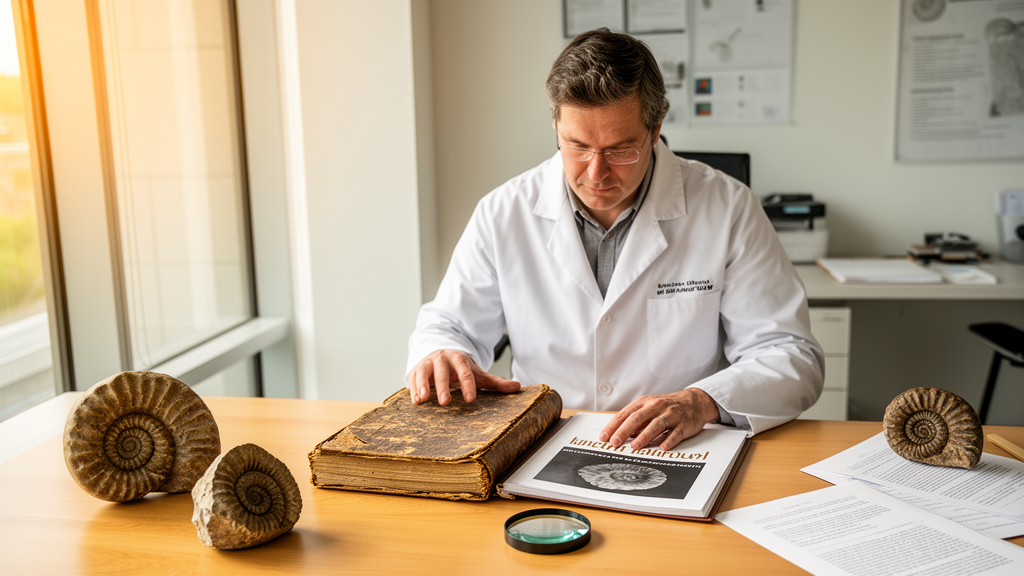
One of Europe’s oldest palaeontological journals has entered a new chapter of its remarkable 150-year history. The Swiss Journal of Palaeontology, first published in 1874 as the Schweizerische Paläontologische Abhandlungen, has officially migrated from SpringerOpen to Pensoft Publishers, marking the latest transformation in a publication lineage that stretches back to the era of some of palaeontology’s most celebrated names. The move, announced in an editorial by Chief Editor Daniel Marty and colleagues, comes with a redesigned logo, a refreshed financial model, and an ambitious plan to grow the journal while keeping its content freely accessible to researchers and fossil enthusiasts around the world.
The journal’s origins read like a who’s who of nineteenth-century palaeontology. Founded as a series of mostly monographs, the Schweizerische Paläontologische Abhandlungen carried the work of pioneering researchers such as Oskar Heer, Ludwig Rütimeyer, Paul de Loriol, and many others whose names remain familiar to anyone who has studied the history of the discipline. A considerable backstock of these printed manuscripts, including many of the old monographs, is still available for sale today, and some of the earliest volumes can be downloaded through the Biodiversity Heritage Library. Few scientific journals can trace an unbroken publishing tradition across three centuries of geological and biological thought.
Institutional stewardship of the series changed hands in 1940, when the Schweizerische Naturforschende Gesellschaft, now known as the Swiss Academy of Sciences SCNAT, formally took over publishing responsibility from the foundation that had originally issued the monographs. The foundation’s funds were transferred to the society, which committed to managing them in a dedicated stock reserved solely for the publication of the series. At the same time, a commission was established to oversee the journal, and that body, today known as the Commission for the Swiss Journal of Palaeontology, has remained in charge of publication ever since.
For decades, from the 1930s until 2010, the monograph series appeared at irregular intervals through the Basel-based scientific publisher Birkhäuser, which was itself acquired by Springer in 1985. A decisive modernisation arrived in 2011, when the series was renamed the Swiss Journal of Palaeontology and established as a peer-reviewed scientific journal. From volume 130 in 2011 until 2019, the journal was published with Springer as a hybrid journal that was still printed on paper, and from 2020 onward it became an online-only, fully open access publication under the SpringerOpen imprint. Since 2025, the journal has been officially affiliated with the Swiss Geological Society, into which the Swiss Palaeontological Society was integrated as a specialist section back in 2015.
The shift to full open access in 2020 was not merely a fashion statement. It was triggered by a policy decision of the Swiss National Science Foundation, which declared that it would no longer support publication in traditional subscription-model journals, including hybrid open access journals. The funder required grantees to make the results of its projects available in open access journals or databases, and offered grants to cover open access publishing costs. That policy pushed the journal fully into the open access era, and the consequences have been striking: freed from the considerable expenses of printing and the associated workload on the chief editor, the journal has grown steadily, publishing more than 70 articles in 2025 alone, with an annual target of at least 30 to 40 articles going forward.
With its contract with SpringerOpen expiring at the end of 2025, the Commission for the Swiss Journal of Palaeontology and the Swiss Geological Society began searching for a publishing partner whose workflows would be more closely tailored to the journal’s needs. Negotiations with Pensoft Publishers started in July 2025, and contracts were signed in September 2025. The Swiss Journal of Geosciences, which is also affiliated with the Swiss Geological Society, made the same migration from SpringerOpen. Since October 2025, the new journal website has been live, and to commemorate the change the journal unveiled a new logo featuring the iconic ammonite genus Macrocephalites paired with a Swiss cross, a visual nod to both the journal’s scientific subject matter and its national heritage.
The move also brings a new financial model designed to widen access to publication for researchers who lack dedicated funding. Authors who do have full funding for open access publication, for example through a Swiss National Science Foundation project, are asked to pay the standard Article Processing Charge of 1,500 euros, which covers publication of up to 26 pages in the final print-ready PDF, with additional pages costing 30 euros each. Crucially, part of that fee flows directly back into the journal’s equity mechanisms rather than into the publisher’s margins, funding waivers and discounts for authors without adequate funding. Members of the Swiss Geological Society will receive at least a 25 percent discount, or a full waiver if they lack funding and serve as corresponding or first author. Requests for waivers or discounts must be made during manuscript submission, and the journal is explicit that such requests have no bearing on the outcome of peer review.
The editorial team has also refreshed the journal’s focus and scope to reflect the breadth of modern palaeontology. The journal welcomes original research and review articles across the full spectrum of the field, from alpha taxonomy and systematics to palaeobiology, palaeoecology, palaeobiodiversity, biostratigraphy, and conservation palaeontology. Notably, it explicitly embraces studies employing cutting-edge methods such as CT and synchrotron scanning, geochemical analyses, and complex phylogenetic analyses, alongside work that documents high-quality palaeontological data in regional contexts, particularly Switzerland and its neighbouring countries. Topical Collections will continue to be published, and articles within them remain eligible for Swiss National Science Foundation financing, whereas articles in Special Issues are no longer covered by the funder.
Bibliometric indicators suggest the journal’s visibility has never been stronger. Since 2017 it has held a Clarivate Impact Factor, and its current metrics place it firmly in the first quartile of palaeontology journals: a Scopus CiteScore of 4.8 and a Clarivate Web of Science two-year Impact Factor of 2.2, both for 2024. That first-quartile standing matters enormously to researchers, since many funders and institutions require publication in top-ranked journals. The appetite for the journal’s content is also reflected in its download statistics, with 188,139 full-text downloads recorded in 2024. Pensoft additionally offers a print-on-demand service for readers who still want physical copies, as well as professional language editing and tailored press release campaigns to amplify the reach of published research.
Behind the scenes, the journal has invested in professional editorial infrastructure. A part-time Chief Editor position was created in 2014 to help the journal run more efficiently and compete with journals published by profit-oriented publishers, a role currently held by Dr. Daniel Marty. The editorial board has been strengthened in recent years and is actively seeking new subject editors, with a particular push to increase the number of women in palaeontology serving as editors. The commission also continues to nurture the next generation through the Paleoprize, awarded since 2006 to an early-career researcher for the best talk at the annual palaeontology session of the Swiss Geoscience Meeting, and through the Prize Amanz Gressly, which honours major contributions to the field. With the 145th volume now launching under Pensoft, the editorial team is looking to the Swiss palaeontological community, from established professors to students, to submit manuscripts, review papers, and help steer a journal that has now survived long enough to see its own fossils of publishing history. For a publication born in the age of hand-copied monographs, the open access future looks remarkably bright.
Subject of Research: The migration of the Swiss Journal of Palaeontology to Pensoft Publishers and its publishing history
Article Title: Editorial – Swiss Journal of Palaeontology migrates to Pensoft Publishers
Article References: Marty, D., Cavin, L., Daley, A. C., Drage, H. B., Hautmann, M., Joyce, W., & Klug, C. (2026). Editorial – Swiss Journal of Palaeontology migrates to Pensoft Publishers. Swiss Journal of Palaeontology, 145, 1-16. https://doi.org/10.3897/sjp.145.181236
Image Credits: AI Generated
Keywords: Swiss Journal of Palaeontology, Pensoft Publishers, open access, palaeontology, scientific publishing, Swiss Geological Society, Swiss National Science Foundation, ammonite, peer review, journal migration, Swiss Academy of Sciences, article processing charge
Cite Scienmag News
Gavin Prescott. (October 18, 2026). Swiss Journal of Palaeontology Moves to Pensoft Publishers After 150 Years. Scienmag. https://scienmag.com/swiss-journal-of-palaeontology-moves-to-pensoft-publishers-after-150-years/
Gavin Prescott. "Swiss Journal of Palaeontology Moves to Pensoft Publishers After 150 Years." Scienmag, 18 October 2026, https://scienmag.com/swiss-journal-of-palaeontology-moves-to-pensoft-publishers-after-150-years/. Accessed 18 October 2026.
Gavin Prescott. "Swiss Journal of Palaeontology Moves to Pensoft Publishers After 150 Years." Scienmag. October 18, 2026. https://scienmag.com/swiss-journal-of-palaeontology-moves-to-pensoft-publishers-after-150-years/


