


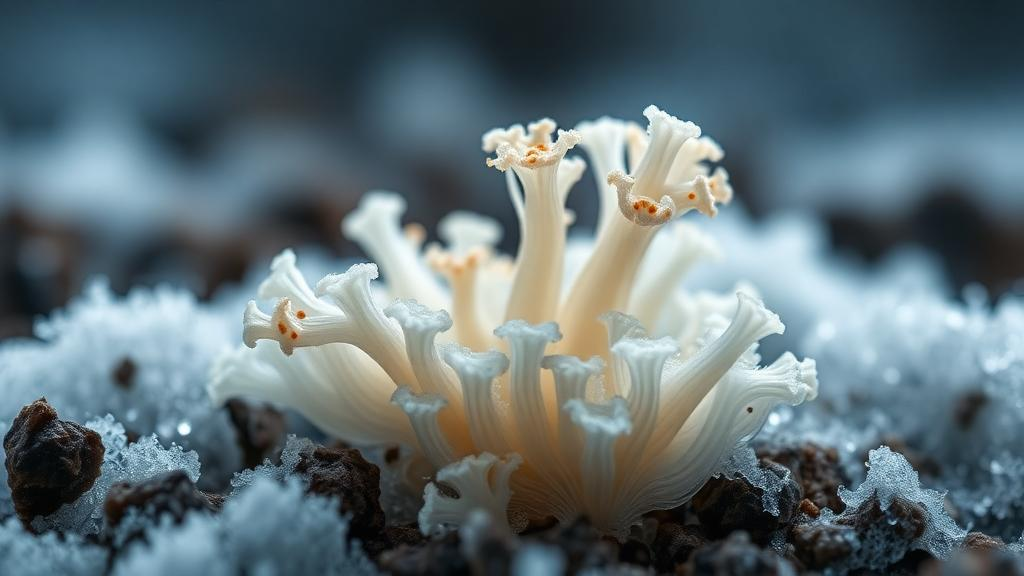
Deep beneath the shoreline sediment of King George Island, near Antarctica’s Collins Glacier, a fungus has been quietly harboring a chemical arsenal that scientists are only now beginning to unlock. A new study published in IMA Fungus presents the first annotated genome of Pseudogymnoascus australis strain UA-032-E, a psychrophilic fungus isolated from Antarctic marine sediment, and reveals a striking biosynthetic capacity encoded within its DNA. By combining hybrid genome sequencing with targeted chemical elicitation, an international research team has demonstrated that this cold-adapted organism carries at least 44 biosynthetic gene clusters, most of which have no close counterparts in existing databases, and that many of these silent pathways can be coaxed into producing detectable metabolites under the right laboratory conditions.
The research team, working with specimens collected during Antarctic expeditions in 2014 and 2016, sequenced the fungus using both Illumina short-read and Oxford Nanopore long-read technologies, assembling a high-quality hybrid genome of approximately 37.25 million base pairs across 33 contigs. The assembly achieved over 96% completeness with an N50 of 1.91 megabases, indicating strong contiguity. Functional annotation identified 10,800 protein-coding genes, along with 48 rRNA and 199 tRNA genes, and nearly 10,000 proteins carrying conserved PFAM domains. Phylogenetic analysis based on concatenated ITS, RPB2, and Tef1 sequences confirmed the strain’s placement within the P. australis clade with 99% statistical support, clearly distinguishing it from related species such as P. griseus and P. pannorum.
What makes this genome particularly compelling is the density and diversity of its secondary metabolite machinery. Using antiSMASH version 8.0.1 with relaxed detection parameters, the researchers predicted 44 biosynthetic gene clusters, including 20 type I polyketide synthases, 8 nonribosomal peptide synthetases, 5 terpene clusters, and 4 NRPS-PKS hybrid systems. Only 13 of these clusters showed significant similarity to previously characterized entries in the MIBiG reference database, meaning the vast majority represent potentially novel biosynthetic pathways. Notable matches include clusters associated with geodin production (70% identity, 99.39% coverage), the F9775A/F9775B/orsellinic acid pathway (74% identity), and ustilaginoidin biosynthesis (66% identity), suggesting the fungus may produce compounds with structural parallels to known bioactive molecules.
BiG-SCAPE comparative analysis grouped the 44 clusters into 41 gene cluster families, of which 39 were singletons, meaning they shared little to no similarity with other clusters in the same genome. This pattern of low genetic redundancy combined with high structural diversity is a hallmark of organisms with rich, underexplored chemical repertoires. Two multi-member families stood out: FAM_00002 comprises three NRPS-type clusters with the canonical A–T–C domain architecture, predicted to generate small cyclic dipeptides incorporating aromatic and aliphatic amino acids, closely resembling diketopiperazine synthases from Penicillium rubens. FAM_00001 encodes a highly conserved iterative type I PKS involved in synthesizing 1,3,6,8-tetrahydroxynaphthalene, a critical precursor in the DHN-melanin biosynthetic pathway, sharing 81% sequence identity with a known cluster from Glarea lozoyensis.
Having mapped the genetic blueprint, the team turned to the challenge of activating these silent pathways. In standard laboratory culture, many fungal biosynthetic gene clusters remain transcriptionally dormant, producing no detectable metabolites. To overcome this, the researchers employed two well-established elicitation strategies: sodium nitroprusside (SNP), which releases nitric oxide, and lipopolysaccharide (LPS) from Escherichia coli O55:B5, which mimics bacterial cell wall components that fungi perceive as threat signals. Nitric oxide functions as a signaling molecule in fungi, regulating developmental processes and neutralizing nitrosative stress while promoting the expression of cryptic biosynthetic genes. LPS, meanwhile, has been shown in prior studies to activate secondary metabolism in approximately 15% of tested fungal strains, including Penicillium and Aspergillus species.
The team cultivated P. australis UA-032-E in twelve different culture media using a micro-bioreactor system, then narrowed the screen to five media (M2, IMA, YES, ISP-4, and CG4) that best supported secondary metabolite production. Cultures were incubated at 15°C for seven days, mirroring the fungus’s natural psychrophilic growth conditions. Metabolites were extracted in situ with ethyl acetate and analyzed by LC–QTOF–MS/MS on an Agilent 6545 Q-TOF instrument equipped with a Zorbax C8 column. The resulting data were processed through MZmine for feature detection and then subjected to molecular networking via the GNPS Feature-Based Molecular Networking platform, complemented by in silico structure prediction using the SIRIUS, ZODIAC, CSI:FingerID, and CANOPUS computational tools.
The metabolomic analysis detected a core set of 75 mass spectral features consistently present across all four experimental treatments (LPS-negative, LPS-positive, SNP-negative, and SNP-positive). Among the annotated compounds were three diketopiperazine cyclic dipeptides: cyclo(L-Phe-L-Pro) at m/z 245.1280, cyclo(L-Val-L-Pro) at m/z 197.1281, and cyclo(L-Pro-L-Leu) at m/z 211.1437. These stable ring-structured metabolites, commonly produced by fungi, have been previously isolated from species including Penicillium chrysogenum, Aspergillus terreus, and marine-derived Pseudofusicoccum. The SIRIUS platform additionally identified maculosin [cyclo(L-Pro-L-Tyr)] at m/z 261.1230, a compound known from Alternaria alternata with documented antimicrobial properties, and methyl asterrate at m/z 385.0896, a polyketide-derived metabolite previously reported from Geomyces species with inhibitory activity against Aspergillus fumigatus.
Beyond small-molecule secondary metabolites, the analysis revealed the presence of DGTS 18:2, a betaine lipid producing a characteristic fragment ion at m/z 498.3800 corresponding to its monoacyl form. In other organisms such as the green alga Chlorella kessleri, DGTS species are known to replace phosphatidylcholine under phosphorus-deficient conditions as part of membrane remodeling strategies. The detection of this lipid in P. australis is consistent with a possible adaptive response to the nutrient-limited conditions of Antarctic sediments, although the researchers caution that a direct causal relationship in this specific context remains to be established through targeted lipidomic studies. The alkaloid harman, a β-carboline detected at m/z 183.0910, and N⁶,N⁶-dimethyladenine at m/z 164.0930, a methylated purine implicated in fungal cytokinin biosynthesis, further round out the chemical profile.
The YES medium supplemented with LPS elicitation yielded the highest metabolic diversity among all tested conditions, suggesting this combination effectively stimulates specialized metabolism in P. australis. The combined SNP-plus-LPS treatment also produced more features than either elicitor alone, consistent with previous findings in Antarctic bacteria where combined elicitation triggered dormant pathways and enhanced metabolite diversity. However, not all predicted biosynthetic gene clusters had corresponding metabolites detected in the analysis. The researchers note this could indicate a requirement for more specific activation signals, or that novel metabolites were produced but remained among the unannotated features in the metabolomic datasets. Certain clusters may also be epigenetically regulated, produce metabolites at very low concentrations, or generate unstable or non-ionizable compounds under the applied analytical conditions.
This study represents a significant step forward in the bioprospecting of polar fungi, demonstrating that the integration of genomic mining with chemical elicitation and metabolomic profiling can efficiently navigate the complex chemical space of psychrophilic organisms. With only approximately 10% of microbial biosynthetic gene clusters currently described in the literature, the findings underscore how much unexplored chemistry remains hidden in extreme environments. The annotated genome of P. australis UA-032-E, deposited in NCBI under accession JBLVTM000000000, now provides a foundational resource for future functional studies and targeted bioprospecting efforts aimed at discovering novel bioactive metabolites with potential applications in pharmaceuticals, agriculture, and industrial biotechnology.
Subject of Research: Genome mining and elicitation of silent biosynthetic pathways in the Antarctic fungus Pseudogymnoascus australis
Article Title: Exploration of inactive metabolic pathways in Antarctic Pseudogymnoascus australis through elicitation: a genomic and metabolomic approach to investigate its biotechnological potential
Article References: Leal, K., Machuca, J., Madariaga, D., Contreras, M. J., Barrientos, L., Nuñez-Montero, K., Chavarría, E., Bruna, P., & Iturrieta-González, I. (2026). Exploration of inactive metabolic pathways in Antarctic Pseudogymnoascus australis through elicitation: a genomic and metabolomic approach to investigate its biotechnological potential. IMA Fungus, 17, Article e156018. https://doi.org/10.3897/imafungus.17.156018
Image Credits: AI Generated
DOI: 10.3897/imafungus.17.156018
Keywords: Pseudogymnoascus australis, Antarctic fungi, biosynthetic gene clusters, secondary metabolites, elicitation, genomics, metabolomics, psychrophilic fungi, bioprospecting, natural products, nitric oxide, lipopolysaccharide
Cite Scienmag News
Juliet Wilcox. (October 18, 2026). Silent Genes of an Antarctic Fungus Wake Up to Reveal Hidden Chemistry. Scienmag. https://scienmag.com/silent-genes-of-an-antarctic-fungus-wake-up-to-reveal-hidden-chemistry/
Juliet Wilcox. "Silent Genes of an Antarctic Fungus Wake Up to Reveal Hidden Chemistry." Scienmag, 18 October 2026, https://scienmag.com/silent-genes-of-an-antarctic-fungus-wake-up-to-reveal-hidden-chemistry/. Accessed 18 October 2026.
Juliet Wilcox. "Silent Genes of an Antarctic Fungus Wake Up to Reveal Hidden Chemistry." Scienmag. October 18, 2026. https://scienmag.com/silent-genes-of-an-antarctic-fungus-wake-up-to-reveal-hidden-chemistry/


