


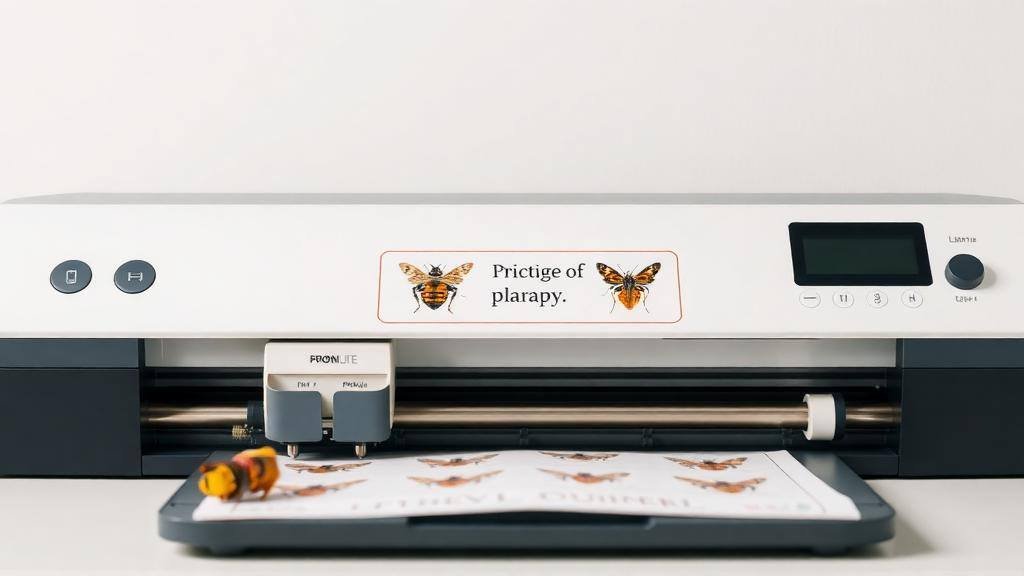
Behind every pinned beetle or butterfly in a natural history museum lies a small but indispensable piece of cardboard: the specimen label. Without it, a beautifully preserved insect is scientifically almost worthless, because the label carries the locality, date, collector and other data that transform a dead animal into a documented biological record. Yet the production of these labels has long been one of the most tedious, time-consuming and underappreciated chores in entomology, and a new study now shows that a humble hobbyist gadget can do the job roughly ten times faster than human hands with scissors.
The study, published in the journal Nota Lepidopterologica, describes an automated labelling workflow built around a low-cost cutting plotter, a device more commonly found in craft rooms than in museum back offices. The author reports that within about a year, roughly 42,000 labels were cut using the system, at an average cost of about 0.007 euros per label. When the cutting time was benchmarked against five colleagues asked to cut the same sheet of labels by hand, the automated procedure proved on average around ten times faster, while producing perfectly uniform, border-free labels of standardized dimensions.
The scale of the problem the method addresses is easy to underestimate. Entomological collections are among the largest biodiversity collections in existence, and a single entomologist’s holdings can easily run to several hundred thousand specimens. Labelling such material is a laborious step that is often treated as a peripheral activity of taxonomic work and consequently neglected. As a result, very large collections are frequently left with temporary labels referring only to a collecting event, or with unlabelled specimens arranged in a row in which only the first specimen carries a label. In many cases the temporary label contains nothing more than a number pointing to a field notebook, which means that all the associated information is at risk if that notebook is lost.
The consequences of this neglect can be serious. The study notes that many successful entomologists leave their collections unlabelled or only partially labelled when their employment ends, forcing institutions to hire staff to bring the material into proper order. That work must be done with great care, because any confusion of locality, date or other label information can lead to significant scientific errors downstream, in everything from biodiversity assessments to ecological modelling. Depending on the workflow, manual labelling can take anywhere from about one minute to three to five minutes per specimen, so any saving in the cutting stage translates into substantial gains across an entire collection.
Aesthetics matter in this world as well. Entomologists traditionally prefer labels that are uniform and standardized in size, usually printed on cardboard and then cut out. The labels are typically framed either with a double border so that each label is evenly edged in black, or with very narrow borders that are almost invisible. Some workers use a layout guillotine or paper trimmer to avoid borders altogether. In every case, however, the cutting must be done carefully, and careful cutting cannot be fast. It is precisely this bottleneck that the new procedure targets.
The technical heart of the method is a Silhouette Portrait 2 cutting plotter, a compact and inexpensive device, driven through a special extension called Inkscape-Silhouette version 1.25 that connects the plotter to the open-source vector graphics editor Inkscape version 1.1. A vector template file for the label layout is provided as supplementary material with the paper, allowing other collections to reproduce the setup. The labels themselves are generated in the specialized collection management software Specify version 7.6: information for each specimen collected during the day is entered into the database, so that creating the labels requires no additional time later. The finished labels measure 10 by 20 millimetres and are printed on 160 grams per square metre A4 cardboard, fitting 234 to 243 labels on a single sheet.
One of the practical innovations described in the study concerns the cutting mat, the adhesive surface on which the cardboard rests while the blade does its work. The cardboard is attached to polymer sheets with a temporary adhesive, and the author found that the original plates sold with the plotter can be replaced with almost any polymer sheet of the appropriate size and thickness, between 0.3 and 0.5 millimetres, made of materials such as polyethylene, PVC or polyurethane. Lines drawn on the sheet position the cardboard, and a temporary adhesive spray of the kind often used for cutting fabric is applied; this adhesive does not remain on the paper after peeling. In the reported setup, food-grade liners purchased from a household products store served as the base, and the adhesive used successfully was Takter 650 Adhesive Spray from the Italian manufacturer Siliconi Commerciale. Notably, the results were even better than with the original cutting pads, because the labels peeled off more easily while still adhering firmly enough during the cut.
The performance figures are striking. Cutting a single sheet of 234 to 243 labels took about two to two and a half minutes, including positioning the sheet on the cutting mat and setting up the plotter, which itself takes between thirty seconds and one minute. That works out to roughly 0.49 to 0.64 seconds per label. When cutting without registration marks, a tolerance of about half a millimetre from the ideal cut line proved sufficient. The cut labels remain temporarily adhered to the polymer sheet and can be peeled off with tweezers or a spatula, which also keeps them in the correct sequence, matching the order in which they were generated from the database. The time needed to peel the labels was not counted separately, since it is tied to the subsequent assembly of labels onto the pinned specimens.
The comparison with manual cutting makes the advantage vivid. Five colleagues were each asked to cut one sheet of 243 labels with scissors, and their times ranged from 16 to 42 minutes per sheet, equivalent to 4.0 to 10.4 seconds per label, with an average of 27.4 minutes or 6.8 seconds per label. Against the automated average of roughly half a second per label, the machine is around ten times faster. The quality was consistent too: the method yielded evenly sized labels with no black borders left on the edges, meeting the aesthetic standards expected in curated collections.
The economics are equally persuasive. Over the year in which about 42,000 labels were cut, the total cost, calculated for the Bulgarian market with shipping and taxes included, came to 293 euros. This figure includes the plotter itself at 222 euros, valued as fully depreciated even though it still works; a spear cutting knife at 15 euros, with the original blade wearing out after about 30,000 labels; two cans of spray glue at 12 euros; the original cutting mat at 15 euros; six generic cutting mats from an online marketplace at 16.80 euros including shipping; four home-made cutting mats from a hardware store at 3.20 euros; and 250 sheets of 160 grams per square metre cardboard at 9 euros. Divided across the output, the consumables and depreciation amount to an average price of 0.007 euros per label, a cost that even a modest museum budget can absorb.
The author concludes with a clear recommendation: cutting plotters should be used to produce labels for entomological and similar collections, because they relieve highly skilled personnel of simple, repetitive tasks that consume their time without requiring their expertise. The workflow can be optimized further by using registration marks, a feature that most cutter plotter management software already provides, which would allow even tighter cutting tolerances. For institutions grappling with backlogs of unlabelled or temporarily labelled specimens, the message is that a few hundred euros of craft-shop hardware, combined with open-source software and a database-driven printing pipeline, can turn one of taxonomy’s most stubborn bottlenecks into a nearly automated step, freeing curators to spend their hours on the science rather than on the scissors.
Subject of Research: Automated cutting of entomological specimen labels using a low-cost cutting plotter
Article Title: An automated procedure ten times more efficient in cutting labels for entomological collections
Article References: Gjonov, I. (2022). An automated procedure ten times more efficient in cutting labels for entomological collections. Nota Lepidopterologica, 45, 133-137. https://doi.org/10.3897/nl.45.81451
Image Credits: AI Generated
DOI: 10.3897/nl.45.81451
Keywords: entomology, natural history collections, cutting plotter, specimen labels, collection management, Inkscape, Specify software, museum workflows, automation, taxonomy, labelling, cost analysis
Cite Scienmag News
Gavin Prescott. (October 18, 2026). Low-cost cutting plotter slashes entomological label preparation time tenfold. Scienmag. https://scienmag.com/low-cost-cutting-plotter-slashes-entomological-label-preparation-time-tenfold/
Gavin Prescott. "Low-cost cutting plotter slashes entomological label preparation time tenfold." Scienmag, 18 October 2026, https://scienmag.com/low-cost-cutting-plotter-slashes-entomological-label-preparation-time-tenfold/. Accessed 18 October 2026.
Gavin Prescott. "Low-cost cutting plotter slashes entomological label preparation time tenfold." Scienmag. October 18, 2026. https://scienmag.com/low-cost-cutting-plotter-slashes-entomological-label-preparation-time-tenfold/


