

Saturday, October 24, 2026
Science
No Result
View All Result
  • Login
  • HOME
  • SCIENCE NEWS
  • CONTACT US
  • HOME
  • SCIENCE NEWS
  • CONTACT US
No Result
View All Result
Scienmag
No Result
View All Result
Home Science News Technology and Engineering

Swapping Animal Protein for Plant Protein Tied to Better Grades in Spanish Teens

October 24, 2026
in Technology and Engineering
Daisy Hatcher
By Daisy Hatcher Scienmag Editorial Profile - Food Safety and Toxicology
Reading Time: 3 mins read
0
Swapping Animal Protein for Plant Protein Tied to Better Grades in Spanish Teens

Swapping Animal Protein for Plant Protein Tied to Better Grades in Spanish Teens

65
SHARES
587
VIEWS
Share on FacebookShare on Twitter
ADVERTISEMENT

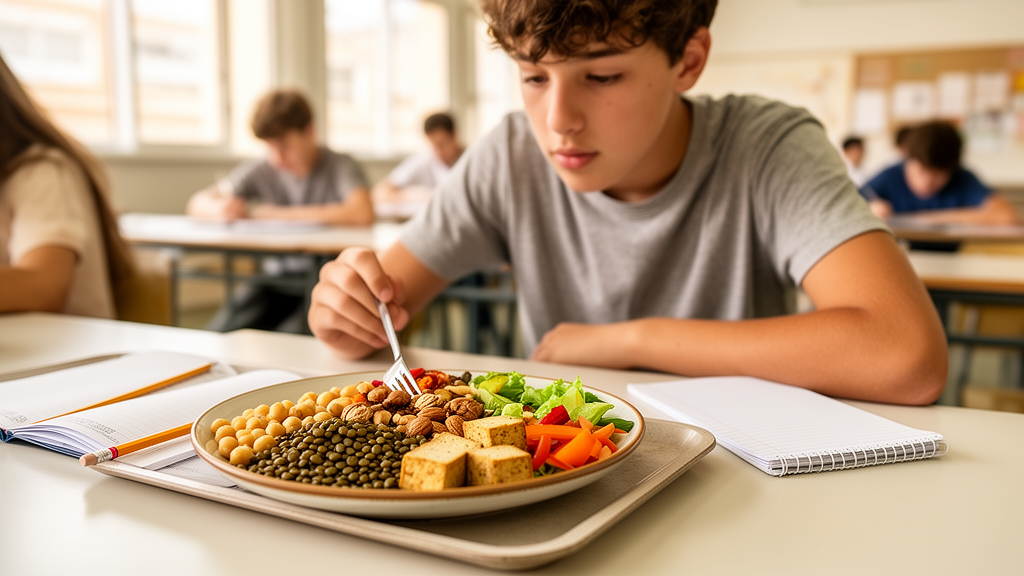
Replacing even a small share of the protein in an adolescent's diet with plant-based sources was consistently associated with better school results, according to a secondary analysis of data from the Eating Healthy and Daily Life Activities (EHDLA) study published in Pediatric Research. The analysis included 769 Spanish adolescents aged 12 to 17, of whom 55.5 percent were girls, and found that substituting animal-based protein with plant-based protein was linked to higher scores on a grade point average as well as on specific subjects including language, mathematics, and foreign language. All reported associations reached the study's statistical threshold, with p values below 0.001.

The researchers used an isocaloric substitution framework, a statistical approach that models what happens when one dietary component replaces another while total energy intake is held constant. In this study, dietary intake was assessed with a 45-item food-frequency questionnaire, and the substitution models were estimated using robust linear regression. The models adjusted for relevant sociodemographic, lifestyle, and anthropometric factors, meaning the analysis attempted to account for differences in family circumstances, health behaviors, and body size that could independently relate to school performance.

The size of the modeled effect was framed in terms of dietary share: replacing 5 percent of total energy intake from animal-based protein with plant-based protein was associated with a higher grade point average and with higher subject-specific scores. When the authors examined which animal protein sources drove the pattern, the associations were primarily attributable to replacing protein from red and processed meat, and from certain fish, with plant-based sources. In other words, the observed signal was not simply that any animal food displaced by plants corresponded to better grades; the specific origin of the displaced animal protein mattered, with dietary patterns carrying a higher contribution of red and processed meat protein relative to plant protein being associated with less favorable academic outcomes.

The study's authors describe this as the first investigation to apply an isocaloric substitution approach to the question of protein source and academic performance in adolescents. Protein source has previously been linked in the literature to cognitive outcomes, but the researchers note that evidence on the association between isocaloric substitution of protein sources and academic performance in adolescents specifically has been limited, which they cite as the rationale for the analysis. They conclude that the findings highlight the potential importance of protein source within dietary patterns related to educational outcomes.

Several constraints on interpretation deserve emphasis. The analysis identifies associations, not causal effects, so it cannot establish that changing protein sources would improve grades, only that the substitution was associated with academic performance in this population. The authors also note that the underlying datasets, being sensitive in nature, are not publicly available but can be requested from the corresponding author on reasonable request.

The findings come from a single Spanish cohort, and the evidence remains at the level of observed association.

Subject of Research: Association between isocaloric substitution of animal-based protein with plant-based protein and academic performance in Spanish adolescents

Article Title: Isocaloric substitution of animal-based protein with plant-based protein and academic performance in Spanish adolescents: The EHDLA study

Article References: López-Gil, J. F., Cristi-Montero, C., Muñoz-Pardeza, J., Miño, C., Quiroz-Cárdenas, F., Yáñez-Sepúlveda, R., Quiroz-Cárdenas, D., Ridgell, L., Yon, D. K., & López-Moreno, M. (2026). Isocaloric substitution of animal-based protein with plant-based protein and academic performance in Spanish adolescents: The EHDLA study. Pediatric Research. https://doi.org/10.1038/s41390-026-05552-w

Image Credits: AI Generated

DOI: 10.1038/s41390-026-05552-w

Keywords: adolescent nutrition, plant-based protein, animal protein, academic performance, isocaloric substitution, EHDLA study, dietary patterns, red and processed meat, grade point average, Pediatric Research, Spain, Isocaloric

Cite Scienmag News

Daisy Hatcher. (October 24, 2026). Swapping Animal Protein for Plant Protein Tied to Better Grades in Spanish Teens. Scienmag. https://scienmag.com/swapping-animal-protein-for-plant-protein-tied-to-better-grades-in-spanish-teens/


Daisy Hatcher. "Swapping Animal Protein for Plant Protein Tied to Better Grades in Spanish Teens." Scienmag, 24 October 2026, https://scienmag.com/swapping-animal-protein-for-plant-protein-tied-to-better-grades-in-spanish-teens/. Accessed 24 October 2026.

Daisy Hatcher. "Swapping Animal Protein for Plant Protein Tied to Better Grades in Spanish Teens." Scienmag. October 24, 2026. https://scienmag.com/swapping-animal-protein-for-plant-protein-tied-to-better-grades-in-spanish-teens/

Tags: academic performanceadolescent nutritionadolescent nutrition and academic performanceanimal proteinanimal protein replacementdietary patternsdietary protein sources and cognitive outcomeseffects of diet on language and math scoresEHDLA studyfood-frequency questionnaire dietary assessmentgrade point averageimpact of plant protein on teens’ academic achievementIsocaloricisocaloric dietary substitutionisocaloric substitutionpediatric researchplant vs. animal protein health and educational benefitsplant-based diets and school gradesplant-based proteinred and processed meatrobust linear regression in nutrition researchsociodemographic factors influencing student performanceSpain
Share26Tweet16
Previous Post

Bamboo extract lowers stress genes in diabetic rats, docking study finds

Next Post

Ionis Pharmaceuticals Tops Science Survey of Best Biotech and Pharma Employers

Related Posts

Four Nuclear Medicine Societies Issue New Guideline for Lung Ventilation–Perfusion Scintigraphy
Technology and Engineering

Four Nuclear Medicine Societies Issue New Guideline for Lung Ventilation–Perfusion Scintigraphy

October 24, 2026
Maximum Entropy Method Outpaces Classical Raking in High-Dimensional Synthetic Population Generation
Science News

Maximum Entropy Method Outpaces Classical Raking in High-Dimensional Synthetic Population Generation

October 24, 2026
Research report: The evolutionary accessibility of cultural fitness landscapes
Biology

Research report: The evolutionary accessibility of cultural fitness landscapes

October 24, 2026
Residual-state accounting targets leftover inspection opportunity in UAV route planning
Technology and Engineering

Residual-state accounting targets leftover inspection opportunity in UAV route planning

October 24, 2026
Hybrid Deep Learning Model Boosts Prediction of Slope Stability Safety Factor
Technology and Engineering

Hybrid Deep Learning Model Boosts Prediction of Slope Stability Safety Factor

October 24, 2026
New AI Method OSCAR Reveals Hidden Brain Network Reorganization in Tasks and Psychosis
Technology and Engineering

New AI Method OSCAR Reveals Hidden Brain Network Reorganization in Tasks and Psychosis

October 24, 2026
Next Post
Ionis Pharmaceuticals Tops Science Survey of Best Biotech and Pharma Employers

Ionis Pharmaceuticals Tops Science Survey of Best Biotech and Pharma Employers

  • Mothers who receive childcare support from maternal grandparents show more optimized

    Mothers who receive childcare support from maternal grandparents show more parental warmth, finds NTU Singapore study

    27656 shares
    Share 11059 Tweet 6912
  • University of Seville Breaks 120-Year-Old Mystery, Revises a Key Einstein Concept

    1061 shares
    Share 424 Tweet 265
  • Bee body mass, pathogens and local climate influence heat tolerance

    682 shares
    Share 273 Tweet 171
  • Researchers record first-ever images and data of a shark experiencing a boat strike

    546 shares
    Share 218 Tweet 137
  • Groundbreaking Clinical Trial Reveals Lubiprostone Enhances Kidney Function

    531 shares
    Share 212 Tweet 133
Science

Embark on a thrilling journey of discovery with Scienmag.com—your ultimate source for cutting-edge breakthroughs. Immerse yourself in a world where curiosity knows no limits and tomorrow’s possibilities become today’s reality!

RECENT NEWS

  • Insilico Medicine executives to appear across five global AI and biopharma summits in one week
  • Ionis Pharmaceuticals Tops Science Survey of Best Biotech and Pharma Employers
  • Swapping Animal Protein for Plant Protein Tied to Better Grades in Spanish Teens
  • Bamboo extract lowers stress genes in diabetic rats, docking study finds

Categories

  • Agriculture
  • Anthropology
  • Archaeology
  • Athmospheric
  • Biology
  • Biotechnology
  • Blog
  • Bussines
  • Cancer
  • Chemistry
  • Climate
  • Earth Science
  • Editorial Policy
  • Marine
  • Mathematics
  • Medicine
  • Pediatry
  • Policy
  • Psychology & Psychiatry
  • Science Education
  • Science News
  • Social Science
  • Space
  • Technology and Engineering

Subscribe to Blog via Email

Enter your email address to subscribe to this blog and receive notifications of new posts by email.

Join 5,152 other subscribers

© 2025 Scienmag - Science Magazine

Welcome Back!

Login to your account below

Forgotten Password?

Retrieve your password

Please enter your username or email address to reset your password.

Log In
No Result
View All Result
  • HOME
  • SCIENCE NEWS
  • CONTACT US

© 2025 Scienmag - Science Magazine

Discover more from Science

Subscribe now to keep reading and get access to the full archive.

Continue reading