


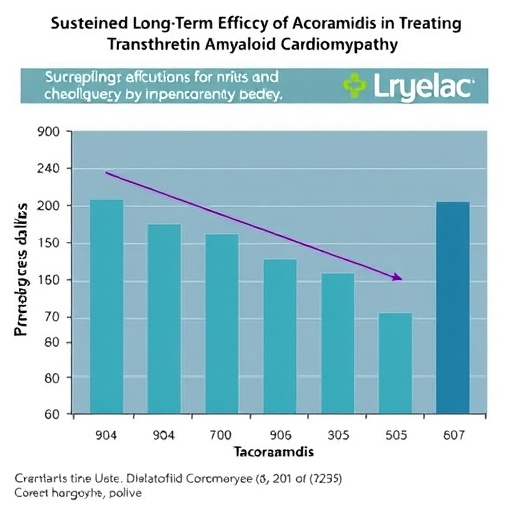
In recent advancements within cardiovascular medicine, a groundbreaking study has emerged from an open-label extension of the ATTRibute-CM randomized clinical trial. This pivotal research highlights the profound impact of early and sustained treatment with acoramidis on patients diagnosed with transthyretin amyloid cardiomyopathy (ATTR-CM). The study provides compelling evidence that continuous administration of acoramidis not only yields incremental reductions in all-cause mortality but also significantly lowers cardiovascular-related mortality and decreases the incidence of first cardiovascular hospitalizations over an extended period of 54 months.
Acoramidis represents a novel therapeutic class targeting the underlying pathophysiology of ATTR-CM, a progressive and often fatal condition characterized by the deposition of misfolded transthyretin amyloid fibrils within cardiac tissue. This amyloid infiltration impairs myocardial structure and function, culminating in restrictive cardiomyopathy and consequent heart failure. By stabilizing the transthyretin tetramer, acoramidis effectively prevents its dissociation into amyloidogenic monomers, thereby halting the cascade of amyloid fibril formation and deposition.
The extension phase of the ATTRibute-CM trial meticulously followed patients under continuous acoramidis intervention to evaluate long-term clinical benefits. The findings robustly support the hypothesis that earlier initiation and unwavering adherence to acoramidis therapy produce enduring clinical advantages, underscoring the drug’s potential in altering the natural history of ATTR-CM. Mortality metrics from this longitudinal study delineate a clear survival advantage, which holds profound implications for clinical practice and patient prognosis.
Clinically, the reduction in cardiovascular hospitalizations documents the effectiveness of sustained amyloid load mitigation in ameliorating the severity and frequency of cardiac events. Such hospitalizations, often precipitated by acute decompensated heart failure or arrhythmias, impose substantial morbidity and healthcare burden. The therapeutic impact of acoramidis may thus translate into improved quality of life and reduced healthcare resource utilization for afflicted individuals.
The study’s design as an open-label extension provides a real-world perspective on the medication’s safety and efficacy profile beyond the confines of placebo-controlled phases. Importantly, no new safety signals were observed over the protracted follow-up period, reinforcing acoramidis’ tolerability and positioning it as a viable long-term treatment modality for ATTR-CM.
At the molecular level, the mechanism of transthyretin stabilization addresses the fundamental biochemical aberration in ATTR-CM. The transthyretin protein, responsible for the transport of thyroxine and retinol-binding protein, is prone to misfolding in its mutant or even wild-type forms, particularly with advancing age. By binding selectively and stabilizing the tetrameric structure of transthyretin, acoramidis averts the pathological amyloidogenesis that underlies the cardiomyopathy.
This research also bolsters the paradigm shift toward early intervention in protein misfolding diseases. Identifying patients at the initial stages of transthyretin amyloid accumulation allows for therapeutic intervention before irreversible myocardial damage and clinical decline occur. As such, the study underscores the critical need for heightened clinical awareness and diagnostic acumen for ATTR-CM.
The outcomes from this extensive follow-up reinforce a growing body of evidence that pharmacological stabilization of transthyretin fibrils alters disease trajectory in a meaningful way. For cardiologists and clinical researchers, the data promulgates a compelling case for integrating acoramidis into therapeutic algorithms targeting amyloid cardiomyopathy.
While the ATTRibute-CM open-label extension provides robust data supporting acoramidis, future research directions converge on further refining patient selection and elucidating long-term outcomes, including comparative effectiveness with other amyloid-targeted therapies. The study also lays the groundwork for evaluating combination strategies aiming to synergize transthyretin stabilization with amyloid clearance.
Moreover, this emergent data signals optimism for patients grappling with a historically devastating cardiomyopathy with limited treatment options. The prospect of a disease-modifying therapy such as acoramidis extends a new horizon, offering hope for prolonged survival and improved cardiac function.
At the upcoming American College of Cardiology 75th Annual Scientific Session & Expo, this study’s presentation will underscore its significance within the cardiology community. The dissemination of these findings is poised to influence clinical guidelines and foster advancements in amyloid cardiomyopathy management.
In conclusion, the open-label extension of the ATTRibute-CM trial delineates a compelling narrative for early, continuous, and long-term acoramidis therapy in transthyretin amyloid cardiomyopathy. By demonstrably reducing mortality rates and cardiovascular events over a multi-year horizon, acoramidis establishes itself as a cornerstone in the evolving therapeutic landscape for ATTR-CM. This study catalyzes a transformative approach toward a previously intractable disease, signaling a new era of hope and enhanced patient outcomes.
Cite Scienmag News
Reid Dalton. (March 30, 2026). Sustained Long-Term Efficacy of Acoramidis in Treating Transthyretin Amyloid Cardiomyopathy. Scienmag. https://scienmag.com/sustained-long-term-efficacy-of-acoramidis-in-treating-transthyretin-amyloid-cardiomyopathy/
Reid Dalton. "Sustained Long-Term Efficacy of Acoramidis in Treating Transthyretin Amyloid Cardiomyopathy." Scienmag, 30 March 2026, https://scienmag.com/sustained-long-term-efficacy-of-acoramidis-in-treating-transthyretin-amyloid-cardiomyopathy/. Accessed 4 September 2026.
Reid Dalton. "Sustained Long-Term Efficacy of Acoramidis in Treating Transthyretin Amyloid Cardiomyopathy." Scienmag. March 30, 2026. https://scienmag.com/sustained-long-term-efficacy-of-acoramidis-in-treating-transthyretin-amyloid-cardiomyopathy/


