


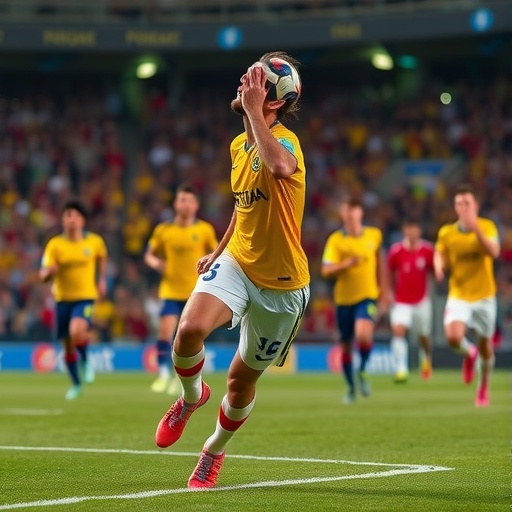
In an unprecedented exploration of the physiological reactions of football fans around the globe, researchers at Bielefeld University have launched a pioneering study poised to unravel how match events during the 2026 FIFA World Cup influence the bodily functions of supporters. This innovative venture emerges from a successful foundation laid by their 2025 study during the DFB Cup final, marking a significant advancement in sports science and data analytics. By leveraging ubiquitous wearable technology, specifically Garmin smartwatches, this research seeks to quantify stress, heart rate variability, movement, and sleep patterns in real time, capturing the intimate, often subconscious responses of fans as they experience the highs and lows of the beautiful game.
This ambitious project is situated at the intersection of sports psychology, data science, and physiology, tapping into the uninterrupted, continuous data streams that modern wearable devices provide. Unlike conventional laboratory-based stress testing, which is constrained by artificial and controlled settings, this study offers a window into real-world emotional and biological reactions. The ability to monitor fans in their natural environments — whether at home, in public viewing spaces, or inside stadiums — adds an invaluable layer of ecological validity to the data gathered. It enables researchers to investigate not only how the body reacts to specific in-game events like goals, fouls, or penalties but also how cultural and national identity might modulate these physiological responses.
Integral to this study’s methodology is the strategic recruitment of participants who own Garmin smartwatches. The devices’ industry-leading battery life and advanced biosensors make them ideal for extended monitoring, capturing a spectrum of vital metrics including heart rate, stress indices derived from heart rate variability, physical activity levels, and sleep quality. Participants voluntarily register via an online portal, providing demographic details such as nationality, country of residence, gender, and subjective measures of fan identity intensity. This personalized approach allows the research team to tailor the study cohort dynamically and ensures that data collection is robust enough to detect nuanced differences across diverse fan populations supporting various national teams.
The World Cup’s unprecedented global stage offers a unique experimental environment for this investigation. By synchronizing physiological data collection with real-time match events, the researchers can dissect the temporal dynamics of emotional arousal linked to moments of triumph or despair. For instance, preliminary data from the prior DFB Cup final study revealed that supporters attending the stadium exhibited markedly elevated heart rates—sometimes climbing 36 percent higher following goals—compared to their television-watching counterparts, whose average heart rates remained significantly lower. This spatial context-dependent physiological divergence underscores how the immediacy and communal nature of live spectatorship amplify emotional and somatic experiences.
Moreover, early stress markers detected hours before match kick-off hint at the anticipatory physiological states that precede emotionally charged events. Such pre-game arousal might reflect psychological processes including excitement, anxiety, or social bonding, themes that this study seeks to elucidate further. Beyond acute responses, the project also investigates recovery patterns post-match by analyzing sleep quality and post-event heart rate variability, shedding light on how successes or defeats manifest in fans’ overall well-being.
Data integrity and participant privacy are paramount considerations driving the study design. Through a data-protection-compliant interface, researchers access anonymized biosensor data, ensuring that personal identifying information remains confidential. Once participants opt in and establish connectivity with their Garmin accounts, data flows seamlessly and continuously into the study database, minimizing participant burden while maximizing data fidelity. This automated data acquisition paradigm exemplifies how contemporary wearable technology can transform social and behavioral research, enabling large-scale, global scientific inquiries that were previously impractical.
The multidisciplinary research team includes experts in data science, psychology, sports science, and statistics, facilitating comprehensive analyses of complex physiological datasets. Their collaborative approach integrates cutting-edge statistical modeling techniques to parse out how variables such as nationality, mode of match consumption (in-stadium, television, public viewing), and supporter intensity modulate physiological responses. The findings promise insights not only pertinent to sports psychology but also valuable for developing personalized wellness applications, stress management strategies, and fostering social cohesion through sports.
Importantly, Bielefeld’s Wissenswerkstadt (Knowledge Hub) supports this endeavor by bridging academic research with community engagement. Their role underscores the significance of leveraging everyday technology—smartwatches worn routinely by millions worldwide—to gather scientific data effortlessly and ethically. This partnership showcases an innovative blueprint for citizen science, where ordinary individuals contribute meaningfully to advancing human understanding from the comfort of their everyday environments.
This ongoing study builds on the legacy of previous sport-related biometric research while breaking new ground by encompassing a multinational, multi-cultural fanbase during one of the most-watched sporting spectacles globally. Initial results from the 2025 DFB Cup final study, soon to be published in a prestigious scientific journal, already confirm the validity of this approach. Fans’ real-time physiological reactions to match dynamics are quantifiable and significant, revealing the profound bio-psycho-social influences sports events exert on individuals.
For football enthusiasts eager to participate, the research team invites prospective subjects to register online. Eligibility is currently limited to Garmin smartwatch users who are supporters of various national teams competing in the 2026 World Cup. After reaching sufficient enrollment numbers for a given team, selected individuals receive comprehensive instructions to synchronize their smartwatches with the study platform, with data collection commencing before and extending beyond World Cup fixtures. In addition, the team collects behavioral data on match consumption habits through voluntary surveys administered during the tournament.
Professor Dr. Christiane Fuchs, a co-leader of the project, highlights the scientific significance of this real-world approach: “Our design reveals the intricate connections between collective emotions, a sense of sporting identity, and physiological responses. These interactions are often elusive in traditional lab settings, but by capturing everyday contexts, we achieve a much deeper understanding.” Her remarks emphasize the shift in behavioral science methodologies enabled by wearable electronics and the potential to revolutionize how we comprehend human emotionality in large populations.
Complementing Fuchs’ insights, Professor Dr. Christian Deutscher underscores the comparative dimension of nationality within the research: “It is captivating to explore whether fans from different countries exhibit distinct physiological intensities to identical match events. The global scale of the World Cup presents a rare harmonized emotional stimulus, providing an ideal platform for this comparative investigation.” Such findings may illuminate cultural or psychological factors driving divergent emotional engagement, with implications extending beyond sports to international social psychology and cross-cultural studies.
As football fever grips millions worldwide ahead of the 2026 FIFA World Cup, this multifaceted research effort channels that passion into groundbreaking scientific inquiry. By turning smartwatches into portals for collecting rich biometric and behavioral data, the study positions itself at the forefront of sport-related health science, data-driven fan engagement, and real-world psychophysiology. The anticipated outcomes promise to deepen our understanding of how shared cultural moments ripple through human bodies and collective identities, highlighting the profound interplay between sport, technology, and science.
News Publication Date: Not provided in the original content.
Web References: https://uni-bi.de/worldcupfever
References: Findings from the 2025 DFB Cup final study published in Scientific Reports by Springer Nature (specific article title and link not provided).
Cite Scienmag News
Reid Dalton. (May 28, 2026). Research Explores the Science Behind World Cup Football Fever 2026. Scienmag. https://scienmag.com/research-explores-the-science-behind-world-cup-football-fever-2026/
Reid Dalton. "Research Explores the Science Behind World Cup Football Fever 2026." Scienmag, 28 May 2026, https://scienmag.com/research-explores-the-science-behind-world-cup-football-fever-2026/. Accessed 4 September 2026.
Reid Dalton. "Research Explores the Science Behind World Cup Football Fever 2026." Scienmag. May 28, 2026. https://scienmag.com/research-explores-the-science-behind-world-cup-football-fever-2026/


