


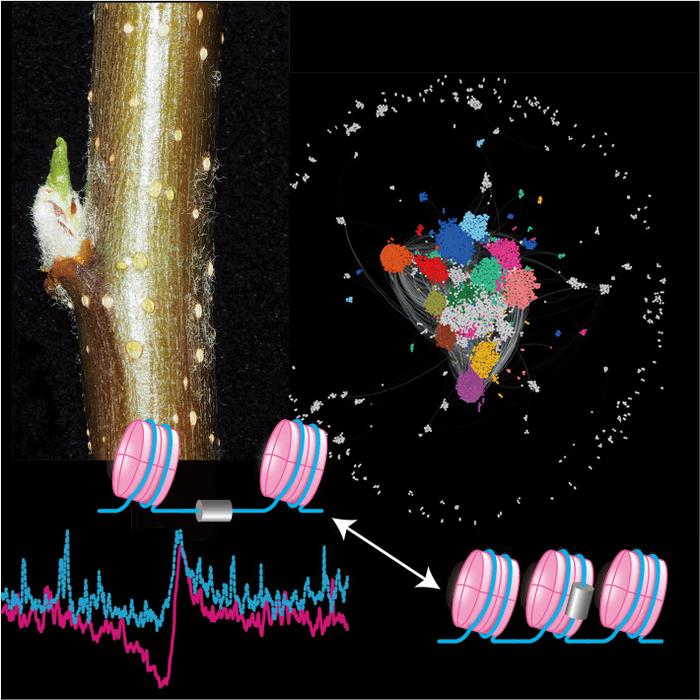
Evolution has enabled plants to survive under adverse conditions. The winter bud of a plant is a crucial structure that establishes adaptability. Depending on environmental and intrinsic conditions, buds can transition between growth and dormancy. The three dormancy phases are determined by signals triggering each phase: ecodormancy, influenced by environmental factors; paradormancy, promoted by other plant organs; and endodormancy, maintained by internal signals within the bud. Paradormant buds enter endodormancy in response to changes in day length and/or low temperature in autumn, while endo-and eco-dormant phases occur in response to chilling temperatures. The transition from para- to endodormancy is a protective phenomenon for the bud. The epigenetic mechanism that triggers endodormancy is under-researched.

Credit: Takanori Saito from Chiba University
Evolution has enabled plants to survive under adverse conditions. The winter bud of a plant is a crucial structure that establishes adaptability. Depending on environmental and intrinsic conditions, buds can transition between growth and dormancy. The three dormancy phases are determined by signals triggering each phase: ecodormancy, influenced by environmental factors; paradormancy, promoted by other plant organs; and endodormancy, maintained by internal signals within the bud. Paradormant buds enter endodormancy in response to changes in day length and/or low temperature in autumn, while endo-and eco-dormant phases occur in response to chilling temperatures. The transition from para- to endodormancy is a protective phenomenon for the bud. The epigenetic mechanism that triggers endodormancy is under-researched.
In this new study published in Tree Physiology on June 21, 2024, Assistant Professor Takanori Saito and his colleagues explore the epigenetic modifications in chromatin structures and transcriptional changes that enable temperature recognition in ‘Fuji’ apple axillary buds. The results were further interpreted by deep-learning artificial intelligence (AI) models and statistical analysis. This research was co-authored by Dr. Shanshan Wang, Dr. Katsuya Ohkawa, Dr. Hitoshi Ohara, and Dr. Satoru Kondo from the Graduate School of Horticulture at Chiba University.
One of the objectives of this study was to understand differently expressed genes (DEGs) in the transition phase from para- to endodormancy. Genes related to the cellular response to hypoxia, the defense response to abscisic acid (ABA), and circadian rhythm were activated at the initial stage of bud dormancy. Further, the authors revealed that nucleosome depletion was not correlated with the transcriptional pattern. “In contrast, among the DEGs, although a nucleosome position shift in the putative promoters was observed, a difference in nucleosome occupancy between the upregulated and downregulated genes in most gene bodies was not observed during the axillary bud dormancy phase transition,” explains Dr. Saito.
Cis-regulatory elements (CREs) are short DNA sequences that influence gene expression. The authors further examined the relationship between transcriptional changes and CREs using a deep-learning AI model. Elaborating on these results, Dr. Saito says, “CREs related to the cell cycle, circadian rhythm, and the TATA box were found. In particular, the importance of the circadian rhythm for downregulated genes was also concomitant with the transcriptional changes.” The data further revealed that COL9 signal were possibly involved in altering CO levels to trigger bud dormancy.
While most AI-based epigenetic studies use large datasets, their model uses a small dataset. Despite this, Bayesian statistical analysis linked epigenetic changes to gene transcription involved in winter bud regulation. The AI approach from this study can enhance epigenetic analysis, particularly for non-model plants with less developed genome databases.
Dr. Saito highlighted, “The collective results of our study using DL showed that the cold-driven circadian rhythm-based machinery in axillary bud dormancy induction is tuned by single-nucleosome oscillations.”
Going ahead, these findings can enable the development of more efficient strategies to maintain a sustainable production of crops, plants, and trees to counter the effects of global warming.
About Assistant Professor Takanori Saito
Dr. Saito is an Assistant Professor at the Faculty of Horticulture at Chiba University. In 2007, he completed his PhD at University of Tsukuba, wherein his thesis was focused on Molecular Mechanism for Endodormancy Phase Transition in Japanese pear. He has authored close to 50 publications. His research focuses on epigenetic mechanisms behind bud dormancy. His research work highlights that dormancy is a protective phenomenon that allows plants and trees to survive the low temperatures in winter by ceasing their growth. Dr. Saito is also the Associate Editor of Scientia Horticulturae since 2022.
Journal
Tree Physiology
Method of Research
Experimental study
Subject of Research
Cells
Article Title
Deep learning with a small dataset predicts chromatin remodelling contribution to winter dormancy of apple axillary buds
Article Publication Date
21-Jun-2024
COI Statement
The authors declare no conflicts of interest
Cite Scienmag News
Drew Townsend. (August 21, 2024). Survival tactics: AI-driven insights into chromatin changes for winter dormancy in axillary buds. Scienmag. https://scienmag.com/survival-tactics-ai-driven-insights-into-chromatin-changes-for-winter-dormancy-in-axillary-buds/
Drew Townsend. "Survival tactics: AI-driven insights into chromatin changes for winter dormancy in axillary buds." Scienmag, 21 August 2024, https://scienmag.com/survival-tactics-ai-driven-insights-into-chromatin-changes-for-winter-dormancy-in-axillary-buds/. Accessed 4 September 2026.
Drew Townsend. "Survival tactics: AI-driven insights into chromatin changes for winter dormancy in axillary buds." Scienmag. August 21, 2024. https://scienmag.com/survival-tactics-ai-driven-insights-into-chromatin-changes-for-winter-dormancy-in-axillary-buds/

